


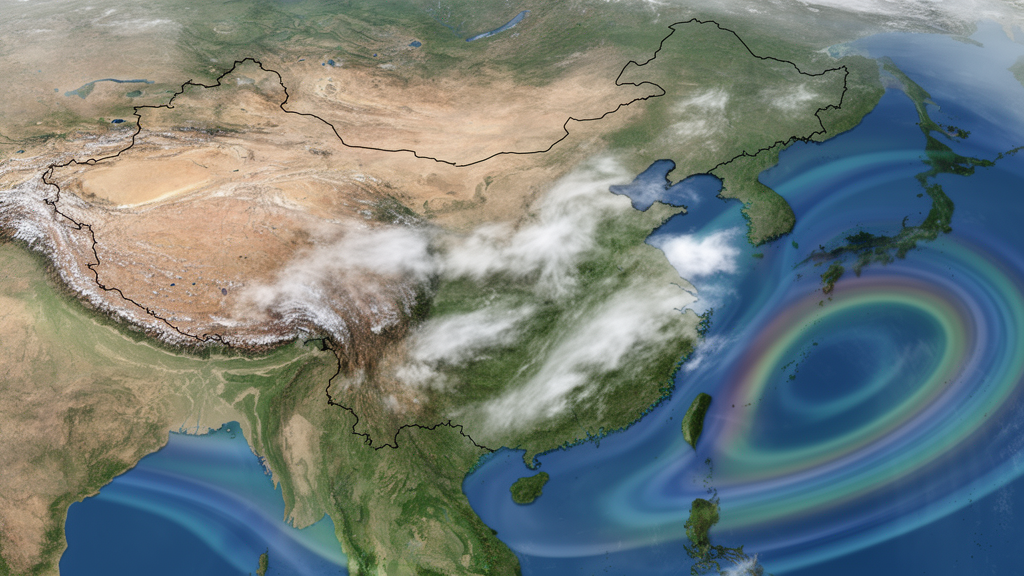
China’s combined warm and wet conditions have shifted repeatedly rather than following a steady long-term trajectory, according to an observational and reanalysis-based study covering 1960–2022. The researchers found that these interdecadal changes were strongly associated with the Pacific Decadal Oscillation, or PDO, through linked changes in atmospheric circulation, moisture transport and precipitation. The association was not uniform across the country: positive PDO phases tended to accompany enhanced warm-wet conditions in Northeast China, northern Xinjiang and southeastern coastal areas, while weakening them over North China and the Tibetan Plateau. Negative phases largely reversed this regional pattern.
The study used a Warm-Wet Index, or WWI, designed to represent the combined influence of temperature, precipitation and surface energy exchanges rather than examining heat or rainfall in isolation. The index incorporates annual precipitation, near-surface air temperature, sensible heat flux and latent heat flux through a moisture-and-energy balance based on the Budyko framework. Because most of China receives the majority of its annual precipitation in summer, the investigators consistently applied the summer-dominant formulation. A higher WWI indicates a climate state in which a greater share of available turbulent surface energy supports evaporation, which the authors associate with relatively warmer and wetter conditions. This approach captures the fact that precipitation, evaporation and surface heating interact differently across China’s humid southeast, arid northwest and high-elevation Tibetan Plateau.
ERA5 reanalysis supplied the principal meteorological fields at their native resolution, including 2-m air temperature, precipitation, wind speed, vertical velocity, specific humidity, sea-surface temperature, and sensible and latent heat fluxes. The authors also used the gridded CN05.1 observational dataset, constructed from records at 2,416 meteorological stations, to evaluate ERA5 precipitation over China, especially in areas with complex terrain and pronounced spatial heterogeneity. The PDO index came from the National Center for Atmospheric Research. This combination of records and reanalysis allowed the authors to examine both the surface hydroclimatic signal and the large-scale ocean and atmospheric patterns associated with it, although the study was observational in design and did not establish the PDO as the sole cause of China’s warm-wet variability.
The background climate over the 63-year period showed substantial warming and uneven precipitation change. China’s national mean temperature rose at approximately 0.30 °C per decade, with trends locally exceeding 0.4–0.5 °C per decade over the Tibetan Plateau. Annual precipitation increased by 2.64 mm per decade nationally, but the spatial pattern differed markedly: northwestern China experienced a robust increase, whereas North China retained a drying tendency. The authors also identified changes in surface energy partitioning, including stronger upward sensible heat transfer in northern China and enhanced upward latent heat flux in association with greater evaporative transfer of energy from the land surface to the atmosphere.
The resulting WWI displayed a northwest-to-southeast gradient, with relatively low values in the arid interior and higher values in the humid southeast. A local maximum appeared over the Tianshan Mountains in northern Xinjiang, where orographic uplift promotes moisture convergence and precipitation despite the surrounding aridity. Temporal variation was more complex than a single warming-and-wetting trend: the national index declined during much of the 1960s and 1970s, recovered in the early 1980s, remained relatively high through much of the 1981–2000 period, and then fluctuated after 2000 with a gradual rebound. Its linear trend was weak, at about −0.01 per decade, whereas its interdecadal component changed on approximate 15–25-year timescales. Empirical orthogonal function analysis separated two leading spatial modes, explaining 20.2% and 13.8% of the total variance and revealing contrasting large-scale patterns in China’s warm-wet conditions.
To isolate the slow-changing component, the authors applied Ensemble Empirical Mode Decomposition to the national WWI and PDO series, then combined the third and fourth intrinsic mode functions as their interdecadal signal. The resulting national WWI and PDO series had a correlation of 0.58. That coefficient indicates a moderately strong association, but its conventional statistical significance did not persist after the effective degrees of freedom were reduced to account for the strong temporal autocorrelation of the low-frequency series. The limited effective sample size therefore requires caution. Regional spatial analyses, which also accounted for effective degrees of freedom, nevertheless identified statistically significant PDO–WWI relationships in several areas. Major PDO phase transitions in the mid-1970s also slightly preceded corresponding changes in the WWI, a timing pattern consistent with the ocean acting as a background modulator rather than merely coinciding with short-term atmospheric fluctuations.
Singular value decomposition provided an ocean–land diagnostic by identifying coupled patterns that maximize the squared covariance between North Pacific sea-surface temperature anomalies and China’s WWI. The leading coupled mode accounted for 58% of the total squared covariance. Its sea-surface temperature pattern resembled the positive PDO “horseshoe,” with negative anomalies across the central and western North Pacific and positive anomalies along the basin’s eastern boundary and near western North America. The associated Chinese pattern formed a meridional tripole: enhanced warm-wet conditions in Northeast China, northern Xinjiang and southeastern coastal regions, and reduced conditions across North China and the Tibetan Plateau. Coherent changes in the paired time coefficients, together with agreement between the coupled mode, the leading empirical orthogonal function modes and the EEMD results, support a physically consistent association between PDO-related ocean variability and China’s warm-wet conditions.
Composite analyses showed that precipitation was the main pathway connecting PDO phase changes to the integrated index. During positive PDO phases, detrended precipitation generally increased over central-eastern and southeastern China, extending northward toward Northeast China, while declining over North China and the Tibetan Plateau. Negative PDO phases produced a broadly reversed pattern, with precipitation deficits across southeastern China, Xinjiang and Northeast China. Multiple linear regression supported this interpretation: precipitation contributed more than 0.6–0.8 to WWI variation across much of eastern, central and southern China and large parts of the Northeast, whereas temperature and the two surface heat-flux terms had smaller, more geographically confined contributions. The authors described precipitation as the dominant statistical control, not a complete explanation for every regional signal.
The circulation diagnostics supplied the dynamic mechanism. Positive PDO phases were associated with sea-surface temperature anomalies in the tropical central-eastern Pacific and Indian Ocean that favored an East Asia–Pacific-type teleconnection response. A pronounced cyclonic circulation developed over much of China, with an anomalous wave train extending from the Philippine Sea toward the Sea of Japan. Enhanced upward motion and moisture convergence appeared over southeastern China, Northeast China and northern Xinjiang, supporting increased rainfall and higher WWI, while subsidence over North China suppressed precipitation. The westerly jet shifted southward, a configuration favorable for more rainfall in southern China, and the Pacific–North American teleconnection was also strengthened. During negative PDO phases, the pressure and circulation anomalies generally reversed, with anticyclonic flow and widespread subsidence replacing ascent over the same regions. These findings describe a consistent ocean–atmosphere–land pathway, but they do not prove that the PDO alone drives the observed changes; the Atlantic Multidecadal Oscillation, internal atmospheric variability and other factors may also contribute. The authors also identify separation of externally forced trends from internal decadal variability, seasonal mechanisms and future climate-model projections as unresolved questions.
Subject of Research: Interdecadal variability of China’s integrated warm-wet conditions and its association with the Pacific Decadal Oscillation
Article Title: Decadal variability of the integrated warm-wet conditions over China and its modulation by the pacific decadal oscillation
Article References: Yang, X., Ji, F., Zhang, S., Chang, J., Hu, S., Luo, M., Chen, Y., & Guan, X. (2026). Decadal variability of the integrated warm-wet conditions over China and its modulation by the pacific decadal oscillation. Frontiers in Environmental Science, 14, 1992362. https://doi.org/10.3389/fenvs.2026.1992362
Image Credits: AI Generated
DOI: 10.3389/fenvs.2026.1992362
Keywords: China, Pacific Decadal Oscillation, warm-wet index, interdecadal variability, precipitation, atmospheric circulation, ERA5 reanalysis, moisture transport, climate teleconnections, regional climate, Decadal, variability
Cite Scienmag News
Violet Maxwell. (October 21, 2026). China’s Decadal Warm-Wet Variability and Pacific Oscillation Modulation. Scienmag. https://scienmag.com/chinas-decadal-warm-wet-variability-and-pacific-oscillation-modulation/
Violet Maxwell. "China’s Decadal Warm-Wet Variability and Pacific Oscillation Modulation." Scienmag, 21 October 2026, https://scienmag.com/chinas-decadal-warm-wet-variability-and-pacific-oscillation-modulation/. Accessed 21 October 2026.
Violet Maxwell. "China’s Decadal Warm-Wet Variability and Pacific Oscillation Modulation." Scienmag. October 21, 2026. https://scienmag.com/chinas-decadal-warm-wet-variability-and-pacific-oscillation-modulation/


