


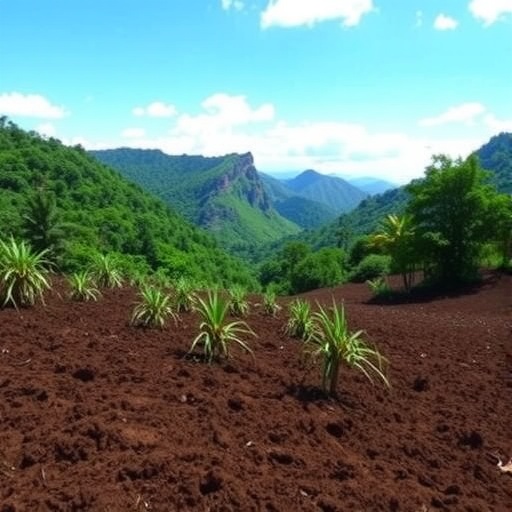
Brazil’s vast native biomes have long been recognized as critical reservoirs of biodiversity and essential components of the global carbon cycle. However, the conversion of these native ecosystems into agricultural landscapes has come at a substantial environmental cost. A recently published study in Nature Communications reveals that this land-use change has caused a staggering loss of approximately 1.4 billion tons of soil carbon, an amount that equates to the emission of 5.2 billion tons of carbon dioxide equivalent (CO₂e). This finding underscores the significant contribution of soil carbon depletion to Brazil’s and, by extension, the world’s greenhouse gas emissions.
The research was conducted by a multi-institutional team from Brazil’s leading agricultural and environmental sciences entities, including the Luiz de Queiroz School of Agriculture at the University of São Paulo (ESALQ-USP), the State University of Ponta Grossa (UEPG), and Embrapa Agricultura Digital, part of the Brazilian Agricultural Research Corporation (EMBRAPA). This collaboration was a central part of the Center for Carbon Research in Tropical Agriculture (CCARBON) initiative, a FAPESP Research, Innovation, and Dissemination Center (RIDC) coordinated by Professor Carlos Eduardo Pellegrino Cerri.
Through the meticulous compilation and analysis of Brazil’s most comprehensive soil carbon database—comprising 4,290 data records from 372 scientific studies conducted over thirty years—the researchers were able to quantify the carbon debt resulting from converting natural habitat into agriculture. They examined soil carbon at multiple depths (ranging from 0 to 100 centimeters), across all major Brazilian biomes, including the Amazon, Atlantic Forest, Cerrado, Caatinga, Pantanal, and others.
One of the study’s most encouraging conclusions is the potential for substantial carbon “recapitalization” or recarbonization. Researchers estimate that restoring soil carbon levels on about one-third of Brazil’s agricultural land could offset the country’s greenhouse gas emissions to meet its Nationally Determined Contribution (NDC) under the Paris Agreement. Brazil aims to reduce emissions by 59 to 67 percent relative to 2005 levels by 2035, and soil carbon recovery is seen as a major lever in this effort.
Achieving this recarbonization would require the adoption of sustainable agricultural practices, including crop rotation, no-till farming, and integrated systems such as Integrated Crop-Livestock-Forest (ICLF). These methods not only rebuild soil organic matter but also improve soil structure and fertility, boosting productivity while reducing emissions. Additionally, rehabilitating the 20 million hectares of degraded pastures in the Atlantic Forest biome presents a vital opportunity to sequester carbon and revive ecosystem services.
Significantly, the research delineates the soil carbon stocks and losses specific to each of Brazil’s distinct biomes. The Atlantic Forest emerged as the biome with the highest natural soil carbon accumulation, roughly 86% more than the semi-arid Caatinga and 36% more than the savannah-like Cerrado in the upper 10 centimeters of soil. Even under agriculture, its carbon stocks exceeded those in the Pantanal and Caatinga by large margins, indicating both its ecological richness and its potential role in carbon mitigation strategies.
The conversion of native ecosystems to monoculture agriculture led to marked declines in soil carbon. In the Atlantic Forest, the researchers observed a 33% loss in soil carbon following such land-use change, while in the Cerrado, the reduction was just under 16%. However, this degradation is not irreversible. Transitioning from monoculture to integrated systems—such as crop-livestock or crop-livestock-forest systems—in the Cerrado was predicted to regenerate soil carbon by approximately 15%, highlighting a feasible restoration pathway.
In the Amazon biome, on the other hand, the potential for carbon increase through sustainable shifts in agricultural practices is notable but differs. Transitioning from monoculture farming to diversified crop rotation or mixed cropping systems could boost soil carbon stocks by an estimated 14.1%, reflecting the sensitivity and opportunity for optimized land management in this globally critical region.
The methodology underpinning the study involved quantifying soil carbon sequestration and emission using CO₂ equivalent metrics, which facilitate comparability across disparate greenhouse gases. The conversion factor of roughly 3.66 was applied to reflect the molecular weight differences between carbon and CO₂, crucial for translating soil carbon losses into standardized emission data that can be integrated into national inventories and global carbon budgets.
Importantly, the study provides a data-driven foundation to support policy development and private sector engagement, particularly concerning sustainable farming initiatives and the burgeoning carbon credit market in Brazil. By establishing robust estimates of soil carbon stocks, losses, and re-sequestration potentials in diverse biomes, the research offers a clear guide for environmentally sound agricultural policies that could simultaneously enhance food security and climate resilience.
This massive undertaking also sets the stage for more refined carbon monitoring efforts. In December 2025, a consortium including Shell, Petrobras, and CCARBON launched Carbon Countdown, the most extensive carbon stock database project in Brazil. Employing standardized sampling and analytical protocols nationwide, Carbon Countdown aspires to validate and improve upon the findings reported by this landmark study.
The broader implications are profound: Brazil’s soil carbon management could become a model for tropical countries with large agricultural sectors. Techniques such as no-till farming, integrated systems, and pasture restoration not only hold promise for carbon sequestration but can replenish soil health, bolster agricultural productivity, and support biodiversity conservation. As the planet faces escalating climate challenges, the interwoven benefits of restoring soil carbon stocks in tropical agriculture highlight a critical nexus of ecological and socioeconomic sustainability.
The study underscores the urgency of addressing soil carbon deficits, framing soil not just as a medium for plant growth but as a pivotal reservoir in the Earth’s carbon cycle. With practical strategies illuminated and a rich database underpinning understanding, Brazil’s potential to significantly curb emissions via agriculture stewardship shines as a beacon of hope in the global fight against climate change.
News Publication Date: 26-Jan-2026
Web References:
- https://www.fapesp.br/en
- https://www.agencia.fapesp.br/en
- https://doi.org/10.1038/s41467-026-68340-4
References:
- Villela, J. M., Cerri, C. E. P., et al. (2026). Soil carbon debt from land use change in Brazil. Nature Communications. DOI: 10.1038/s41467-026-68340-4
Cite Scienmag News
Alan Morgan. (April 24, 2026). Brazil Loses 1.4 Billion Tons of Soil Carbon Following Conversion of Natural Lands to Agriculture. Scienmag. https://scienmag.com/brazil-loses-1-4-billion-tons-of-soil-carbon-following-conversion-of-natural-lands-to-agriculture/
Alan Morgan. "Brazil Loses 1.4 Billion Tons of Soil Carbon Following Conversion of Natural Lands to Agriculture." Scienmag, 24 April 2026, https://scienmag.com/brazil-loses-1-4-billion-tons-of-soil-carbon-following-conversion-of-natural-lands-to-agriculture/. Accessed 3 September 2026.
Alan Morgan. "Brazil Loses 1.4 Billion Tons of Soil Carbon Following Conversion of Natural Lands to Agriculture." Scienmag. April 24, 2026. https://scienmag.com/brazil-loses-1-4-billion-tons-of-soil-carbon-following-conversion-of-natural-lands-to-agriculture/


