


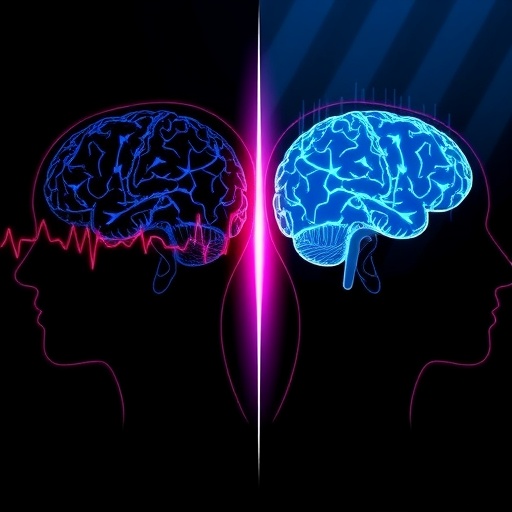
In a groundbreaking study set to redefine the diagnostic landscape in psychiatry, researchers have unveiled compelling neurophysiological differences between unipolar depression and bipolar II disorder during depressive episodes. Published in the prestigious BMC Psychiatry, this retrospective case-control study breaks new ground by harnessing event-related potential (ERP) measurements to distinguish between these often conflated mental health conditions, potentially paving the way for more accurate and objective diagnoses.
The challenge of differentiating bipolar II disorder (BD II) from major depressive disorder (MDD), also known as unipolar depression, is a longstanding hurdle in psychiatric practice. Both disorders present with overlapping depressive symptoms, making clinical diagnosis notoriously difficult and frequently leading to misdiagnoses that can compromise treatment efficacy. Recognizing this critical gap, the research team embarked on a study that leverages sophisticated neurophysiological markers, marking a significant advance beyond conventional symptom-based assessments.
This study enrolled 180 participants divided evenly into three groups—patients diagnosed with unipolar depression during a current major depressive episode, patients with bipolar II disorder also in a depressive phase, and a control group of healthy, age- and sex-matched individuals. This tripartite design ensured a balanced comparison across cohorts, enabling the team to isolate subtle neurophysiological signatures that could serve as distinguishing biomarkers. Psychological assessments included the Generalized Anxiety Disorder Scale (GAD-7), the Patient Health Questionnaire (PHQ-9), and the Hypomania Checklist (HCL-32), collectively providing a comprehensive clinical profile of each subject.
Central to the study was the utilization of event-related potentials, neuroelectric brain responses elicited by specific sensory or cognitive events, which are measured via electroencephalography (EEG). ERPs afford millisecond precision in tracking neuronal processing, allowing researchers to observe the timing and amplitude of brain responses to auditory stimuli. Participants underwent auditory brain stem response (ABR) tests to rule out peripheral hearing impairments, followed by detailed ERP examinations focusing on the P300 paradigm—a well-established cognitive marker linked to attention and stimulus evaluation processes.
The findings were striking. Both unipolar and bipolar II depressed patients exhibited significantly prolonged reaction times compared to healthy controls, indicating a generalized cognitive delay associated with depressive pathology. Moreover, patients in both clinical groups demonstrated increased amplitudes in the P2-N2 complex of their ERP waveforms, suggesting heightened neural responsiveness or altered sensory processing during the depressive state. These shared neurophysiological changes affirm the presence of depression-related brain function disturbances regardless of disorder subtype.
However, it is in the subtle distinctions where this study truly shines. The bipolar II group displayed a notably prolonged S2-P50 latency relative to their unipolar counterparts, highlighting a delay in early sensory processing specific to BD II during depressive episodes. Additionally, the bipolar II patients showed extended N2 latency compared to healthy controls, underscoring a slower neural response associated with cognitive control and conflict monitoring in this population. These temporal disparities in ERP components are critical, as they provide the first objective physiological markers differentiating BD II from unipolar depression during comparable depressive phases.
The S2-P50 component, related to sensory gating mechanisms, plays a key role in filtering out irrelevant stimuli—a process often disrupted in mood disorders. Prolongation in this latency among BD II patients implicates distinct neurobiological dysfunctions, possibly linked to the fluctuating mood states characteristic of bipolar spectrum disorders. These insights could revolutionize our understanding of underlying pathophysiological mechanisms and refine the phenotypic boundaries between these psychiatric illnesses.
Importantly, the study observed no significant demographic differences across the three groups, demonstrating that the observed ERP disparities were unlikely confounded by age, sex, education, marital status, or socioeconomic status. This strengthens the argument for the intrinsic neurophysiological nature of these findings, anchored in disease pathology rather than extraneous variables.
By identifying measurable, distinct brain responses associated with unipolar and bipolar II depressive episodes, the research addresses a pressing clinical need for objective diagnostic tools. Such tools promise to transform psychiatric diagnostics, shifting away from subjective symptom checklists towards biomarker-informed assessments that enhance diagnostic precision and, by extension, treatment personalization.
This work also contributes to the burgeoning field of translational psychiatry, where electrophysiological methods offer non-invasive, replicable measures of brain function. It beckons further exploration into how these ERP markers correlate with clinical outcomes, medication responses, and longitudinal mood state variations. The implications extend beyond diagnosis, potentially informing prognostic models and enabling earlier intervention strategies tailored to neurophysiological profiles.
As bipolar II disorder frequently goes undetected until hypomanic episodes manifest, integrating ERP-based screening in clinical practice could expedite accurate identification during depressive phases. This would have profound clinical implications, reducing misdiagnosis rates, minimizing inappropriate pharmacological treatments, and ultimately improving patient quality of life.
Future research directions may include expanding sample sizes, longitudinal designs to track ERP changes across mood cycles, and cross-validation using multimodal neuroimaging techniques. Additionally, elucidating the molecular and circuit-level underpinnings of these ERP differences could uncover novel targets for therapeutic development, bridging neurophysiology and clinical psychiatry.
In sum, this pioneering study illuminates previously uncharted neurophysiological terrain that differentiates unipolar depression from bipolar II disorder within the depressive symptom spectrum. By showcasing the potential of event-related potentials as diagnostic discriminators, it heralds a new era of precision psychiatry, where brain-based biomarkers become indispensable allies in unraveling the complexities of mood disorders.
Cite Scienmag News
Glenn Wilkins. (October 22, 2025). Brainwave Differences: Unipolar vs Bipolar II. Scienmag. https://scienmag.com/brainwave-differences-unipolar-vs-bipolar-ii/
Glenn Wilkins. "Brainwave Differences: Unipolar vs Bipolar II." Scienmag, 22 October 2025, https://scienmag.com/brainwave-differences-unipolar-vs-bipolar-ii/. Accessed 5 September 2026.
Glenn Wilkins. "Brainwave Differences: Unipolar vs Bipolar II." Scienmag. October 22, 2025. https://scienmag.com/brainwave-differences-unipolar-vs-bipolar-ii/


