


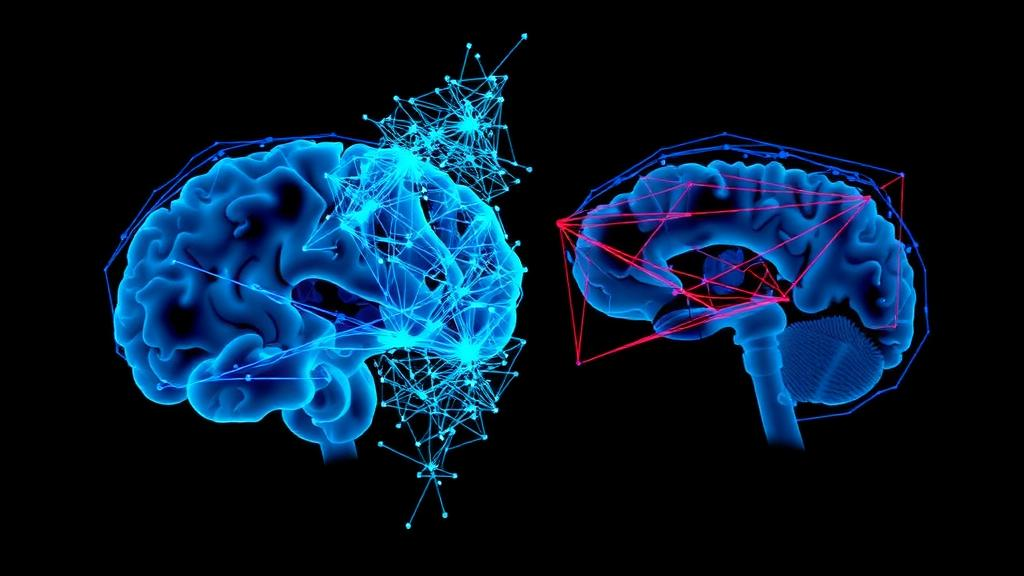
Suicidal ideation is one of the most feared and least predictable features of major depressive disorder. Clinicians have long lacked reliable biological tools to distinguish depressed patients who experience suicidal thoughts from those who do not, relying instead on clinical interviews and self-report, both of which can be incomplete or masked. A new study published in BMC Psychiatry by Hongfang Li, Xinyu Wang and colleagues at Beijing Anding Hospital of Capital Medical University and collaborating institutions now offers a fresh line of evidence that suicidal thinking in recurrent depression is mirrored in measurable changes in how the brain’s large-scale functional networks talk to each other.
The research team compared resting-state functional magnetic resonance imaging data from 94 patients with recurrent major depressive disorder who experienced suicidal ideation, 53 patients with recurrent depression who did not, and 84 healthy controls. Resting-state fMRI, which records spontaneous brain activity while participants simply lie still in the scanner, allows researchers to compute functional connectivity, a statistical measure of how strongly the activity of different brain regions rises and falls together over time. Regions that co-activate are assumed to form functionally coupled networks, and disruptions in this coupling have repeatedly been implicated in psychiatric illness.
By organizing the brain into its canonical intrinsic networks, including the default mode network, the visual network, the sensorimotor network, the dorsal attention network, the frontoparietal network, the ventral attention network and the subcortical network, the investigators set out to ask two complementary questions. First, which connections between networks are abnormally weak or strong in each patient group? Second, does the global architecture of the brain network, as captured by graph theory, differ between patients with and without suicidal thoughts? Graph theory treats the brain as a set of nodes, corresponding to regions, connected by edges, corresponding to functional links, and then computes properties such as how efficiently information can travel across the network.
The answer to the first question was strikingly clear. When compared with healthy controls, the patients with suicidal ideation showed more widespread dysconnectivity than the patients without suicidal ideation. Specifically, the suicidal ideation group exhibited reduced connectivity between the default mode network and the visual network, between the default mode network and the sensorimotor network, and between the sensorimotor network and the dorsal attention network. The default mode network, which is most active during self-referential thought and rumination, is a central player in depression research, and its weakened dialogue with perceptual and attentional systems may reflect how ruminative loops intrude on ordinary sensory and attentional processing.
Importantly, the two patient groups were not simply more or less severe versions of the same picture. Patients with and without suicidal ideation shared some impairments, notably reduced connectivity between the visual network and the sensorimotor network and within the sensorimotor network itself, suggesting that these changes form part of the common neural substrate of recurrent depression. But the suicidal ideation group carried an additional burden. Relative to depressed patients without suicidal thoughts, they showed reduced connectivity between the visual network and the dorsal attention network, and between the default mode network and the sensorimotor network. These two connections, moreover, were negatively correlated with the severity of suicidal ideation, meaning that the weaker the functional link, the more severe the suicidal thoughts tended to be.
That correlation is the kind of finding that turns a descriptive study into a clinically meaningful one. If the strength of specific inter-network connections tracks the intensity of suicidal thinking, then those connections could serve as candidate imaging biomarkers, objective measurements that complement what patients disclose. The study also examined the second question, the topological organization of the network. Patients with suicidal ideation showed nodal topological alterations in the occipital lobe relative to both depressed controls without suicidal ideation and healthy participants. However, this topological difference did not reach statistical significance, a sobering reminder that connectivity measures and network-architecture measures may capture different aspects of brain dysfunction with different statistical power in a given sample.
The most ambitious part of the study was its attempt to translate group-level differences into individual-level diagnosis. Using a support vector machine, a standard supervised machine learning algorithm, the researchers tested whether the features that differed significantly between groups could classify individual patients. The result was encouraging: a classifier that combined functional connectivity measures with topological metrics outperformed classifiers built on either type of feature alone, achieving an accuracy of 0.74 to 0.78 in identifying patients with suicidal ideation. In a field where neuroimaging-based prediction of suicidal behavior has struggled to reach usable levels of accuracy, a combined-feature approach approaching 78 percent is a notable proof of concept.
The logic behind combining the two feature types is worth unpacking. Functional connectivity features capture local abnormalities in specific circuits, such as the weakened link between the visual and dorsal attention networks that correlated with suicidal severity. Topological features, by contrast, describe more global properties of how nodes are embedded in the network as a whole, such as whether a region serves as an efficient relay point for information flow. Because these two perspectives are mathematically distinct, a classifier that sees both can in principle detect patterns that neither could reveal alone, and the observed performance gain supports that intuition, even if it will need to be validated in independent cohorts before any clinical deployment.
The study’s scale and design strengthen its credibility. It drew on data from the REST-meta-MDD consortium, a large multi-site Chinese resting-state fMRI collaboration, with data collected at multiple hospitals including The Affiliated Guangji Hospital of Soochow University, the First Affiliated Hospital of China Medical University, the First Affiliated Hospital of Xi’an Jiaotong University, the Faculty of Psychology of Southwest University, Second Xiangya Hospital of Central South University and Affiliated ZhongDa Hospital of Southeast University, each with local ethics approval and written informed consent from participants. Multi-site designs are essential for brain-imaging biomarker research because they guard against findings that are artifacts of a single scanner or a single recruitment strategy, although they also introduce site-related variability that analysis pipelines must control carefully.
The broader implications are considerable. Suicide remains a leading cause of death worldwide, and most people who die by suicide have contact with health services beforehand, yet prediction at the individual level remains notoriously difficult. Studies like this one do not claim that a scan can predict who will act on suicidal thoughts; suicidal ideation itself is the target here, and ideation is one step in a complex cascade. Still, identifying a neural signature associated with ideation in recurrent depression, one that correlates with severity and supports above-chance individual classification, adds a biologically grounded instrument to a risk-assessment toolkit that has long relied on behavioral and clinical information alone. The authors suggest that the combination of connectivity and topological metrics may hold potential as imaging markers to aid clinical diagnosis, and future work will determine whether such markers can be refined, replicated and eventually woven into routine psychiatric practice.
Subject of Research: Functional brain network connectivity and topology in recurrent major depressive disorder with and without suicidal ideation
Article Title: Impaired connectivity and topology of functional networks in recurrent major depressive disorder with and without suicidal ideation
Article References: Li, H., Wang, X., Wang, Y., Li, X., Zhang, F., Hang, H., Li, J., Huang, J., Zhou, J., Xiao, L., Feng, L., Zhou, Y., Yan, C., Dong, K., Ji, X., & Yu, A. (2026). Impaired connectivity and topology of functional networks in recurrent major depressive disorder with and without suicidal ideation. BMC Psychiatry. https://doi.org/10.1186/s12888-026-08638-1
Image Credits: AI Generated
DOI: 10.1186/s12888-026-08638-1
Keywords: suicidal ideation, major depressive disorder, resting-state fMRI, functional connectivity, brain networks, graph theory, default mode network, sensorimotor network, dorsal attention network, support vector machine, neuroimaging biomarkers, BMC Psychiatry
Cite Scienmag News
Glenn Wilkins. (October 14, 2026). Brain Network Breakdown: Scans Reveal a Signature of Suicidal Thinking in Recurrent Depression. Scienmag. https://scienmag.com/brain-network-breakdown-scans-reveal-a-signature-of-suicidal-thinking-in-recurrent-depression/
Glenn Wilkins. "Brain Network Breakdown: Scans Reveal a Signature of Suicidal Thinking in Recurrent Depression." Scienmag, 14 October 2026, https://scienmag.com/brain-network-breakdown-scans-reveal-a-signature-of-suicidal-thinking-in-recurrent-depression/. Accessed 14 October 2026.
Glenn Wilkins. "Brain Network Breakdown: Scans Reveal a Signature of Suicidal Thinking in Recurrent Depression." Scienmag. October 14, 2026. https://scienmag.com/brain-network-breakdown-scans-reveal-a-signature-of-suicidal-thinking-in-recurrent-depression/


