

Thursday, July 16, 2026
Science
No Result
View All Result
  • Login
  • HOME
  • SCIENCE NEWS
  • CONTACT US
  • HOME
  • SCIENCE NEWS
  • CONTACT US
No Result
View All Result
Scienmag
No Result
View All Result
Home Science News Mathematics

Braided Exotic Particles May Enable Reliable, Universal Quantum Computers

July 15, 2026
in Mathematics
Reading Time: 3 mins read
0
Braided Exotic Particles May Enable Reliable, Universal Quantum Computers

Braided Exotic Particles May Enable Reliable, Universal Quantum Computers

65
SHARES
587
VIEWS
Share on FacebookShare on Twitter
ADVERTISEMENT

A truly useful quantum computer should run any algorithm with the flexibility of an ordinary laptop. Now, researchers have demonstrated a path toward that universality using a rarely explored resource: non-Abelian anyons—exotic quantum excitations whose internal state changes in a way that depends on how they are manipulated. In a new study, physicists report a complete toolkit of operations built from these emergent particles, providing evidence that universal quantum computation can be engineered on real hardware.

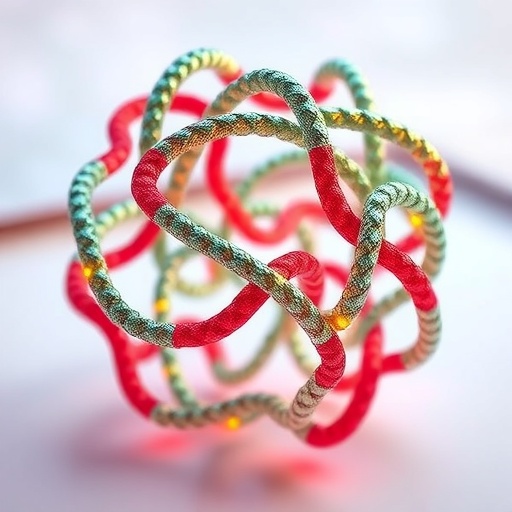
The work brings together teams from the University of Chicago Pritzker School of Molecular Engineering, Harvard, Stony Brook University, and Quantinuum. Using non-Abelian anyons encoded across multiple qubits, the researchers show that by moving (braiding) these excitations in carefully chosen patterns—and combining that with additional operations—they can implement the full range of gates needed for arbitrary quantum algorithms.

“We demonstrated a universal gate set,” said Ruben Verresen of UChicago PME, explaining that storing information in these emergent quark-like degrees of freedom and then manipulating them enables essentially any quantum computation. The goal is not just proof that quantum effects can be controlled, but that the control is broad enough to scale into general-purpose computing.

A central motivation is fault tolerance. Conventional quantum error correction protects qubits by spreading information across many physical qubits, but universal gate sets usually require resource-heavy “magic states.” Building those states typically involves distillation procedures that consume significant machine time and qubits—one of the biggest practical costs in leading architectures.

Non-Abelian anyons are naturally attractive because their information is distributed across entangled degrees of freedom, making them comparatively resilient to local noise. Just as importantly, their braiding can function as computation. Yet prior demonstrations using the D4 symmetry group—based on rotations and reflections of a square—showed that braiding alone was not enough to reach full universality.

The new study targets a different symmetry, S3, associated with rotations and mirror flips of an equilateral triangle. On Quantinuum’s H2 trapped-ion processor, the team entangled 54 qubits to realize S3-based anyons. Crucially, the researchers show that universality emerges only when braiding is paired with fusion, a measurement-like operation where two anyons are merged and the outcome is read out.

To benchmark the approach, the team encoded information in “topological qutrits,” which use three quantum levels rather than the two levels of ordinary qubits. Braiding produced an entangling operation, while fusion generated distinct measurement operations; together, these components can in principle synthesize any quantum transformation, including gates unreachable by braiding alone. The protocol also enables preparation of a magic state directly via topological operations, potentially avoiding expensive distillation.

In the current results, the researchers did not perform active error correction. Instead, they verified key building blocks and confirmed that a magic state produced through anyon-based procedures matches theoretical expectations. “So far, we’ve ignored the question of error correction,” Verresen said—framing the work as a proof of principle.

The next step is to integrate this anyon-based approach with error correction to move from demonstrated primitives to scalable, fault-tolerant computation. Verresen and collaborators are already exploring methods to stabilize non-Abelian quantum memories, aiming to make this “dark horse” architecture practical for large-scale quantum machines.

Subject of Research: Universal quantum computation with non-Abelian anyons (braiding and fusion) and implications for fault-tolerant quantum error correction
Article Title: Universal gates from braiding and fusing anyons on quantum hardware
News Publication Date: 15-Jul-2026
Web References: https://www.nature.com/articles/s41586-026-10709-y
References: Lo et al., Nature (July 15, 2026). DOI: 10.1038/s41586-026-10709-y
Image Credits:
Keywords: quantum computing; non-Abelian anyons; topological qutrits; universal gate set; quantum error correction; braiding and fusion; trapped-ion processor

Tags: braiding of exotic particlesemergent quantum excitationsfault-tolerant quantum systemsmulti-qubit operationsnon-Abelian anyonsquantum algorithms implementationQuantum Computingquark-like degrees of freedom in quantum systemsscalable quantum hardwaretopological quantum computationtopological quantum error correctionuniversal quantum gates
Share26Tweet16
Previous Post

China COPE Seminar Focuses on Integrity Infrastructure After 24hreview Launch

Next Post

Black and Asian doctors face up to 30 times fewer specialty training posts

Related Posts

Machine Learning Enables Safer Testing of Chemical Threats to Endangered Fish
Mathematics

Machine Learning Enables Safer Testing of Chemical Threats to Endangered Fish

July 15, 2026
Researchers Uncover Hidden Identity of Elusive Superconductor
Mathematics

Researchers Uncover Hidden Identity of Elusive Superconductor

July 15, 2026
Blood P-Tau217 predicts cognitive impairment progression, study finds
Mathematics

Blood P-Tau217 predicts cognitive impairment progression, study finds

July 15, 2026
Scientists Develop Technique for Ultra-Thin Quantum Material Stacks
Mathematics

Scientists Develop Technique for Ultra-Thin Quantum Material Stacks

July 14, 2026
Shear Loading Causes Accelerating Damage Growth in Metals
Mathematics

Shear Loading Causes Accelerating Damage Growth in Metals

July 14, 2026
Quantum Bath Enables Remote Qubits to Synchronize
Mathematics

Quantum Bath Enables Remote Qubits to Synchronize

July 14, 2026
Next Post
Black and Asian doctors face up to 30 times fewer specialty training posts

Black and Asian doctors face up to 30 times fewer specialty training posts

  • Mothers who receive childcare support from maternal grandparents show more

    Mothers who receive childcare support from maternal grandparents show more parental warmth, finds NTU Singapore study

    27656 shares
    Share 11059 Tweet 6912
  • University of Seville Breaks 120-Year-Old Mystery, Revises a Key Einstein Concept

    1061 shares
    Share 424 Tweet 265
  • Bee body mass, pathogens and local climate influence heat tolerance

    682 shares
    Share 273 Tweet 171
  • Researchers record first-ever images and data of a shark experiencing a boat strike

    546 shares
    Share 218 Tweet 137
  • Groundbreaking Clinical Trial Reveals Lubiprostone Enhances Kidney Function

    531 shares
    Share 212 Tweet 133
Science

Embark on a thrilling journey of discovery with Scienmag.com—your ultimate source for cutting-edge breakthroughs. Immerse yourself in a world where curiosity knows no limits and tomorrow’s possibilities become today’s reality!

RECENT NEWS

  • Engineered Biochar Converts Biomass Waste into Safer, More Effective Wastewater Cleaners
  • Accurate Diagnosis Crucial as Rare Cervical Tumor Explains Persistent Menorrhagia
  • Barrier-Free Cascaded Sulfur Reduction Enables 2-Ah Stable Lithium-Sulfur Pouch Cell
  • Study Uncovers a Winter-Adjusted Biological Clock in Living Organisms

Categories

  • Agriculture
  • Anthropology
  • Archaeology
  • Athmospheric
  • Biology
  • Biotechnology
  • Blog
  • Bussines
  • Cancer
  • Chemistry
  • Climate
  • Earth Science
  • Editorial Policy
  • Marine
  • Mathematics
  • Medicine
  • Pediatry
  • Policy
  • Psychology & Psychiatry
  • Science Education
  • Social Science
  • Space
  • Technology and Engineering

Subscribe to Blog via Email

Enter your email address to subscribe to this blog and receive notifications of new posts by email.

Join 5,146 other subscribers

© 2025 Scienmag - Science Magazine

Welcome Back!

Login to your account below

Forgotten Password?

Retrieve your password

Please enter your username or email address to reset your password.

Log In
No Result
View All Result
  • HOME
  • SCIENCE NEWS
  • CONTACT US

© 2025 Scienmag - Science Magazine

Discover more from Science

Subscribe now to keep reading and get access to the full archive.

Continue reading
