


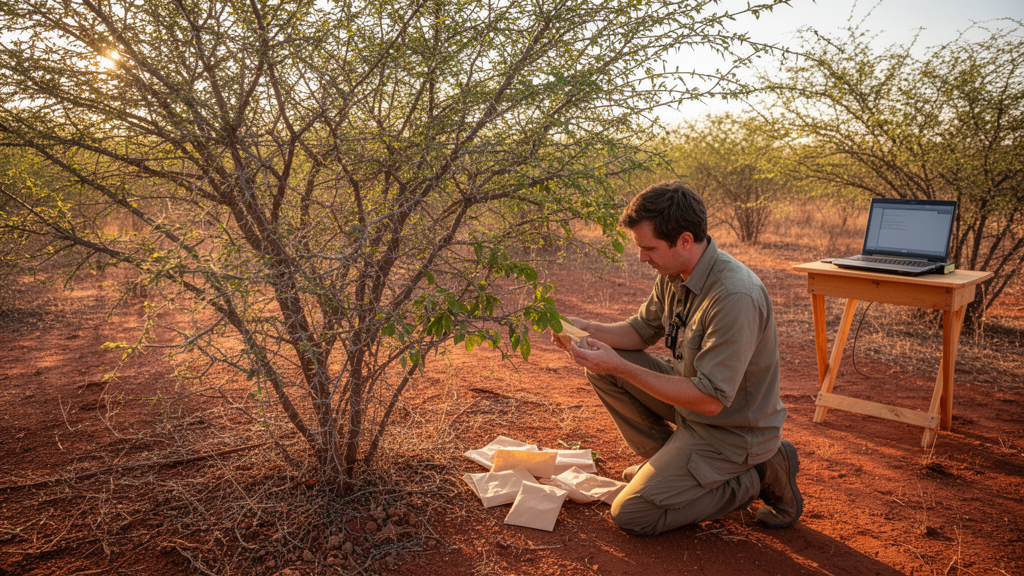
The Bolivian Vegetation Ecology Database, known as BOVEDA, has been registered with the Global Index of Vegetation-Plot Databases (GIVD) under the identifier SA-BO-005, and its first release compiles 320 georeferenced vegetation relevés from the Chacoan region. According to the team behind the project, the plot count in this first stage already exceeds that of any other GIVD-registered database from Bolivia, filling a conspicuous gap in the global archive of vegetation data. The database arrives at a moment when the study of vegetation and biogeography has been transformed by the compilation of plot-level records into shared archives.
The GIVD and the sPlot Consortium have driven what the BOVEDA authors describe as a paradigm shift, allowing researchers to combine standardized floristic and ecological observations across continents. Until now, Bolivia — a country of extraordinary ecosystem diversity — has been largely absent from that network. BOVEDA was created to change that, with the aim of making floristic and ecological data for the country's vegetation types available online through the GIVD archive and of connecting researchers working on Bolivian ecosystems.
The scale of the task is considerable. Bolivia spans 1,098,581 square kilometres and encompasses four biogeographical regions: Amazonian, Brazilian-Paranean, Chacoan and Tropical Andean. Some 12,245 vascular plant species are currently known from the country, with roughly 8,000 more expected to be described in the future, bringing the estimated total richness to approximately 20,000 species.
Against that backdrop, the Chaco was chosen as the database's first stage, and the authors report their results in the journal Vegetation Classification and Survey. The Gran Chaco is one of the great biogeographic units of the Neotropics, spanning territories in five different countries and divided along a decreasing temperature gradient into a northern Boreal Chaco and a southern Austral Chaco. A rainfall gradient rising from west to east further distinguishes dry and wet portions of the region.
Within Bolivia lies one of the vastest extensions of the Chaco Boreal, a lowland xeric biome covering more than 127,700 square kilometres, of which 34,411 square kilometres fall within Kaa-Iya del Gran Chaco National Park and Integrated Area — the largest protected area in the country. The physical setting of the Bolivian Chaco helps explain why its forests vary so strikingly from place to place. Geologically, the region formed from the end of the Pliocene into the beginning of the Pleistocene out of the alluvial fans of the Parapetí, Gande, Pilcomayo and Teuco-Bermejo rivers.
That sedimentary origin left soils rich in sands, silts and clays, and the authors note that the varying combination of these grain sizes, together with small topographical differences, determines how well the soils drain and how they flood — one of the major factors determining which forest formation develops at a given site. The bioclimate is xeric, with dry and semiarid precipitation zones. The 320 relevés in the first release come mainly from fieldwork conducted in the Bolivian Chaco, with some plots from neighbouring countries.
About 60 percent of the sampling was carried out in the last decade of the twentieth century and 40 percent in the first decade of the twenty-first. Sampling was balanced across physiognomic vegetation types to reflect the diversity of the plant landscape. Almost all plots average 2,000 square metres and follow a band-transect design, 200 metres long and 10 metres wide, extending five metres on either side of a path — a method adopted because of the difficulty of access and the impenetrability of the vegetation in many places.
Plant cover was estimated with the Braun-Blanquet scale. The sampling design carries some important limitations that the authors document explicitly. Nearly all plots (98 percent) record terrestrial vegetation, and within those, 23 percent include additional information on epiphytes; freshwater vegetation was also recorded.
However, only woody species were recorded in the terrestrial plots, because sampling was confined to the dry season, when herbaceous plants are not developed and access to the area is possible. The authors also note that tropical forests have a relatively species-poor herb layer compared with temperate forest ecosystems. A small proportion of relevés, fewer than 2 percent, record only plant presence rather than cover.
Beyond the floristic lists, the database captures a wide range of environmental and structural information. Altitude is recorded for 30 percent of plots and slope inclination for 8 percent. More than half of the samples include substrate data, with soil specifications present for 54 percent of plots and measurements of water electrical conductivity in hygromorphic habitats for 5 percent; soil texture was classified in the field according to USDA standards.
Vegetation structure and typology are also covered: formation type is given for 37 percent of plots, vegetation series for 27 percent and canopy height for 17 percent. Degradation status related to human impact — mostly overgrazing, proximity to settlements or roads, and sometimes fires — is available for 9 percent of plots. The data are held in a single spreadsheet stored in xls format with csv export, available on request under a specific agreement.
The taxonomic content of the first release is substantial. A total of 633 taxa were identified to species level, 836 were assigned only to genus, and 1,010 remained unidentified at the time of survey, all belonging to 114 families. Nomenclature follows the World Flora Online and the Catalogue of the Vascular Plants of Bolivia, accessible through the Tropicos database of the Missouri Botanical Garden.
Among the woody vegetation, shrublands and woodlands are the most predominant structure at 35 percent, followed by palm tree forests at 17 percent. A preliminary classification of the data suggests that the Bolivian Chacoan woody vegetation encompasses nine distinct units: deciduous forests of alluvial plains on well to moderately well drained soils; deciduous to semideciduous Chaco forests transitional to the Andes; deciduous and sclerophyllous Cerrado thorn-woodlands and shrublands transitional to the Chaco, known as Abayoy; xeromorphic thorn shrubland and thickets on vertic, poorly drained soils; woodlands and savannas on sand dunes and aeolian surfaces; saltwater swamp forests; freshwater swamp forests; phreatophytic forests; and deciduous to semideciduous Chaco forests transitional to the Chiquitania. An analysis of species richness found the richest forests to be the Chaco forests transitional to the Chiquitania and the woodlands and savannas on dunes and sands, while the swamp forests were the least rich and the other forest types intermediate.
Across the relevés, the five most species-rich families were Cactaceae at 23 percent, Fabaceae at 22 percent, Capparaceae at 12 percent, Bromeliaceae at 11 percent and Apocynaceae at 8 percent. BOVEDA is projected to grow well beyond the Chaco. Planned updates will add the Bofedales wetlands, Polylepis forests, Altiplano shrublands, dry inter-Andean valleys vegetation and a set of relevés of Altiplano aquatic flora, bringing the estimated total to 1,000 existing plots, with the intention of continuing further with data from multiple sources.
The team also plans to store data from past and current fieldwork in other South American countries, including Argentina, Chile, Brazil, Venezuela and Ecuador. The project's expansion is laid out in two steps: first, incorporating the raw data of works already published by the authors, and second, adding unpublished information from areas such as the inter-Andean dry valleys and hygrophytic vegetation such as High-Andean wetlands. With its registration in GIVD and the updates to come, the authors write, BOVEDA offers botanists and ecologists access to large amounts of original data from regions where published field data are rare and difficult to obtain, opening possibilities for biodiversity analysis and mapping, species range mapping, biogeographical analysis, and assessments of degradation, deforestation and ecosystem resilience to disturbances such as forest clearing, overgrazing and fire.
Subject of Research: A new vegetation-plot database (BOVEDA) documenting the Chacoan forests of Bolivia
Article Title: BOVEDA , the Bolivian Vegetation Ecology Database: first stage, the Chacoan forests
Article References: Oliveira, J., Molina, J. A., & Navarro, G. (2022). BOVEDA, the Bolivian Vegetation Ecology Database: first stage, the Chacoan forests. Vegetation Classification and Survey, 3, 191-197. https://doi.org/10.3897/vcs.84418
Image Credits: AI Generated
DOI: 10.3897/VCS.84418
Keywords: BOVEDA, Bolivia, Gran Chaco, vegetation ecology, relevés, GIVD, biodiversity, dry forests, plant databases, biogeography, Kaa-Iya National Park, species richness
Cite Scienmag News
Gavin Prescott. (October 26, 2026). BOVEDA database opens up Bolivia’s Chaco forests to vegetation science. Scienmag. https://scienmag.com/boveda-database-opens-up-bolivias-chaco-forests-to-vegetation-science/
Gavin Prescott. "BOVEDA database opens up Bolivia’s Chaco forests to vegetation science." Scienmag, 26 October 2026, https://scienmag.com/boveda-database-opens-up-bolivias-chaco-forests-to-vegetation-science/. Accessed 26 October 2026.
Gavin Prescott. "BOVEDA database opens up Bolivia’s Chaco forests to vegetation science." Scienmag. October 26, 2026. https://scienmag.com/boveda-database-opens-up-bolivias-chaco-forests-to-vegetation-science/


