

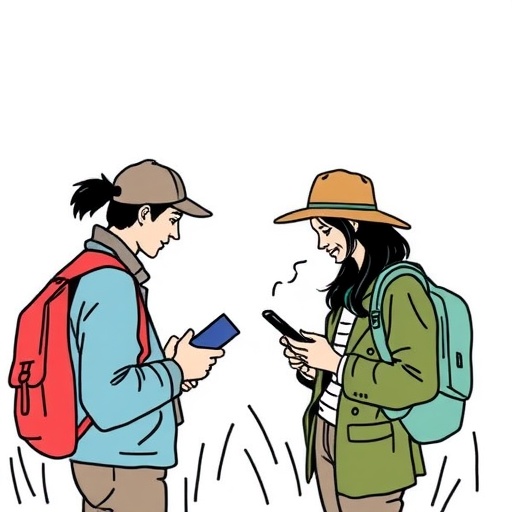
The phenomenon known as “nemotia,” a neologism coined to describe the paralyzing sense of futility and disconnection that arises when one feels powerless to effect meaningful change, has found a surprising antidote in the realm of citizen science. Researchers at the Florida Museum of Natural History have uncovered compelling evidence that contributions from both highly engaged and more casual citizen scientists hold significant value—often in complementary ways—for biodiversity research and environmental monitoring.
Citizen science stands as a dynamic collaborative enterprise wherein laypeople collect and share data that serve a broad spectrum of scientific endeavors, ranging from the tracking of ecological changes and the assessment of conservation status, to public health initiatives and urban development planning. This reciprocal arrangement not only benefits scientists through an expanded data pool but also provides volunteers with a profound opportunity to deepen their connection with the natural environment.
Traditional volunteer-based projects often see a participation skew toward those with considerable time, financial resources, and subject expertise—the so-called “super users.” However, the latest study illuminates that casual contributors, who may engage sporadically or out of daily routine, equate in their collective importance to these dedicated individuals. These findings derive from the analysis of a vast dataset encompassing approximately 7.5 million biodiversity observations submitted by nearly 283,000 users on iNaturalist, a globally utilized digital platform that facilitates species identification, citizen engagement, and bioblitz events.
Erin Grady, the lead author and current engagement coordinator for the USA National Phenology Network, conducted this research amidst her graduate studies at the Florida Museum. Grady’s interest emerged following a personal grappling with nemotia. Initially focusing on phenological studies linking plant life cycles with environmental variables, she found her initial theoretical underpinnings insufficient for fostering meaningful engagement. Her immersion into contributory science provided an intersection of biodiversity research impact, community involvement, and environmental interaction.
The study deployed a rigorous analytical framework, parsing data from a large, ecologically diverse region in the southeastern United States. Observations were spatially categorized into land-use types such as protected conservation areas, urban neighborhoods, and agricultural zones. Furthermore, socio-economic dimensions were integrated by classifying data collection sites into high- and low-income regions, thereby probing the intersection of community resources and scientific engagement. Users were further classified into “travelers” and “residents” based on the geographical breadth of their submitted observations relative to the study area.
One of the pivotal revelations from the study is the distinct spatial sampling preferences exhibited by user groups. Highly active observers disproportionately sample biodiverse hotspots such as green or protected spaces, while casual participants contribute observations primarily within urban landscapes and their immediate vicinity. This dichotomy addresses a longstanding bias in citizen science data, which tends to overrepresent pristine natural environments while neglecting urban biodiversity—a factor that can skew ecological models and conservation priorities.
Crucially, the integration of diverse user data helps mitigate these sampling biases. Casual observers, who document flora and fauna encountered during routine activities like dog walking or backyard gardening, provide valuable data points from socioeconomically varied and often underrepresented urban settings. This complementary data enriches ecological datasets, providing a more nuanced understanding of biodiversity distributions across different land-use spectra.
Rob Guralnick, curator of biodiversity informatics at the Florida Museum and senior co-author of the study, has widely contributed to urban ecology research utilizing citizen science platforms. He underscores that understanding the comprehensive ecological footprint of urbanization demands geographical and temporal replication of observations across multiple cities worldwide, a task uniquely suited to the participatory model that iNaturalist and similar platforms enable. As urban expansion continues, the role of citizen science in assessing urban heat islands, hydrological changes, and habitat fragmentation increasingly gains centrality.
The study also highlights a pressing social dimension: the underrepresentation of lower-income communities within citizen science datasets. Such disparities not only limit scientific understanding of biodiversity in marginalized areas but also curtail the potential for these communities to leverage data in advocating for environmental justice and policy reforms. Citizen science thus becomes a tool not merely for data collection but for empowerment and community resilience.
Beyond the quantitative contributions, Grady and Guralnick point to an intangible yet profound outcome of citizen science—transformational personal experiences that restore agency and belonging. For individuals wrestling with feelings of inefficacy like nemotia, the act of observing, documenting, and sharing observations connects them to a global community united by curiosity, stewardship, and appreciation for the natural world.
The authors foresee that the coming decade will witness an amplified emphasis on observational engagement as a form of activism and personal solace. Scientific data will continue to flow more freely from diverse sources, democratizing knowledge production and enabling fine-grained ecological insights. Simultaneously, the social fabric woven through citizen science promises resilience against the pervasive sense of alienation wrought by environmental crises.
Published in the peer-reviewed journal Citizen Science: Theory and Practice, this study substantiates the growing recognition that biodiversity science benefits immeasurably from inclusive participation. By embracing and encouraging contributions across the spectrum of engagement intensity, scientific projects can enhance data richness, address biases, and foster broader communal involvement.
Funding for this research was provided in part by the National Science Foundation and supported through the USDA’s intramural research initiatives. Additional co-authors include Caitlin Campbell of Bat Conservation International and Corey Callaghan from the University of Florida. The investigation rigorously establishes that all data inputs—whether stemming from dedicated super-users or casual daily observers—are vital pieces of the complex mosaic that informs contemporary biodiversity science.
Subject of Research: Citizen Science Contributions and Biodiversity Sampling Bias
Article Title: iNaturalist Users Exhibit Distinct Spatiotemporal Sampling Preferences, with Implications for Biodiversity Science and Project Planning
News Publication Date: January 29, 2026
Web References:
- iNaturalist platform: https://www.inaturalist.org/
- USA National Phenology Network: https://www.usanpn.org/
- Original study DOI: http://dx.doi.org/10.5334/cstp.868
References: Grady et al., Citizen Science: Theory and Practice, DOI 10.5334/cstp.868
Image Credits: Florida Museum photo by Jeff Gage
Keywords: Biodiversity, Citizen Science, Sampling Bias, Urban Ecology, Socioeconomic Disparities, Environmental Monitoring, iNaturalist, Phenology, Nemotia, Community Engagement, Conservation Science, Data Democratization


