


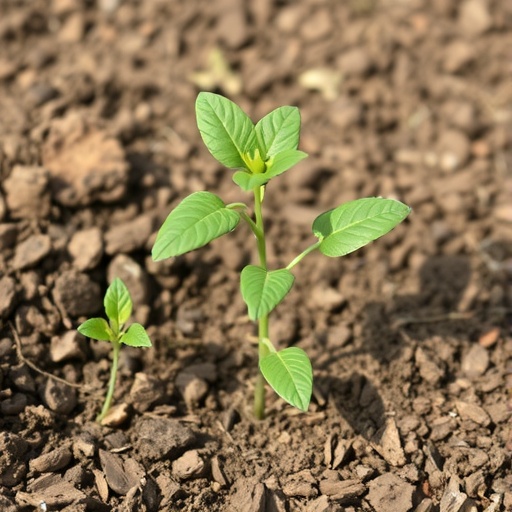
Water transport in plants is a feat of natural engineering that has long fascinated scientists. Despite plants drawing water from the soil upward against the force of gravity, they achieve this seemingly impossible task through a phenomenon known as negative water potential. This negative tension, essentially a form of suction, allows water to travel from soil through stems and leaves, sustaining life and enabling photosynthesis. Yet, researchers have puzzled over what ultimately limits a plant’s capacity to extract water efficiently, especially under drought conditions.
A breakthrough study by an interdisciplinary team led by Professors Andrea Carminati and Tim Brodribb now reveals a paradigm-shifting insight: it is not the intrinsic properties of the plant that predominantly restrict water uptake, but rather the physical properties and dynamics of water in the soil itself. This discovery, published in the prestigious journal Science, sheds new light on the complex interfaces between plants and their growing environments, with profound implications for agriculture and ecology.
At the heart of this revelation lies the behavior of water inside soil pores. Soil is a complex matrix of mineral particles and organic matter, filled with pores of diverse sizes that hold water with various degrees of adherence. This retention of water owes much to capillary forces—physical forces that cause water to cling tightly within the narrow confines of soil pores. When the soil moisture potential drops below a critical threshold of approximately -1.5 megapascals, these capillary forces increase to a point where water is bound too tightly for plant roots to overcome effectively. In effect, as soil dries, the energy required for plants to pull water upwards surges, and their ability to satisfy transpiration demands diminishes.
To unravel how plants perceive and respond to these soil-driven constraints, the combined expertise of soil physicists and plant physiologists proved essential. Stomata, minute pores located on the undersides of leaves, operate as dynamic valves regulating the exchange of gases and vapor between the plant interior and the atmosphere. These microscopic gates open to allow carbon dioxide entry for photosynthesis but release water vapor during transpiration. Their sensitivity to environmental conditions means they can promptly adjust their aperture to conserve water during times of scarcity.
The closing of stomata presents plants with a vital trade-off: water conservation at the expense of carbon uptake. When stomata shut to prevent dehydration, photosynthetic carbon assimilation slows, limiting sugar production and retarding growth. Thus, the stomatal response directly influences plant productivity and biomass accumulation, intricately linking water transport mechanisms to global carbon cycling. Understanding the delicate control of stomatal aperture in response to soil water availability is crucial for grasping plant resilience in drought-prone habitats.
From a structural perspective, plants invest significant energy in reinforcing their vascular tissues to withstand the negative pressures generated during water transport. Thickened cell walls in xylem vessels prevent collapse under tension, maintaining a continuous water column from root to leaf. Within leaves, osmotic adjustments sustain cell turgidity despite the high tension in adjacent vascular elements, enabling physiological processes to continue even under stress.
The agricultural sector has long sought to improve drought tolerance by breeding plants capable of maintaining higher osmotic pressures in their cells to facilitate water absorption. However, these efforts have yielded disappointing results. The new findings elucidate the reason: the bottleneck to water uptake is not due to plant cellular limitations but rather to the physical constraints imposed by soil water properties and capillary phenomena. This shifts the focus from solely plant breeding to soil management and irrigation strategies that can alleviate these hydraulic limitations.
The research exemplifies the power of interdisciplinary collaboration. Carminati’s team, grounded in soil physics, initially concentrated on the subterranean mechanics of water retention and movement before, together with Brodribb’s expertise in plant physiology, progressively extended their analysis upwards into the leaf tissues. Concurrently, Brodribb brought an opposing perspective by starting from plant cellular functions and scaling down to root-level water interactions. This bidirectional approach enabled a comprehensive understanding of how soil and plant systems integrate to regulate vascular tension.
By employing advanced modeling techniques of water potential and hydraulic function, the researchers provided quantitative validation of their conceptual framework. The models demonstrate that soil drying and pore geometry dictate the limits of water uptake more than previously appreciated physiological or anatomical traits of plants. This fundamental insight opens pathways for new approaches in both ecological research and practical agriculture, aimed at mitigating drought impacts amidst changing climate conditions.
The findings invite further exploration of soil texture, pore size distribution, and moisture dynamics as co-determinants of plant water status. Enhanced soil exploration technologies, alongside remote sensing and plant phenotyping, might enable precision agriculture tailored to optimize water availability at the root-soil interface. Ultimately, this research paves the way for integrated water management practices that harmonize plant physiology and soil physics for sustainable crop production.
In sum, the study redefines our understanding of plant hydraulic regulation by spotlighting the dominant role of soil water physics. The constrained water supply dictated by soil pores translates directly into vascular tensions within plants, governing stomatal responses and whole-plant water use strategies. This breakthrough challenges longstanding assumptions and offers a unified theoretical basis for future innovations in plant science and environmental management.
Cite Scienmag News
Alan Morgan. (March 25, 2026). Why Plants Struggle to Thrive in Dry Soil. Scienmag. https://scienmag.com/why-plants-struggle-to-thrive-in-dry-soil/
Alan Morgan. "Why Plants Struggle to Thrive in Dry Soil." Scienmag, 25 March 2026, https://scienmag.com/why-plants-struggle-to-thrive-in-dry-soil/. Accessed 5 September 2026.
Alan Morgan. "Why Plants Struggle to Thrive in Dry Soil." Scienmag. March 25, 2026. https://scienmag.com/why-plants-struggle-to-thrive-in-dry-soil/


