


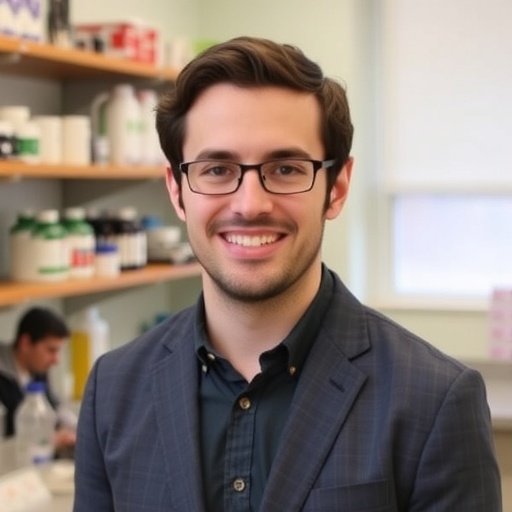
Boston College chemist Alexis Grimaud has received a five-year National Science Foundation CAREER Award worth nearly $600,000 to investigate a largely unexplored class of battery materials that could help reshape the future of energy storage. His research targets transition metal oxychlorides—compounds made from oxygen, chlorine, and a metal such as iron—and seeks to control their structure and chemical behavior so they can store and release lithium or sodium ions efficiently.
The project, titled “Controlling dimensionality and ligand connectivity to tune intercalation properties in transition metal oxychlorides,” addresses one of the central challenges facing rechargeable batteries: how to develop high-performing materials from elements that are abundant, affordable, and less vulnerable to supply-chain limitations. Lithium-ion batteries have become essential in electric vehicles, consumer electronics, and renewable-energy systems, but many of their constituent materials depend on geographically concentrated resources and complex refining networks.
Grimaud, an associate professor of chemistry who joined Boston College in 2022, leads a research group focused on the fundamental chemistry of electrochemical interfaces. These interfaces are the regions where electrodes and electrolytes meet, and they govern how ions move, how electrons flow, and how battery materials change during charging and discharging. A material that appears promising in isolation may perform poorly in a working battery if it reacts unfavorably with the surrounding electrolyte.
“The same battery material may succeed or fail depending on the electrolyte surrounding it,” Grimaud explained. His team is therefore studying not only the solid electrode materials themselves but also the chemical environment in which they operate. Electrolytes—liquids or solids that transport ions between battery electrodes—can influence the stability, reversibility, voltage, and lifetime of a cell. By designing electrolytes with adjustable chemical properties, researchers may be able to make previously unstable materials function reliably.
The new NSF-supported research will focus on mixed-anion materials containing both oxygen and chlorine. In conventional battery compounds, oxygen is often the dominant negatively charged element, or anion. Replacing or combining oxygen with another anion can change the electronic structure, bonding, crystal geometry, and reactivity of a material. Those changes may determine how easily lithium or sodium ions can enter and leave the structure, a process known as intercalation.
During intercalation, ions move reversibly into spaces within a host material without completely destroying its framework. This process is fundamental to the operation of many rechargeable batteries. When a battery charges, lithium or sodium ions migrate into the electrode; when it discharges, they move back while electrons travel through an external circuit. The speed, capacity, and durability of this process depend on the pathways available for ion movement and on whether the host structure can withstand repeated chemical and structural changes.
Grimaud’s team has already achieved reversible lithium intercalation in several oxychloride materials. In one demonstration, a compound composed of iron, oxygen, and chlorine delivered energy density and electrochemical performance comparable to an established iron-and-phosphate material. Iron, oxygen, and chlorine are relatively abundant and inexpensive elements, while phosphate-based materials can be tied to sourcing and refining constraints and may compete with agricultural uses for phosphate resources.
The researchers now aim to determine how the dimensionality of these compounds and the connectivity of their chemical building blocks affect ion storage. In materials science, dimensionality describes whether a structure forms isolated units, chains, sheets, or three-dimensional networks. Ligand connectivity refers to the way atoms or molecular groups bind to a central metal and to one another. Adjusting these features could allow scientists to tune a material’s voltage, capacity, conductivity, structural stability, and selectivity for lithium or sodium.
The implications extend beyond batteries. Grimaud said that precise control over the electronic and structural properties of oxychloride materials could open possibilities in electronics and quantum technologies, where unusual electrical, magnetic, or optical behaviors are valuable. The work may also support the development of sodium-ion batteries, which are attracting interest as a complement to lithium-based systems because sodium is widely distributed and potentially easier to source at large scale.
The CAREER Award will support both laboratory research and educational programs. Grimaud plans to use findings from the project to introduce Boston College students to the links between materials design, energy technology, and environmental consequences. He will also work with students in grades eight through twelve who participate in The Academy, a free enrichment program supported by Boston College’s Pine Manor Institute for Student Success. Laboratory activities will introduce these students to battery chemistry while encouraging them to consider how raw materials are sourced, refined, used, and eventually recycled.
As battery technologies expand rapidly, Grimaud argues that performance alone cannot define progress. Future materials must be evaluated alongside their social and ecological costs, including mineral availability, energy-intensive processing, waste, and geopolitical dependence. By combining fundamental chemistry with education and broader sustainability questions, the project aims to develop better battery materials while preparing a new generation of scientists to think critically about the technologies they create.
Keywords
Chemistry, energy, electrochemistry, electrochemical cells, batteries, battery materials, lithium-ion batteries, sodium-ion batteries, materials science, quantum technologies, National Science Foundation, Boston College
Cite Scienmag News
Faith Mcneil. (August 10, 2026). Boston College Chemist Alexis Grimaud Wins NSF CAREER Award. Scienmag. https://scienmag.com/boston-college-chemist-alexis-grimaud-wins-nsf-career-award/
Faith Mcneil. "Boston College Chemist Alexis Grimaud Wins NSF CAREER Award." Scienmag, 10 August 2026, https://scienmag.com/boston-college-chemist-alexis-grimaud-wins-nsf-career-award/. Accessed 4 September 2026.
Faith Mcneil. "Boston College Chemist Alexis Grimaud Wins NSF CAREER Award." Scienmag. August 10, 2026. https://scienmag.com/boston-college-chemist-alexis-grimaud-wins-nsf-career-award/


