

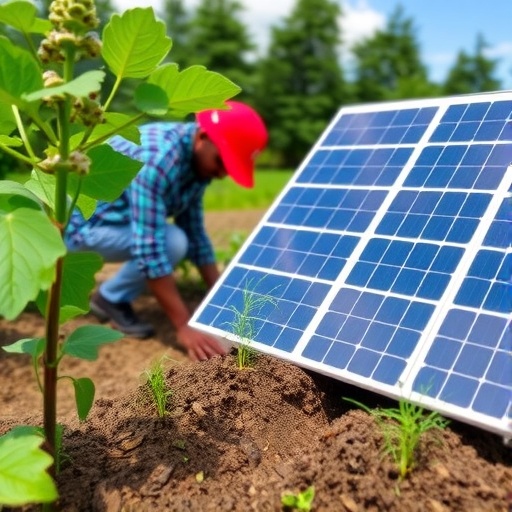
Agrivoltaics, the innovative integration of solar photovoltaic panels with agricultural practices, is rapidly emerging as a transformative technology poised to reshape sustainable farming, particularly in challenging climatic zones such as the Mediterranean. In a groundbreaking study published in npj Sustainable Agriculture, Rapella, Viovy, and Faranda et al. provide compelling evidence that agrivoltaic systems can be fine-tuned to optimize fertilizer usage, thus enhancing the sustainability of crop production amidst water scarcity and climatic volatility. This research propels agrivoltaics beyond mere dual land use, revealing its potential to fundamentally alter resource management strategies in agroecosystems.
The Mediterranean region, characterized by hot, dry summers and mild, wet winters, presents unique obstacles for agriculture. Fertilizer runoff, soil degradation, and water scarcity intensify the need for innovative solutions that reduce environmental impact while maintaining crop yields. The study by Rapella and colleagues addresses these challenges head-on, investigating how agrivoltaic installations—solar panels set above crop rows—can modulate microclimates and influence nutrient cycling to reduce fertilizer dependency. Their approach integrates field experiments with advanced modeling to unravel the complex interactions between light interception, soil moisture, and plant nutrient uptake.
At the heart of the research is the concept that the shading effect provided by photovoltaic panels can moderate extreme microclimatic conditions, reducing evapotranspiration and soil nutrient leaching. This shading not only alleviates plant stress during peak heat but also creates a microenvironment with greater moisture retention, which is crucial in Mediterranean environments where drought periods are prolonged. By slowing nutrient loss and enhancing soil fertility dynamics under partial shade, crops potentially require less synthetic fertilizer input, directly contributing to sustainable agricultural practices.
Quantitatively, the authors demonstrate that agrivoltaic configurations reduce fertilizer nutrient runoff by significant margins when compared to conventional open-field cultivation. This is achieved without compromising photosynthetic efficiency or crop productivity, signaling a paradigm shift in how energy harvesting infrastructures can be leveraged to synergistically benefit agriculture. The research elucidates the spatial heterogeneity introduced by panel shading, showing that optimized panel heights and spacing can strategically distribute light and moisture to match crop nutrient needs more effectively.
The methodology adopted in this study is rigorous and multi-faceted. The researchers employed an array of sensors to monitor soil moisture, temperature, and nutrient concentrations across various depths and proximities to photovoltaic panels throughout different growth stages of selected crops. Concurrently, they utilized sophisticated computational models to simulate nutrient cycling and plant uptake dynamics under varying agrivoltaic design parameters. This integrative method allowed for both empirical validation and predictive optimization, enhancing the robustness and applicability of their findings.
One of the striking outcomes pertains to the reduction in nitrogen fertilizer application rates achieved through careful agrivoltaic system design. Nitrogen, a critical but environmentally problematic macronutrient, often leads to eutrophication in water bodies when excessively applied. The study reports that under agrivoltaic conditions, the optimal nitrogen fertilizer required for peak plant growth can be lowered by up to 25%, significantly decreasing the risk of leaching and greenhouse gas emissions associated with nitrogenous fertilizers.
The researchers also explore the influence of agrivoltaics on phosphorus management, another vital nutrient with limited global reserves. Their data suggest improved phosphorus use efficiency within shaded microenvironments, driven by modified root zone moisture and microbial activity that enhances phosphorus availability. This dual improvement in nitrogen and phosphorus management underscores agrivoltaics’ holistic impact on nutrient stewardship, pivotal for long-term agroecosystem resilience.
Beyond nutrient optimization, the study reveals that agrivoltaic systems induce beneficial shifts in the soil microbiome, amplifying populations of beneficial bacteria and fungi associated with nutrient cycling and plant growth promotion. These biological feedback loops are essential in maintaining soil health, and their enhancement under agrivoltaic conditions offers a promising avenue for reducing synthetic input reliance while fostering natural soil fertility processes.
The implications of this research extend to policy and agricultural planning spheres, suggesting that deployment of agrivoltaic systems be coupled with site-specific nutrient management strategies. The authors advocate for a new generation of precision agriculture frameworks that integrate energy harvesting infrastructure design with fertilizer application technologies, effectively turning farm landscapes into multifunctional eco-productive units capable of balancing energy production, food security, and environmental stewardship.
This study also addresses the socio-economic dimensions of adopting agrivoltaic systems. By enabling fertilizer savings and enhancing crop resilience in climate-stressed regions, farmers can potentially reduce costs and buffer against climatic shocks, improving livelihood stability. Moreover, the co-location of energy and food production holds promise for decentralized rural energy access, facilitating cleaner energy generation without sacrificing agricultural output.
However, the researchers caution that agrivoltaic system design must be carefully tailored to local climatic conditions, crop types, and soil characteristics. The complex interactions observed demand adaptive management strategies responsive to seasonal variations and crop phenology. Overly dense panel coverage or inappropriate orientation could inadvertently limit crop growth or exacerbate nutrient imbalances, highlighting the need for continuous monitoring and flexibility in agrivoltaic farm design.
Future research directions outlined by the authors focus on expanding the range of crops tested, refining mechanistic models to include plant physiological responses under variable light spectra, and integrating socio-economic modeling to optimize agrivoltaic deployment at regional scales. Additionally, long-term field trials are crucial for assessing cumulative soil health impacts and the durability of fertilizer use reductions over multiple growing cycles.
In synthesizing agrivoltaics with nutrient management, this study exemplifies the potential of interdisciplinary approaches in addressing pressing sustainability challenges. The convergence of renewable energy technologies with precision agronomy illustrates a pathway towards resilient agricultural systems that can thrive under increasing climate uncertainty while mitigating environmental degradation.
As Mediterranean agricultural zones grapple with water scarcity and nutrient pollution, the insights offered by Rapella and collaborators pave the way for a new era in farming—one where solar panels do not just power homes but actively contribute to sustaining food production and safeguarding ecosystem health. This research signals an exciting frontier for sustainable agriculture, aligned with global goals for climate action, biodiversity conservation, and resource efficiency.
In conclusion, optimizing fertilizer use through agrivoltaics in Mediterranean climates represents a strategic innovation with transformative potential. The delicate balance between energy generation and ecological stewardship achieved by this integrated system could redefine profitable and responsible farming in vulnerable regions. The visionary work of Rapella, Viovy, Faranda, and their team illuminates how cross-sectoral collaboration and scientific rigor can unlock synergies between agriculture and renewable energy—a critical step towards a sustainable future.
Subject of Research: Optimizing fertilizer use for sustainable crop production in Mediterranean climates through agrivoltaic systems.
Article Title: Optimizing fertilizer use for sustainable crops with Agrivoltaics in Mediterranean climates.
Article References:
Rapella, L., Viovy, N., Faranda, D. et al. Optimizing fertilizer use for sustainable crops with Agrivoltaics in Mediterranean climates. npj Sustain. Agric. 4, 3 (2026). https://doi.org/10.1038/s44264-025-00112-x
Image Credits: AI Generated


