


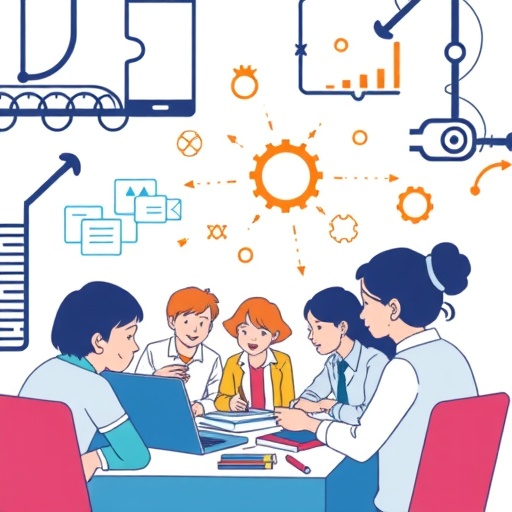
In a groundbreaking study poised to reshape the landscape of elementary education, researchers have delved deeply into the integration of engineering concepts within teacher preparation programs. The investigation, led by Kidd, Rhemer, Gutierrez, and their colleagues, explores the impact of deliberately teaching engineering principles to beginning elementary preservice teachers. Their findings reveal significant enhancements not only in these future educators’ engineering-related knowledge but also in their attitudes and beliefs regarding the discipline—a crucial factor in how they will subsequently engage their young students with STEM subjects.
At the heart of this research lies a vital pedagogical challenge: how to effectively embed engineering education within the broader context of elementary teacher training. Elementary educators frequently serve as the first gateway to formal STEM learning for children. However, many preservice teachers enter their programs with limited exposure to engineering concepts and often carry apprehensions about teaching technology and engineering subjects. Addressing this gap, the researchers meticulously designed an intervention aimed at bolstering both the content knowledge and self-efficacy of these teachers before they even enter classroom environments.
The study employs a comprehensive instructional design, emphasizing hands-on, inquiry-based learning methodologies drawn from authentic engineering practices. Rather than treating engineering as an ancillary topic, the program situates engineering as an integral, interdisciplinary approach closely linked with science and mathematics. Through deliberate inclusion of engineering design challenges, computational thinking exercises, and collaborative problem solving, preservice teachers gain a robust conceptual framework. This immersive approach prepares them not only intellectually but also psychologically to confidently impart engineering to young learners.
Underlying the success of the intervention is the deliberate alignment of engineering content with education theory and practice. For example, the teachers engage with engineering design processes that involve defining problems, generating solutions, testing prototypes, and optimizing performance. These steps mirror the scientific method and similarly nurture critical thinking and creativity. By facilitating mastery experiences in engineering, participants develop a stronger sense of competence, which is foundational for educators to possess positive beliefs about integrating STEM into early education.
Measurement of impact involved rigorous assessment instruments capturing nuanced shifts in knowledge and beliefs. The preservice teachers exhibited statistically significant gains in their understanding of core engineering concepts, such as systems thinking, structural stability, and materials science, as well as enhanced appreciation for engineering’s societal relevance. Crucially, attitudinal surveys documented improvements in confidence and motivation to implement engineering activities, attributes known to predict long-term instructional practices. This dual focus on cognitive and affective domains establishes a comprehensive profile of teacher readiness.
Beyond the immediate results, this research holds profound implications for policy and curriculum development in teacher education. The findings suggest that early and explicit instruction in engineering can cultivate a more technologically literate cohort of educators, who are better equipped to dismantle barriers to STEM access for diverse student populations. As the demand for STEM-proficient citizens grows globally, such foundational improvements in teacher preparation become imperative for sustainable educational reform.
Moreover, this study adds to a growing recognition of engineering as a distinct yet complementary STEM discipline that can invigorate elementary education. Unlike traditional science curricula which lean heavily on content memorization, engineering education emphasizes design thinking and real-world problem solving. Introducing these approaches early creates fertile ground for nurturing curiosity, resilience, and innovation skills among children, ultimately contributing to a more dynamic and inclusive STEM ecosystem.
One particularly innovative aspect of the approach described by Kidd and colleagues involves the use of cross-disciplinary projects that require preservice teachers to integrate concepts from biology, physics, and environmental science into engineering design tasks. For example, designing water filtration systems or simple machines offers tangible, context-rich opportunities to apply theoretical knowledge. This method not only strengthens content understanding but also models pedagogical strategies for engaging diverse learning styles and promoting collaborative teamwork.
Integrating engineering into elementary education also helps counteract pervasive stereotypes about who can succeed in STEM fields. The intervention described encourages preservice teachers to reflect critically on their own implicit biases and cultural preconceptions regarding engineering. Through guided discussions and reflective journaling, participants develop a more inclusive and growth-oriented mindset, which is essential for fostering equitable learning environments. Equipping teachers in this way is a key lever for broadening participation in STEM from the earliest grades.
While the benefits of the intervention are clear, the researchers also highlight challenges and future directions. Scaling such programs across diverse teacher education institutions will require systemic support, including professional development for faculty, resource allocation, and ongoing research to fine-tune curricular elements. Additionally, longitudinal studies tracking teacher practices after program completion would shed light on the sustained impact of enhanced engineering preparation on student outcomes.
Technological tools featured in the intervention further distinguish this work, with the incorporation of digital simulations, CAD software, and maker kits serving as contemporary pathways for experiential learning. These resources bridge the gap between abstract principles and hands-on application, engaging preservice teachers in multimodal learning that mirrors modern engineering workplaces. The effective deployment of such technology showcases the potential for integrating digital literacy into STEM pedagogy at the earliest instructional stages.
In synthesis, the research conducted by Kidd, Rhemer, Gutierrez, and their team represents a critical advance in understanding how to elevate engineering education within elementary teacher preparation. Their multifaceted approach, combining rigorous content instruction, psychological empowerment, and reflective practice, creates a transformative learning experience. This not only prepares teachers to confidently introduce engineering concepts, but also positions them as catalysts for cultivating the next generation of innovative thinkers and problem solvers.
As educational stakeholders aim to close equity gaps and meet evolving workforce demands, such insights have profound significance. The groundwork laid by this study provides a scalable blueprint for integrating engineering into early education foundations, ultimately helping to embed engineering fluency in wider society. Future educators armed with this knowledge and positive disposition hold the promise of inspiring young minds to explore, invent, and thrive amid a rapidly changing technological landscape.
In conclusion, the evidence presented underscores a pivotal shift in elementary STEM education philosophy. Engineering is no longer relegated to specialized tracks but is increasingly recognized as core to developing essential 21st-century skills. The deliberate targeting of preservice teachers’ knowledge and beliefs ensures that this shift receives strong instructional support from the very start of teachers’ careers. By fostering early positive experiences with engineering education among educators, the pathway opens for sustained student engagement and achievement in STEM fields.
This study affirms that equitable and effective STEM education begins with the preparation of confident and competent teachers ready to embrace engineering. The research offers a compelling mandate for policymakers, curriculum developers, and teacher educators to prioritize such initiatives. Doing so will help secure a future workforce equipped not only with technical capabilities but also with creativity, critical thinking, and a commitment to solving real-world problems—hallmarks of true engineering excellence.
Cite Scienmag News
Denise Maddox. (August 2, 2025). Boosting Future Teachers’ Engineering Knowledge and Beliefs. Scienmag. https://scienmag.com/boosting-future-teachers-engineering-knowledge-and-beliefs/
Denise Maddox. "Boosting Future Teachers’ Engineering Knowledge and Beliefs." Scienmag, 2 August 2025, https://scienmag.com/boosting-future-teachers-engineering-knowledge-and-beliefs/. Accessed 4 September 2026.
Denise Maddox. "Boosting Future Teachers’ Engineering Knowledge and Beliefs." Scienmag. August 2, 2025. https://scienmag.com/boosting-future-teachers-engineering-knowledge-and-beliefs/


