


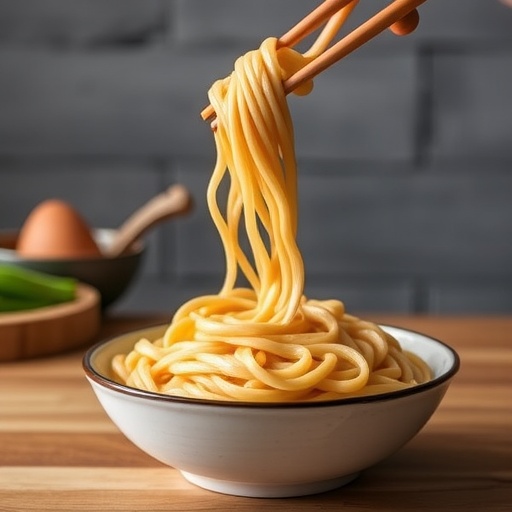
In the intricate world of culinary science, the oxidative stability of deep-fried foods emerges as a crucial determinant of both nutritional value and sensory appeal. Recently, a groundbreaking study led by Kim, S., Hwang, H., Kim, J., and colleagues has shed new light on how antioxidants, when incorporated either into dough or frying oil, influence the oxidative integrity of deep-fat fried noodles. This research, published in the renowned journal Food Science and Biotechnology in 2025, delves into the complex chemical interactions that dictate lipid oxidation during frying—a phenomenon that affects food safety, shelf life, and consumer health.
Frying is a popular cooking method worldwide, renowned for imparting crispy textures and rich flavors. However, the process instigates oxidative degradation of lipids, which not only deteriorates the food’s sensory qualities but also leads to the formation of potentially harmful compounds such as aldehydes and free radicals. These compounds have been implicated in various health risks, including inflammation and chronic diseases. Therefore, improving the oxidative stability of fried foods has become a focal point in food science innovation.
The study at hand uniquely examines the dual approach of antioxidant addition: embedding antioxidants within the dough matrix versus fortifying the frying oil with these protective agents. Traditionally, antioxidants like tocopherols, ascorbic acid derivatives, and natural polyphenols have been used to retard oxidation, but their effective application in frying processes remains challenged by thermal degradation and migration dynamics between food components and frying media.
Using sophisticated analytical techniques, the researchers meticulously measured peroxide values, conjugated dienes, and carbonyl content—key markers indicative of the extent of lipid oxidation in fried noodles. The data revealed that antioxidant incorporation directly into the dough prior to frying significantly enhanced oxidative stability compared to antioxidant addition solely to frying oil. This suggests that antioxidants embedded in the food matrix are more resilient to thermal breakdown and more effective in quenching lipid radicals as they form.
Furthermore, the paper discusses the implications of antioxidant localization regarding their interaction with pro-oxidant elements. In oil, antioxidants face a hostile environment characterized by elevated temperatures and oxygen exposure, which can rapidly degrade these molecules. Conversely, within the dough, antioxidants are sheltered to some extent by the starch-protein matrix, allowing sustained antioxidative activity during the frying process.
An intriguing aspect of the research is the examination of frying oil degradation after sequential frying cycles. Repeated use of frying oil is common in commercial settings to maximize resources, but leads to acceleration of deleterious oxidation and polymerization reactions. The study carefully tracked how the presence of antioxidants, whether in oil or dough, mitigated progressive oil deterioration, thereby extending frying oil life and indirectly protecting food quality.
Beyond chemical parameters, the investigation also evaluated sensory attributes such as taste, aroma, and texture of the fried noodles. The antioxidant-treated samples, particularly those with antioxidants in the dough, scored higher in sensory acceptance, indicating that oxidative stabilization is integrally linked to consumer-perceptible quality. This finding highlights how biochemical processes intertwine with organoleptic factors in determining food desirability.
Delving deeper, the paper explores the mechanistic pathways through which antioxidants function under high-temperature frying conditions. The authors elaborate on free radical scavenging capabilities, metal chelation properties, and the interruption of chain-propagation steps in lipid peroxidation. They also address the impact of antioxidant molecular structure on thermodynamic stability and efficacy, identifying compounds with specific chemical configurations that confer enhanced resistance to thermal degradation.
The pragmatic dimensions of this research resonate strongly within the food industry. Commercial fried noodle manufacturers often contend with balancing cost-efficiency and product quality. Incorporating antioxidants into dough formulations might represent a strategic innovation that minimizes reliance on high-quality frying oils, which are more expensive and require frequent replacement. This method also aligns with clean-label trends by potentially allowing the use of natural antioxidants sourced from plant extracts.
Moreover, the study underscores environmental benefits associated with antioxidant usage in frying processes. By extending frying oil lifespan and reducing the generation of toxic oxidative byproducts, this approach could decrease waste and lessen the ecological footprint of mass frying operations—a growing concern amid global sustainability agendas.
The comprehensive methodology employed in this work incorporates both conventional and cutting-edge analytic techniques, including spectrophotometric assays, chromatography, and electron spin resonance spectroscopy. These tools afforded precise quantification of oxidative markers and facilitated insight into antioxidant behavior in complex frying matrices.
Importantly, the scientists acknowledged the limitations of their study, noting that the antioxidant efficacy might vary with noodle composition, frying temperature, and duration. They advocate for future investigations encompassing a broader range of antioxidants, diverse food formats, and longer frying cycles to fully elucidate the potential for widespread application.
A forward-looking consideration discussed in the article relates to tailoring antioxidant combinations. Synergistic effects among various antioxidants could amplify protective outcomes beyond what single agents achieve. The research community is thus encouraged to design multiplex formulations optimized for frying conditions, possibly integrating nanoscale delivery systems for targeted release within the food matrix.
This illuminating study resonates beyond academic circles and into everyday kitchens and industrial arenas. It invites a re-examination of conventional frying practices and offers a scientifically grounded pathway toward healthier, longer-lasting, and more sustainable fried foods. The integration of antioxidants, judiciously deployed within dough or frying oil, emerges as a promising lever to mitigate lipid oxidation’s adverse effects that have long challenged the food sector.
As consumer demand intensifies for food items that balance indulgence with nutritional integrity, such innovative research provides a cornerstone for next-generation frying technologies. Through ongoing collaboration across food chemistry, nutrition science, and industrial engineering, the frying process can be fundamentally transformed to align with modern health and environmental priorities.
In conclusion, Kim and colleagues’ study marks a pivotal advancement in understanding how antioxidant deployment strategies influence oxidative stability in deep-fat fried noodles. This work elevates the discourse on lipid oxidation control and invites a paradigm shift in how frying processes are designed and optimized. It lays the groundwork for subsequent innovations destined to enrich food quality, safety, and sustainability worldwide.
Kim, S., Hwang, H., Kim, J. et al. Antioxidant addition to dough or frying oil: effects on the oxidative stability of deep-fat fried noodles.
Food Sci Biotechnol (2025). https://doi.org/10.1007/s10068-025-01943-7
Cite Scienmag News
Daisy Hatcher. (August 6, 2025). Boosting Fry Stability: Antioxidants in Noodles Oil. Scienmag. https://scienmag.com/boosting-fry-stability-antioxidants-in-noodles-oil/
Daisy Hatcher. "Boosting Fry Stability: Antioxidants in Noodles Oil." Scienmag, 6 August 2025, https://scienmag.com/boosting-fry-stability-antioxidants-in-noodles-oil/. Accessed 4 September 2026.
Daisy Hatcher. "Boosting Fry Stability: Antioxidants in Noodles Oil." Scienmag. August 6, 2025. https://scienmag.com/boosting-fry-stability-antioxidants-in-noodles-oil/


