


A simple blood test for muscle aging may be one step closer to reality. A new cross-sectional study from China suggests that two circulating blood vessel growth signals — vascular endothelial growth factor, or VEGF, and angiopoietin-1, known as ANGPT1 — are markedly lower in older adults with sarcopenia, the progressive loss of skeletal muscle mass and strength that erodes mobility and independence in later life. The research, published in Frontiers in Medicine, examined 471 older patients admitted to Nanyang Central Hospital in Henan province between May 2019 and May 2024, and found that those with the weakest grip strength and least muscle mass carried the lowest concentrations of these angiogenic markers in their blood.
Sarcopenia is one of the quiet epidemics of an aging world. It is diagnosed when both muscle strength and muscle quantity fall below defined thresholds, and it predicts falls, fractures, hospitalization, and death. Yet the biology behind it remains only partly understood. Most research has focused on neuromuscular decline, protein metabolism, chronic inflammation, and inactivity. The new study turns attention to a less obvious suspect: the network of tiny blood vessels that feeds muscle tissue, and the molecular signals that build and maintain that network.
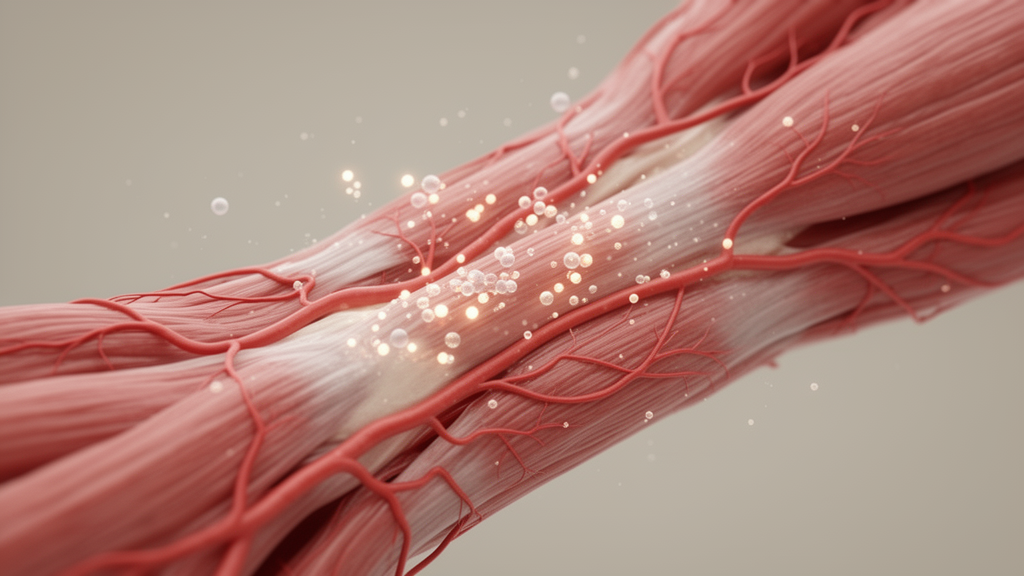
Angiogenesis — the sprouting of new capillaries from existing vessels — is essential to muscle health. Every muscle fiber depends on a dense microcirculation to deliver oxygen, glucose, amino acids, and hormones, and to clear metabolic waste. When a muscle is injured, new vessel formation is one of the earliest events in repair, preceding the regeneration of the muscle fibers themselves. As people age, capillary density in skeletal muscle falls, a process called capillary rarefaction, and the decline is most pronounced around the fast-twitch type II fibers that sarcopenia strips away first. Human biopsy studies have linked this vascular thinning directly to weaker grip, smaller appendicular muscle mass, and poorer physical performance.
The research team, led by Hui Li and Feng Jia of Nanyang Central Hospital together with colleagues at the Seventh People’s Hospital of Zhengzhou, measured three serum angiogenesis markers using enzyme-linked immunosorbent assays: VEGF, the master driver of new vessel growth; ANGPT1, which stabilizes and matures vessels; and ANGPT2, which antagonizes ANGPT1 and promotes vessel remodeling. Fasting blood samples were drawn the morning after admission, processed under standardized conditions, stored at minus 80 degrees Celsius, and assayed in duplicate by laboratory staff blinded to each patient’s clinical status. Quality controls kept measurement variability below 10 percent within assays and below 15 percent between batches spread across five years.
Sarcopenia was defined according to the Asian Working Group for Sarcopenia criteria, requiring both reduced hand grip strength and reduced appendicular skeletal muscle mass. Grip was tested with a calibrated dynamometer in a standardized seated posture, three trials per hand, with the best value recorded. Muscle mass was estimated by multi-frequency bioimpedance analysis using an eight-frequency device that measured each limb separately, performed after an overnight fast with strict controls for hydration status. Of the 471 participants, 68 — or 14.44 percent — met the criteria for sarcopenia.
The results were striking in their consistency. Patients with sarcopenia had significantly lower VEGF — an average of 116.95 picograms per milliliter versus 138.60 in those without the condition — and dramatically lower ANGPT1, at 23.68 nanograms per milliliter versus 34.15. ANGPT2, by contrast, showed no meaningful difference. In regression models adjusted first for age, sex, and body mass index, and then further for comorbidity burden, hemoglobin, albumin, smoking, alcohol use, and hypertension, VEGF remained positively correlated with both grip strength and muscle mass, while ANGPT1 held its association with muscle mass and, in the fully adjusted model, with grip strength as well.
The risk statistics are the headline numbers. Using receiver operating characteristic analysis, the team derived cutoff values — VEGF at or below 102.55 picograms per milliliter and ANGPT1 at or below 19.47 nanograms per milliliter — and validated them with ten-fold cross-validation to guard against overestimation. In fully adjusted logistic models, low VEGF was associated with roughly a threefold higher odds of sarcopenia (odds ratio 3.360), and low ANGPT1 with even greater odds (3.709, p < 0.001). Among patients with low ANGPT1, more than a quarter — 25.55 percent — had sarcopenia, compared with fewer than 10 percent of those with normal levels. Adding either marker to a base clinical model built from age, sex, BMI, comorbidities, and routine labs significantly improved the model’s statistical fit, with ANGPT1 delivering the largest gain.
Why would vessel-building signals track so closely with failing muscle? The authors propose a dual-hit mechanism rooted in the aging muscle’s microenvironment. Endothelial cells and satellite cells — the stem cells that rebuild muscle — sit side by side and exchange chemical messages. VEGF acts directly on satellite cell receptors to trigger their activation, proliferation, and migration after injury; ANGPT1 then supports their survival and coordinates their differentiation and fusion into mature, multinucleated muscle fibers. When circulating VEGF and ANGPT1 both fall, the regenerative sequence is disrupted at both ends: the vascular supply shrinks and the stem cell pipeline stalls, leaving chronic micro-injuries to heal poorly — the hallmark of sarcopenic muscle. Animal work supports the plausibility: VEGF gene delivery improves muscle ischemia and repair in rodents, and ANGPT1 enhances regeneration in mice, while exercise and even massage raise VEGF expression in skeletal muscle.
The study’s limitations deserve equal billing. It is cross-sectional, so it cannot say whether low angiogenic markers cause muscle loss or simply reflect it — reverse causation remains a real possibility. Serum VEGF and ANGPT1 are systemic signals, not direct measurements of the muscle microenvironment, and their blood levels can be swayed by subclinical disease, inflammation, nutrition, and activity. The cohort was drawn from a single hospital’s gastroenterology and general surgery service rather than the community, and physical performance testing was unavailable, preventing severity grading. The diagnostic discrimination of the markers alone was modest — area under the curve of 0.641 for VEGF and 0.668 for ANGPT1 — meaning they add incremental value to clinical assessment rather than replacing it. ANGPT2, notably, contributed nothing once confounders were accounted for.
Even with those caveats, the findings open an intriguing therapeutic window. If the vascular niche truly governs the regenerative failure of aging muscle, then interventions that boost angiogenesis — exercise training being the most proven, with hypoxic training, pneumatic compression, and gene therapy as research frontiers — might slow or partially reverse sarcopenia. And if larger, longitudinal, community-based studies confirm that a routine blood draw can flag failing muscle years before a fall, sarcopenia screening could shift from the grip dynamometer to the phlebotomy tray. For now, the message is measured but provocative: the health of aging muscles may be written, in part, in the chemistry of their blood supply.
Subject of Research: Associations between serum angiogenesis markers VEGF and ANGPT1 and sarcopenia in older adults
Article Title: Relationships between serum angiogenesis markers and sarcopenia: a cross-sectional study
Article References: Li, H., Liu, H., Liu, Y., Shi, W., Shi, L., & Jia, F. (2026). Relationships between serum angiogenesis markers and sarcopenia: a cross-sectional study. Frontiers in Medicine, 13, Article 1922045. https://doi.org/10.3389/fmed.2026.1922045
Image Credits: AI Generated
DOI: 10.3389/fmed.2026.1922045
Keywords: sarcopenia, angiogenesis, VEGF, ANGPT1, aging, muscle loss, blood vessels, biomarkers, geriatric medicine, cross-sectional study, hand grip strength, muscle regeneration
Cite Scienmag News
Beatrice Stafford. (October 17, 2026). Blood Vessel Growth Signals May Reveal Aging Muscles in Decline. Scienmag. https://scienmag.com/blood-vessel-growth-signals-may-reveal-aging-muscles-in-decline/
Beatrice Stafford. "Blood Vessel Growth Signals May Reveal Aging Muscles in Decline." Scienmag, 17 October 2026, https://scienmag.com/blood-vessel-growth-signals-may-reveal-aging-muscles-in-decline/. Accessed 17 October 2026.
Beatrice Stafford. "Blood Vessel Growth Signals May Reveal Aging Muscles in Decline." Scienmag. October 17, 2026. https://scienmag.com/blood-vessel-growth-signals-may-reveal-aging-muscles-in-decline/


