


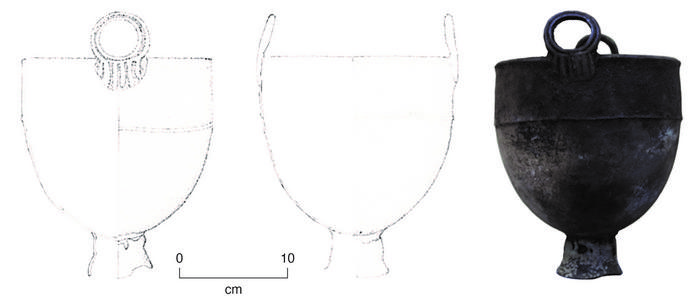
Bronze cauldrons were used by the inhabitants of the Mongolian steppe around 2,700 years ago to process animal blood and milk. This is shown by a protein analysis of archaeological finds from this period.

Credit: Jamsranjav Bayarsaikhan and Bruce Worden
Bronze cauldrons were used by the inhabitants of the Mongolian steppe around 2,700 years ago to process animal blood and milk. This is shown by a protein analysis of archaeological finds from this period.
Scattered across the Eurasian steppe, archaeologists repeatedly come across metal cauldrons from the Bronze Age during excavations. However, it was previously unclear exactly what they were used for. Now, an international study led by researchers at the University of Basel and published in the journal Scientific Reports reveals their secret: Mongolian nomads collected blood from slaughtered animals, presumably for sausage production, in these cauldrons and may have also fermented milk in them, mainly from yaks.
The research team led by Dr. Shevan Wilkin from the University of Basel carried out extensive protein analyses on two metal cauldrons that were discovered in 2019 by herders in northern Mongolia, along with other artifacts. According to radiocarbon dating, the cauldrons date back to the late Bronze Age, i.e. they were in use around 2,700 years ago.
Animal blood in the diet has a long tradition
In the cauldrons, the researchers identified blood remains from ruminants, mainly sheep and goats. “Various historical accounts of the steppe dwellers claim that they regularly drank blood,” explains Dr. Bryan Miller from the University of Michigan, USA, co-author of the study. The new findings now provide a clearer idea of how blood may have been incorporated into the diet of the steppe dwellers.
The researchers suspect that blood was collected in the cauldrons during slaughtering to make blood sausages – a practice similar to contemporary culinary customs in Mongolia. “These parallels with modern times, together with well-founded historical accounts of diet and slaughtering practices in the region, suggest that the processing of blood was a traditional part of Mongolia’s food culture,” says study leader Shevan Wilkin. Sausage production was also an important preservation method for other steppe peoples.
Yaks domesticated earlier than thought
In addition to blood proteins, the cauldrons also contained traces of milk, particularly from domestic cattle and yaks. “This shows that yaks were domesticated and milked in Mongolia much earlier than previously assumed,” notes Wilkin. The milk might have been fermented in the cauldrons in order to preserve it in the form of yogurt, or it might have been an ingredient in the production of sausages.
“Our discoveries offer insights into the traditions and diet of Bronze Age nomads and shed light on the diverse culinary methods of ancient civilizations,” explains Wilkin. In addition to the Universities of Basel and Michigan, experts from the Max Planck Institute for Geoanthropology in Jena and the National Museum of Mongolia were also involved in the research project.
Journal
Scientific Reports
Article Title
Cauldrons of Bronze Age nomads reveals 2700 year old yak milk and the deep antiquity of food preparation techniques
Cite Scienmag News
Courtney Benton. (June 5, 2024). Blood sausages and yak milk: Bronze Age cuisine of Mongolian nomads unveiled. Scienmag. https://scienmag.com/blood-sausages-and-yak-milk-bronze-age-cuisine-of-mongolian-nomads-unveiled/
Courtney Benton. "Blood sausages and yak milk: Bronze Age cuisine of Mongolian nomads unveiled." Scienmag, 5 June 2024, https://scienmag.com/blood-sausages-and-yak-milk-bronze-age-cuisine-of-mongolian-nomads-unveiled/. Accessed 4 September 2026.
Courtney Benton. "Blood sausages and yak milk: Bronze Age cuisine of Mongolian nomads unveiled." Scienmag. June 5, 2024. https://scienmag.com/blood-sausages-and-yak-milk-bronze-age-cuisine-of-mongolian-nomads-unveiled/

