


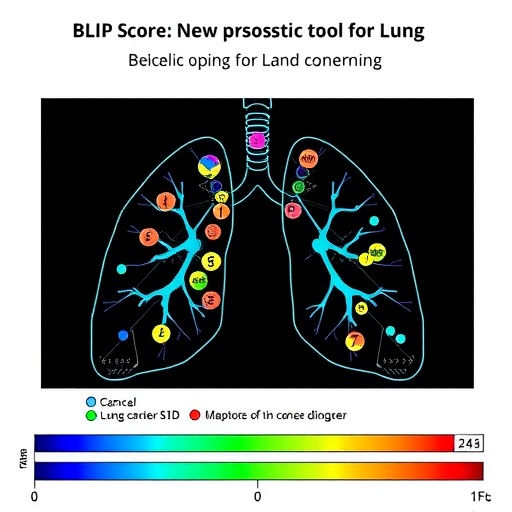
In a groundbreaking development in the treatment and prognostication of non-small cell lung cancer (NSCLC) patients with brain metastases, researchers have introduced the Brain-Lung Immunotherapy Prognostic (BLIP) Score. This novel prognostic tool promises to significantly enhance the predictive accuracy regarding patient outcomes, thereby optimizing clinical decision-making in one of the most challenging oncological circumstances. The BLIP Score emerges at a critical juncture where precision medicine meets the urgent need for better management strategies in NSCLC complicated by cerebral dissemination.
Brain metastases present a dire complication in lung cancer, occurring in a substantial fraction of advanced NSCLC cases, and wielding profound implications for prognosis and treatment pathways. Historically, prognostication in this cohort has faced limitations due to heterogeneous patient populations and the multifactorial nature of disease progression. Conventional scoring systems often fail to incorporate the latest insights derived from immunotherapy responses, which have transformed the therapeutic landscape over recent years. The BLIP Score addresses these gaps through an innovative integration of clinical, radiological, and immunological parameters.
The cornerstone of the BLIP Score is its incorporation of immunotherapy-specific biomarkers alongside established clinical variables. Immunotherapy, leveraging immune checkpoint inhibitors to unleash antitumor immunity, has revolutionized NSCLC treatment but introduced new complexities in predicting therapeutic benefit, especially when the brain is involved. The researchers meticulously analyzed cohorts of NSCLC patients with brain metastases treated with immunotherapy, applying machine learning algorithms to distill the most prognostically relevant variables into a composite score.
Technically, the BLIP Score utilizes a multidimensional approach, combining tumor mutational burden, programmed death-ligand 1 (PD-L1) expression, intracranial lesion burden, and systemic inflammatory markers, among others. This synthesis produces a quantifiable index that reflects both tumor biology and host immune competence. The algorithm’s robustness stems from rigorous internal validation and external cohort comparisons, demonstrating superior prognostic discrimination over existing models such as the Lung-molGraded Prognostic Assessment (Lung-molGPA).
Clinicians stand to benefit immensely from this advancement, as the BLIP Score supports stratification of NSCLC patients into distinct risk categories with differential survival trajectories. This stratification informs nuanced clinical decisions, such as tailoring immunotherapy regimens, considering adjunctive radiotherapy, or altering surveillance intensity. Beyond individual patient management, the BLIP Score holds promise for refining clinical trial designs by enabling more precise patient selection and endpoint definition, ultimately advancing therapeutic innovation.
From a translational perspective, this work exemplifies the critical interface between bioinformatics, immuno-oncology, and neuro-oncology. The integration of high-dimensional data and sophisticated statistical modeling embodies a paradigm shift, moving beyond conventional clinical judgment to evidence-based, algorithm-guided prognostication. Moreover, it underscores the importance of personalized medicine in managing complex metastatic disease, particularly in environments where immune dynamics play a pivotal role.
The development process involved extensive collaborations across multidisciplinary teams, encompassing oncologists, immunologists, radiologists, and computational biologists. Such a concerted effort was essential to capture the multifaceted disease biology and validate the score across diverse patient subsets, ensuring both clinical relevance and generalizability. The underlying data repositories included longitudinal clinical records, imaging databases, and molecular profiling, reflecting the comprehensive nature of the analytical pipeline.
In mechanistic terms, the BLIP Score reflects the interplay between the systemic immune environment and the unique immunosuppressive microenvironment of brain metastases. Tumor cells in the brain exhibit distinct molecular signatures and immune evasion strategies, complicating therapeutic interventions. By quantitatively integrating these variables, the BLIP Score provides a mechanistically informed prediction that aligns with emerging insights into tumor-immune interactions within the central nervous system.
Early application of the BLIP Score in clinical settings has begun to reveal its practical utility. Case studies highlight improved prognostic accuracy enabling better patient counseling and expectation management. Importantly, physicians report that the tool enhances confidence in treatment planning, particularly when contemplating aggressive versus palliative strategies in complex scenarios where therapeutic risks must be balanced carefully against potential benefits.
The impact of introducing such a prognostic tool extends beyond individual patient outcomes. Health systems may leverage the BLIP Score to optimize resource allocation, reducing unnecessary interventions in patients unlikely to benefit and focusing intensive therapies on those with favorable prognoses. This systemic effect could contribute to improved healthcare efficiency and cost-effectiveness, aligning clinical practice with the principles of value-based care.
Looking forward, continuous refinement and adaptive learning are anticipated as new data accrue and therapeutic modalities evolve. Integration with real-world data analytics and artificial intelligence-driven platforms may further enhance the predictive power and applicability of the score. Additionally, the framework established by the BLIP Score could inspire analogous models across varied tumor types where brain metastases complicate clinical management.
Crucially, the BLIP Score also opens avenues for mechanistically guided therapeutic development. By delineating prognostic groups with distinct immune profiles, it lays the foundation for targeted interventions that modulate the tumor-immune interface within the brain. Such strategies could include combinatorial immunotherapy regimens, novel immune modulators, or precision-targeted radiotherapy protocols designed to synergize with immune effects.
As the oncology community embraces this innovation, it is worth reflecting on the paradigm shift represented by the BLIP Score. It embodies the transition from population-level statistics to individualized, biology-informed prognostication — a critical step for improving both survival and quality of life for patients facing the formidable diagnosis of NSCLC with brain metastases. The integration of immunotherapy biomarkers within a clinically accessible tool exemplifies the potential of precision oncology to transform outcomes in real-world settings.
In conclusion, the introduction of the Brain-Lung Immunotherapy Prognostic (BLIP) Score marks a milestone in neuro-oncology and lung cancer research. It emerges as a beacon for personalized patient care, embodying the convergence of immunology, oncology, and computational science to address one of the most formidable clinical challenges. This innovation promises to resonate widely, shaping future research, clinical practice, and ultimately, patient survival and wellbeing in the era of advanced lung cancer treatment.
Cite Scienmag News
Nathaniel Bowman. (May 20, 2026). BLIP Score: New Prognostic Tool for Lung Cancer. Scienmag. https://scienmag.com/blip-score-new-prognostic-tool-for-lung-cancer/
Nathaniel Bowman. "BLIP Score: New Prognostic Tool for Lung Cancer." Scienmag, 20 May 2026, https://scienmag.com/blip-score-new-prognostic-tool-for-lung-cancer/. Accessed 3 September 2026.
Nathaniel Bowman. "BLIP Score: New Prognostic Tool for Lung Cancer." Scienmag. May 20, 2026. https://scienmag.com/blip-score-new-prognostic-tool-for-lung-cancer/


