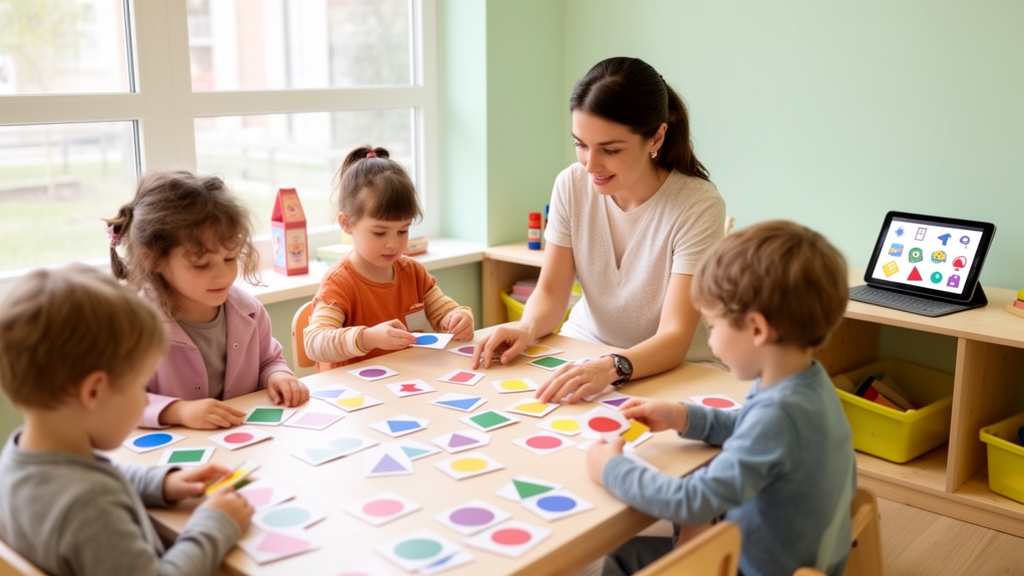
A seven-week program combining educational apps with analog games was associated with a preliminary group difference in one working-memory updating measure among preschoolers in disadvantaged schools in northern Italy. The ShareFUN intervention was widely welcomed by children and teachers, but the analysis found adjusted evidence for only one direct cognitive outcome and a baseline-dependent pattern in teacher-rated inhibition. Apparent advantages in motor inhibition, other executive functions and early learning skills did not survive correction for multiple testing.
The quasi-experimental study involved 76 children with typical development across 11 classes in four preschools, with two children with special educational needs analyzed separately. The researchers recruited participants during the 2021–2022 school year, when COVID-19 restrictions prevented them from entering schools and required classroom teachers to deliver the program. Children in experimental classes received ShareFUN as a structured educational activity, while control classes continued their usual planned activities.
Classes were assigned to conditions on a voluntary basis, making this a pre-test–post-test control-group design rather than a randomized trial. However, the control group had lower baseline scores for school behavioral attitude and general cognitive abilities on a questionnaire of early learning prerequisites, so the researchers adjusted post-test analyses for baseline performance. ShareFUN comprised 14 sessions delivered twice a week for seven weeks, usually in groups of about five children.
Each 45–60-minute session combined paper-and-pencil activities, group games and digital exercises on Android tablets. The sequence progressively targeted working-memory capacity, inhibition, shifting and updating. Sessions opened with a collective nursery rhyme and ended with an adult-guided metacognitive reflection in which children were encouraged to think about the strategies they had used.
Children received one puzzle piece after each session, gradually assembling a picture of a sheep by the end of the program. The digital apps offered immediate feedback, and some automatically adjusted task difficulty to a child’s performance. Teachers received preparatory training, video tutorials and a written manual, and they helped adapt activities for children with special educational needs.
The study assessed perceived feasibility and acceptability through several complementary sources. After individual sessions, children used a pictorial three-point scale showing sad, neutral and happy sheep to indicate enjoyment and perceived difficulty. Across the 12 sessions assessed, the highest positive response ranged from 60.00% to 87.88%, while negative responses ranged from 0.00% to 13.33%.
Combining neutral and positive responses produced evaluations of 86.67% to 100%. Teachers described sustained engagement, noting that children often wanted to continue using the apps. They also valued the opportunity to observe children more closely in small groups.
Main practical barriers were absenteeism linked to the pandemic and the need to adjust task demands or response times for children with special educational needs. Because these observations came from participating teachers and children, they support perceived practicality and acceptability rather than independently verified implementation quality or fidelity. Children’s executive functions and working memory were assessed directly through a digital battery containing tasks adapted to preschool play.
“Magic House” measured updating: children watched sequences of three to five animals enter a house and then recalled the final two animals from eight possible choices, yielding a score from 0 to 18. Its internal consistency was high, with Cronbach’s alpha of 0.86. “Basilio the Ghost,” a go/no-go task, measured motor inhibition by requiring children to tap when a ghost appeared but not when other characters did so.
“Mom and Puppies” tested cognitive flexibility through changing sorting rules, while “Evelyn” required children to maintain and then manipulate object sequences in forward or reverse order. Reliability was acceptable or modest for several tasks and low for the hardest version of Evelyn, partly because few preschoolers reached its upper levels. Classroom teachers also completed the Behavior Rating Inventory of Executive Function–Preschool Version and an observational questionnaire covering early learning skills.
The researchers used analysis of covariance, with post-test performance as the outcome, intervention group as a fixed factor and the corresponding baseline score as a covariate. They tested whether relationships between baseline and post-test scores differed by group, retaining significant interactions in the relevant models. P values were then adjusted separately for families of direct cognitive tasks, teacher-rated executive-function subscales and learning-related subscales.
This procedure reduced the risk of treating one of many outcomes as significant by chance, but its conservative nature also lowered statistical power in a modest sample. Because the same teachers delivered the intervention and completed some ratings, their reports could be influenced by expectancy and were treated as complementary evidence rather than independent confirmation of efficacy. After correction, “Magic House” provided the clearest direct finding.
The intervention group’s observed post-test mean was 10.50, compared with 8.15 in the control group, in analyses that controlled for baseline performance. The group effect was F(1,62) = 8.99, with an unadjusted p value of 0.004, a Bonferroni-adjusted p value of 0.028 and a partial eta squared of 0.127. The authors interpreted this as preliminary, outcome-specific evidence of a group difference in working-memory updating, not proof that the program broadly improved cognition.
The measure was assessed with a single task, and the design cannot establish that ShareFUN caused the difference. An unadjusted advantage in the number of distractor errors on the inhibition task did not remain significant after correction, and no other direct measure met the adjusted criterion. Teacher ratings produced a more complex pattern.
For the inhibition subscale, the relationship between baseline and post-test scores differed by group, and the interaction remained significant after correction: F(1,60) = 9.86, adjusted p = 0.015, with partial eta squared of 0.141. Because this interaction remained in the model, the main group effect was not interpreted as a uniform advantage. A similar interaction for shifting did not survive adjustment, and an initially significant group difference in teacher-rated working memory also became non-significant after correction.
Possible advantages in fine motor skills and a weaker pattern in metacognition were likewise unconfirmed. Thus, the adjusted analyses did not establish broad effects on executive functions or learning prerequisites beyond the specific updating result and the baseline-dependent inhibition pattern. The inhibition interaction also requires clarification before it can be given a straightforward substantive interpretation.
The two children with special educational needs showed heterogeneous changes. One child’s direct performance did not differ significantly from the baseline distribution of typically developing classmates at either assessment, while several teacher-rated learning outcomes moved closer to that reference range but other differences persisted. The second child moved closer to the reference distribution on several direct and learning-related measures, yet remained significantly different on inhibition, teacher-rated working memory, planning and general cognitive abilities; a new difference also appeared for school behavioral attitude.
These comparisons used the baseline distribution of typically developing children as a reference at both assessment points and were explicitly exploratory. With only two cases, no untreated comparison group and no way to separate maturation from practice or measurement variability, the researchers did not attribute the changes conclusively to ShareFUN. The cases nevertheless show how teachers adapted activities through measures such as multimodal instructions, extra time and reduced distractions.
The study’s main constraints make firm causal claims inappropriate. Classes volunteered for their conditions, potentially introducing motivation or selection bias, and the analysis treated children as independent observations even though children were nested within classes, schools and small intervention groups. That clustering may have produced overly precise p values.
Teachers knew they were delivering the intervention and also supplied some outcome ratings, while direct assessors could not be fully blinded, creating possibilities for expectancy or assessment bias. The pandemic further constrained implementation and participation, and teachers delivered the activities without independent observation of fidelity. ShareFUN’s open-source materials and teacher-mediated design were perceived as practical in participating preschool settings, but the feasibility data do not constitute an independent verification of implementation quality.
Larger randomized studies, with more classroom clusters, prespecified primary outcomes, independent fidelity checks and blinded or additional informants, are needed to determine whether the blended approach produces durable and wider developmental benefits.
Subject of Research: Quasi-experimental evaluation of a blended app-and-game preschool intervention for executive functions and working memory
Article Title: Enhancing preschoolers' executive functions and working memory through educational apps and analog games. Evidence from the ShareFUN approach in disadvantaged contexts
Article References: Panesi, S., Bandettini, A., & Ferlino, L. (2026). Enhancing preschoolers' executive functions and working memory through educational apps and analog games. Evidence from the ShareFUN approach in disadvantaged contexts. Frontiers in Developmental Psychology, 4, 1910797. https://doi.org/10.3389/fdpys.2026.1910797
Image Credits: AI Generated
DOI: 10.3389/fdpys.2026.1910797
Keywords: preschool cognition, working memory, executive functions, educational apps, analog games, ShareFUN, blended learning, special educational needs, quasi-experimental study, early childhood education, Enhancing, preschoolers'
Cite Scienmag News
Glenn Wilkins. (October 22, 2026). Blended preschool games show preliminary working-memory group difference. Scienmag. https://scienmag.com/blended-preschool-games-show-preliminary-working-memory-group-difference/
Glenn Wilkins. "Blended preschool games show preliminary working-memory group difference." Scienmag, 22 October 2026, https://scienmag.com/blended-preschool-games-show-preliminary-working-memory-group-difference/. Accessed 22 October 2026.
Glenn Wilkins. "Blended preschool games show preliminary working-memory group difference." Scienmag. October 22, 2026. https://scienmag.com/blended-preschool-games-show-preliminary-working-memory-group-difference/