


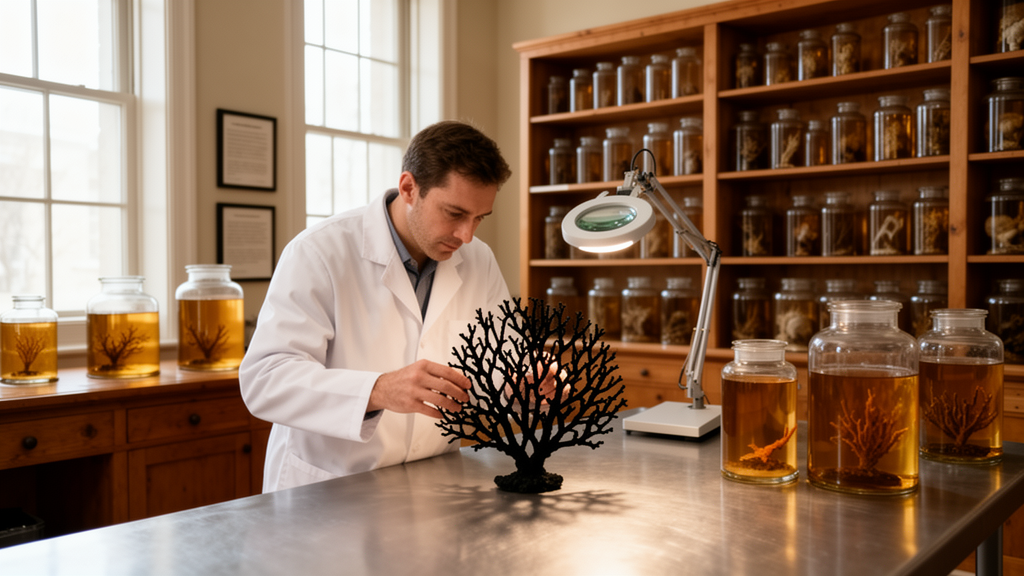
Deep in the storerooms of Naturalis Biodiversity Center in Leiden lies one of the world’s most historically significant collections of black corals, the enigmatic order of cnidarians known scientifically as Antipatharia. A newly published annotated catalogue has now unravelled more than two centuries of collecting history, documenting over 750 specimens representing 118 nominal species, including name-bearing type material for 59 taxa. The work, published in the journal Zoosystematics and Evolution, unifies the formerly separate holdings of the Rijksmuseum van Natuurlijke Historie and the Zoological Museum of Amsterdam, which were merged into Naturalis in 2012.
Black corals are among the most striking yet poorly understood groups of marine invertebrates. Despite their common name, living colonies display a remarkable range of colours, and their flexible, chitinous skeletons have been prized for jewellery for centuries. Taxonomically, however, the group has long suffered from fragmented documentation, with type specimens scattered across institutions, historical labels of variable quality, and nomenclatural practices that have shifted dramatically since the nineteenth century. Type specimens, the physical anchors of scientific names, are the single most important resource for resolving questions about what a given species actually is.
The newly compiled catalogue is the product of a systematic re-inventory that began in 2024. Access to the material had been intermittently limited in the years following the 2012 merger, owing to relocation and re-housing of the collections, the retirement of the former collection manager, and later the COVID-19 pandemic. As a result, systematic curation and verification of the Antipatharia holdings were delayed for over a decade. The recent reorganisation enabled researchers to locate and examine every relevant specimen, verifying catalogue numbers, type status, preservation condition and associated documentation.
The collection’s historical depth is extraordinary. The oldest material dates to the early nineteenth century and includes specimens gathered by pioneering collectors such as Philipp Franz Balthasar von Siebold, Jan Cock Blomhoff, François Joseph Cantraine, Franck van Heukelom, Theodoor Gerard Lidth de Jeude and Dirk Samuel Hoedt. Approximately 80 percent of the specimens are preserved in 70 percent ethanol, while the remainder consists largely of dry-preserved historical material, much of it dating from before 1900. Associated preparations, including glass slides and scanning electron microscope mounts, complement the colonies themselves for some specimens.
The geographic heart of the collection beats in the Indo-Pacific. A major portion of the early holdings originates from the Siboga Expedition of 1899 to 1900, which surveyed Indonesia, Timor and the Philippines and remains one of the most important single sources of antipatharian material anywhere in the world. Subsequent twentieth-century acquisitions derive primarily from expeditions in Indonesian waters, including the Snellius I expedition of 1929 to 1930, the Snellius II expedition of 1966 and the Rumphius Biohistorical Expedition of 1990, as well as surveys in the Caribbean and the eastern Atlantic. Roughly half of the nominal taxa represented by type material in the catalogue originate from Indonesia, spanning numerous genera and encompassing both shallow-water and bathyal species.
A central figure in the collection’s scientific history is the early twentieth-century researcher van Pesch, whose monographic treatments of 1910 and 1914 described numerous new taxa, including species, varieties and subvarieties. Because infraspecific ranks such as varieties and subvarieties are rarely used in modern taxonomy, the nomenclatural status and interpretation of several of these names require clarification on a case-by-case basis. The catalogue carefully documents these historical names without proposing any new taxonomic or nomenclatural acts, noting instead where the International Code of Zoological Nomenclature, specifically Article 45.6.4, may allow pre-1961 variety names to be deemed subspecific depending on the original author’s intent.
The re-inventory also revealed the complexities of specimen exchange between institutions. Fragments of type specimens, sometimes called schizotypes, were donated to or received from other museums, particularly the National Museum of Natural History of the Smithsonian Institution in Washington. In several cases, original colonies described in early works are not preserved as complete specimens at Naturalis, although fragments or associated material are present. The authors stress that the absence of an original colony should not be interpreted as loss of the type material; rather, it reflects historical collecting, exchange and curation practices whereby type material or portions thereof were distributed amongst institutions. All specimens listed in van Soest’s 1977 catalogue of the former Zoological Museum Amsterdam were located during the re-inventory, and additional type specimens have since been identified.
Among the most intriguing findings are specimens bearing historical labels reading Mus. de Paris, possibly linked to Lamarck’s species described in 1816, such as Antipathes lacerata, Antipathes radians and Antipathes scoparia. Their presence in Leiden may be connected to a remarkable episode of European history. During the French Occupation of the Netherlands, most of the Kabinet des Stadhouders collection was taken to France in 1795. After the invasion, the Leiden professor S.J. Brugmans was sent to Paris to retrieve these collections, encountering strong resistance from Lamarck himself, who was then working on his Histoire naturelle des Animaux sans vertèbres. The return of the collections was ultimately negotiated with the assistance of Alexander von Humboldt, but Brugmans came back with a collection of mostly duplicates from the Paris Museum. The Lamarck-era specimens now in Leiden may represent original material, though their status cannot be confirmed without archival investigation, and recent examination has identified several of them as octocorals or gorgonians rather than true black corals.
Methodologically, the catalogue follows the World Register of Marine Species for currently accepted names, listing each species under its accepted name alongside the original combination and publication. Locality and label data were transcribed and standardised, with geographic coordinates converted to decimal degrees, while original labels were retained with the specimens whenever present and newly added labels are clearly distinguishable from historical ones. Where discrepancies between sources were encountered, the most recent revisionary treatment or prevailing usage was followed, and any remaining uncertainty is explicitly noted. The authors also caution that specimens labelled as neotype in the collection without a documented published designation should be treated with care until the relevant nomenclatural acts are confirmed, distinguishing between published designations and internal collection annotations.
The significance of this work extends well beyond Leiden. By providing verified and accessible type data, the catalogue supports taxonomic revision, nomenclatural stability and future comparative research on a group whose deep-water representatives are increasingly encountered in seamount and abyssal surveys. The collection combines a historically important Coral Triangle core with a broader modern comparative framework built through later revisionary work, particularly the series of revisions by Dennis Opresko, whose deep-water taxa from Palau, Hawaii, the North Pacific seamounts, the Caribbean, the Gulf of Mexico, the eastern Atlantic and southern high-latitude localities are represented by holotype fragments at Naturalis. Ongoing molecular studies may further clarify the status of several ambiguous historical names. All specimen data are accessible through the Naturalis collection data portal, ensuring that this transparent and verifiable account of two centuries of black coral scholarship will serve researchers worldwide for generations to come.
Subject of Research: Annotated catalogue of black coral (Antipatharia) type specimens at Naturalis Biodiversity Center
Article Title: Collections Unravelled: an annotated catalogue of Antipatharia ( Cnidaria , Hexacorallia ) type material in Naturalis Biodiversity Center
Article References: Bakker, P. A. J., & Samimi-Namin, K. (2026). Collections Unravelled: an annotated catalogue of Antipatharia (Cnidaria, Hexacorallia) type material in Naturalis Biodiversity Center. Zoosystematics and Evolution, 102(3), 817-828. https://doi.org/10.3897/zse.102.192821
Image Credits: AI Generated
Keywords: Antipatharia, black corals, type specimens, Naturalis Biodiversity Center, taxonomy, Siboga Expedition, nomenclature, biodiversity collections, Indo-Pacific, Cnidaria, museum curation, Lamarck
Cite Scienmag News
Drew Townsend. (October 17, 2026). Black Coral Treasures: Leiden Catalogue Unlocks 200 Years of Type Specimens. Scienmag. https://scienmag.com/black-coral-treasures-leiden-catalogue-unlocks-200-years-of-type-specimens/
Drew Townsend. "Black Coral Treasures: Leiden Catalogue Unlocks 200 Years of Type Specimens." Scienmag, 17 October 2026, https://scienmag.com/black-coral-treasures-leiden-catalogue-unlocks-200-years-of-type-specimens/. Accessed 17 October 2026.
Drew Townsend. "Black Coral Treasures: Leiden Catalogue Unlocks 200 Years of Type Specimens." Scienmag. October 17, 2026. https://scienmag.com/black-coral-treasures-leiden-catalogue-unlocks-200-years-of-type-specimens/


