


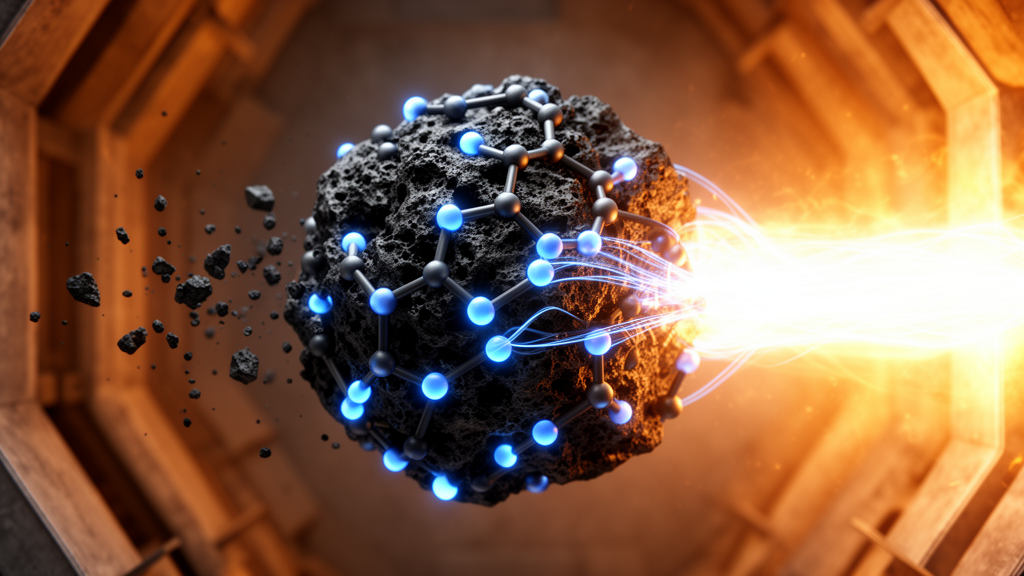
Dissolved black carbon can transfer electrons faster when it is produced at higher pyrolysis temperatures, according to a peer-reviewed experimental study that examined how biomass-derived carbon supports microbial electron exchange. Researchers led by Yufei Wu, Peng Zhang, Zhaofeng Chang and Bo Pan at Kunming University of Science & Technology quantified an apparent heterogeneous electron-transfer rate constant, k₀, for 10 samples derived from rice straw and sawdust pyrolyzed at 200–600 °C. This kinetic measure addresses a limitation of conventional redox testing: electron-donating and electron-accepting capacities reveal how much charge a material can exchange, but not how quickly that exchange occurs.
The team combined cyclic voltammetry and differential pulse voltammetry in a three-electrode system with particle-size measurements, mediated electrochemical experiments, Fourier transform-ion cyclotron resonance mass spectrometry and microbial electrochemical systems containing Shewanella oneidensis MR-1. For rice-straw-derived dissolved black carbon, k₀ increased from (0.54 ± 0.27) × 10⁻⁷ cm s⁻¹ at 200 °C to (1.13 ± 0.73) × 10⁻² cm s⁻¹ at 600 °C. Sawdust-derived material rose from (1.05 ± 0.02) × 10⁻⁴ to (6.18 ± 3.08) × 10⁻² cm s⁻¹ over the same temperature range. Sawdust-derived samples generally had higher k₀ values than rice-straw samples at corresponding temperatures, while smaller average particles were associated with faster apparent diffusion. The rate constant correlated strongly with both diffusion coefficients and electron-exchange capacity.
At pyrolysis temperatures of 400–600 °C, the dissolved black carbon showed greater electron-shuttle ability than natural dissolved organic matter sampled from wetland, soil, river and lake environments. In microbial electrochemical systems, higher-temperature material also produced larger peak and steady currents, and those responses were significantly correlated with log₁₀(k₀), linking the electrochemical kinetic parameter to microbial extracellular electron transfer. Mass-spectrometric profiles indicated that the higher-temperature samples contained greater relative intensities of CHNOS, condensed aromatic and tannin-like compounds, while lignin-like compounds declined. Condensed aromatic and tannin-like molecules were positively associated with k₀, whereas lignin-like molecules were negatively associated with it. Addition tests were consistent with these relationships: tannic acid increased k₀ in low-temperature material, while lignin decreased it in medium-temperature material. The researchers identified redox-active quinone and hydroquinone moieties within aromatic structures as plausible molecular sites for electron donation and acceptance.
The results suggest that dissolved black carbon’s potential to shuttle electrons in soils and waters depends on a combination of redox activity and diffusivity, rather than on total electron-exchange capacity alone. If this behavior carries over to natural conditions, rapidly transferring dissolved carbon could influence microbial metabolism, contaminant transformation, metal cycling and greenhouse-gas production. Those implications remain uncertain because environmental conditions may alter the laboratory results. In particular, Ca²⁺ and Mg²⁺ can promote particle aggregation and reduce effective diffusion. The reported k₀ and diffusion coefficients are apparent parameters measured under standardized electrochemical conditions, so their behavior under realistic pH, ionic strength, mineral association, microbial-community composition and transport regimes still requires evaluation. The tannic-acid and lignin additions also produced physical mixtures, meaning the added compounds may have operated as independent electron shuttles rather than altering the intrinsic structure of the black carbon. Field-scale tests would be needed to establish whether the observed kinetic differences produce measurable effects on contaminant fate, denitrification, methanogenesis or carbon cycling.
Subject of Research: Electron-transfer kinetics and molecular structure of dissolved black carbon from pyrolyzed biomass.
Article Title: How dissolved black carbon moves electrons
Article References: How dissolved black carbon moves electrons. Original publication (Bibliographic details unavailable.)
Image Credits: AI Generated
DOI: Not provided
Keywords: Dissolved black carbon, Electron transfer, Biochar, Pyrolysis, Microbial electrochemistry, Redox chemistry, Biomass carbon, Environmental chemistry, Molecular composition, dissolved, black, carbon
Cite Scienmag News
Bethany Barker. (October 26, 2026). Black carbon’s electron-shuttle speed rises with pyrolysis temperature. Scienmag. https://scienmag.com/black-carbons-electron-shuttle-speed-rises-with-pyrolysis-temperature/
Bethany Barker. "Black carbon’s electron-shuttle speed rises with pyrolysis temperature." Scienmag, 26 October 2026, https://scienmag.com/black-carbons-electron-shuttle-speed-rises-with-pyrolysis-temperature/. Accessed 26 October 2026.
Bethany Barker. "Black carbon’s electron-shuttle speed rises with pyrolysis temperature." Scienmag. October 26, 2026. https://scienmag.com/black-carbons-electron-shuttle-speed-rises-with-pyrolysis-temperature/


