


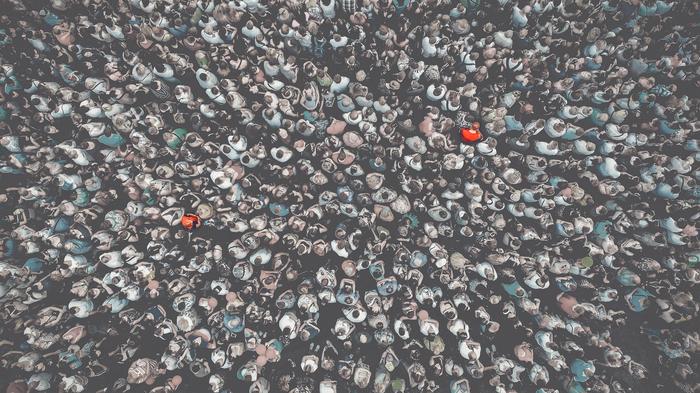
Proteins, which fulfil most of the functions in our body by interacting with other proteins, face a dilemma – they move around the cell with 40 million potential interaction partners. Finding the right partner may therefore seem like searching for a needle in a haystack. Nevertheless, if the probability of a protein meeting the right partner at the right time by chance may seem low – the cell has found a strategy to bring proteins together that resembles meeting a potential partner at work, in a café or in the club: Spatial cues guide proteins to defined cell compartments, such as the plasma membrane or the mitochondrion. The process of cell division, for example, is initiated by signaling processes at the cell membrane, which activates enzymes whose signals ultimately reach the cell nucleus to trigger targeted gene transcription. During the subsequent cell division, a multitude of specific protein interactions lead to the formation of a multi-layered protein complex at the centromeres of the chromosomes, which ensures error-free distribution of the chromosomes in a mother cell to its two daughters. Nature has developed a certain chemistry for interacting proteins: Proteins meant for each other are equipped with evolutionary conserved and exposed interfaces with detailed chemical identities in their 3D-structure that are complementary to each other. These motifs are found across species and enable highly specific protein interactions.

Credit: MPI of Molecular Physiology
Proteins, which fulfil most of the functions in our body by interacting with other proteins, face a dilemma – they move around the cell with 40 million potential interaction partners. Finding the right partner may therefore seem like searching for a needle in a haystack. Nevertheless, if the probability of a protein meeting the right partner at the right time by chance may seem low – the cell has found a strategy to bring proteins together that resembles meeting a potential partner at work, in a café or in the club: Spatial cues guide proteins to defined cell compartments, such as the plasma membrane or the mitochondrion. The process of cell division, for example, is initiated by signaling processes at the cell membrane, which activates enzymes whose signals ultimately reach the cell nucleus to trigger targeted gene transcription. During the subsequent cell division, a multitude of specific protein interactions lead to the formation of a multi-layered protein complex at the centromeres of the chromosomes, which ensures error-free distribution of the chromosomes in a mother cell to its two daughters. Nature has developed a certain chemistry for interacting proteins: Proteins meant for each other are equipped with evolutionary conserved and exposed interfaces with detailed chemical identities in their 3D-structure that are complementary to each other. These motifs are found across species and enable highly specific protein interactions.
A shift in paradigm?
At the turn of the last century, the first cellular compartments not delimited by physical boundaries were first observed. We now know that nucleoli, P-bodies, or stress granules concentrate macromolecules, mainly proteins and RNA, and have important functions in the cell. The discovery of these membraneless compartments has opened up a new field of research full of unanswered questions, the most challenging of which is how these compartments are formed and how they maintain their structure. In recent years, the idea that these compartments form by a process called liquid-liquid demixing or liquid-liquid phase separation, comparable to the spontaneous formation of oil-droplets in water, has gained considerable momentum. According to this view, membraneless compartments are “condensates” whose formation is based on transient, weak and unspecific interactions of “driver” proteins, ultimately causing their accumulation there at concentration higher than in the surrounding medium. Assays investigating phase separation properties of proteins outside the cell have identified dozens of these drivers to date, including the chromosomal passenger complex (CPC), which has been claimed to form condensates at the centromere to modulate its organization and function during mitosis.
In vitro is not in vivo – You cannot neglect the cytosol
“For many scientists phase separation has become the default explanation for the formation of membraneless compartments. However, there is little evidence that LLPS assays performed in vitro can really predict a physiological process in the cell’s environment”, says Musacchio. Together with his team, he has developed a strategy to evaluate a widely used LLPS assay and its predictive power, and applied it to CPC. “In our opinion, a major weakness of the assays is that it does not model the solvent with sufficient accuracy. The solvent defines a protein’s solubility and thus its ability to interact with other proteins”. In order to mimic the natural environment of the cell as closely as possible, the scientist added diluted bacterial or mammalian cell lysates to standard LLPS buffers. Even at highly diluted concentrations, lysates completely prevented the formation of condensates. To assess how general this was, the scientists repeated the same experiment with several additional proteins, all of which showed LLPS properties in the standard assay. And indeed, in all cases addition of cell lysates dissolved the “condensates”. “These results confirm our assumption that the cellular environment effectively buffers the unspecific weak interactions that are thought to cause LLPS in vitro”, says Musacchio.
Poor predictive power
The interactions and functions of proteins in the cell are strongly regulated by so-called post-translational modifications. Targeted addition or removal of phosphate groups at critical places, for example, can disrupt the interaction between two proteins with immediate effect. These natural modifications can be mimicked in the laboratory by mutations and are the method of choice when it comes to investigating many cellular processes. By introducing mutations at four residues involved in the recognition of phosphorylated cues, the scientist generated a mutant of the CPC that cannot be recruited to centromeres and does not accumulate there. Nevertheless, this mutant still showed full LLPS potential in the in vitro assay, showing that the assay is unable to predict CPC localization and function.
“Our results show that LLPS of a single component in vitro cannot predict solubility and localization in the complex and crowded environment of the cell. The list of putative LLPS scaffolds identified through the established assays will need extensive re-examination, and the validation strategy we are presenting here may guide this effort”, says Musacchio. In the future we plan to repeat our experiments with many putative LLPS scaffolds, especially those that have become flagships in the growth of the LLPS field. Our experiments show that the cytosol is a potent solvent whose role cannot be neglected. Therefore, it will be important to generate appropriate cytomimetic media as standards for assessing biochemical reactions in vitro. We will try to contribute to this area of research”.
Journal
Molecular Cell
Method of Research
Experimental study
Subject of Research
Cells
Article Title
A validation strategy to assess the role of phase separation as a determinant of macromolecular localization
Article Publication Date
12-Apr-2024
Cite Scienmag News
Drew Townsend. (April 23, 2024). Biomolecular condensates: Are they condensates? Scienmag. https://scienmag.com/biomolecular-condensates-are-they-condensates/
Drew Townsend. "Biomolecular condensates: Are they condensates?" Scienmag, 23 April 2024, https://scienmag.com/biomolecular-condensates-are-they-condensates/. Accessed 4 September 2026.
Drew Townsend. "Biomolecular condensates: Are they condensates?" Scienmag. April 23, 2024. https://scienmag.com/biomolecular-condensates-are-they-condensates/

