


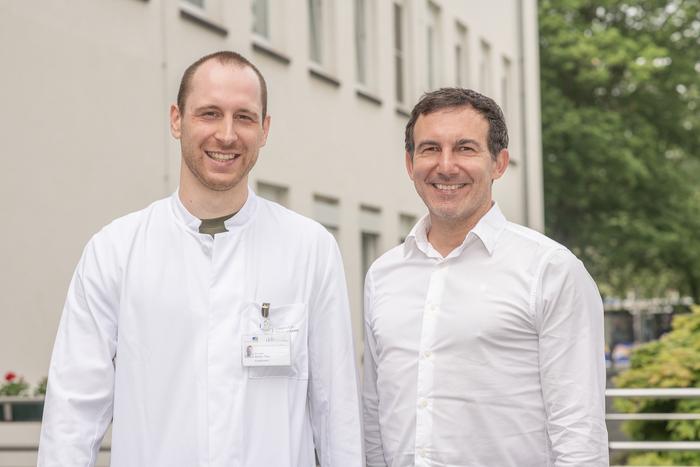
If black skin cancer (melanoma) spreads, there are various therapies that can be used. However, there is still insufficient research into who responds to which therapy and whether resistance may develop over time. In a new study, Dr Simon Fietz, assistant physician at the Clinic for Dermatooncology & Phlebology at the Centre for Skin Diseases at the University Hospital Bonn (UKB) and PD Dr Dimo Dietrich, scientist at the Clinic and Polyclinic for Otorhinolaryngology at the UKB, have discovered that a specific liquid biopsy biomarker harbors the potential to identify the effectiveness of a treatment at an early stage. This could enable a more individualized treatment for patients with melanoma. The results have now been published in the well-established journal ‘Clinical Chemistry’.

Credit: University Hospital Bonn (UKB) / R. Müller
If black skin cancer (melanoma) spreads, there are various therapies that can be used. However, there is still insufficient research into who responds to which therapy and whether resistance may develop over time. In a new study, Dr Simon Fietz, assistant physician at the Clinic for Dermatooncology & Phlebology at the Centre for Skin Diseases at the University Hospital Bonn (UKB) and PD Dr Dimo Dietrich, scientist at the Clinic and Polyclinic for Otorhinolaryngology at the UKB, have discovered that a specific liquid biopsy biomarker harbors the potential to identify the effectiveness of a treatment at an early stage. This could enable a more individualized treatment for patients with melanoma. The results have now been published in the well-established journal ‘Clinical Chemistry’.
Immunotherapy with PD-1 inhibitors is a common palliative and adjuvant therapy for patients with melanoma. ‘However, this therapy does not work for all patients. Some patients are resistant or develop resistance during treatment,’ says Dr Fietz, who also conducts research at the University of Bonn. ‘In our study, we have now developed a method which we can use to find out who will respond to the treatment and when the therapy should be changed at an early stage.’
Biomarkers provide important information
The researchers analyzed the blood of both patients with and without tumors for biomarkers and found that a certain biomarker (SHOX2 methylation of circulating cell-free DNA in blood plasma) derives directly from the tumor cells. A total of 42 patients undergoing palliative and 55 patients undergoing adjuvant anti-PD-1 immunotherapy were analyzed. The values were compared with 126 control patients without cancer. The research group of Dr Fietz and PD Dr Dietrich examined the SHOX2 methylation status in the blood plasma before and 4 weeks after start of treatment in order to predict and evaluate response to therapy and survival. They found that SHOX2 methylation levels were elevated in 60 percentage of melanoma patients, while 98 percentage of the control group showed low levels. In addition, patients with elevated levels before treatment which decreased after 4 weeks responded particularly well.
‘The results of our study suggest that SHOX2 methylation in the blood could be a promising predictor of response to anti-PD-1 therapy in melanoma patients. Therefore, testing for this biomarker can support individualized treatment decision making by indicating the effectiveness of anti-PD-1 therapy at an early stage,’ explains Dr Fietz. ‘Additionally, this biomarker test also helped us to detect metastases in patients undergoing adjuvant therapy at an early stage.’
The results could make an important contribution to improving the treatment of patients with melanoma. To further manifest these results, a larger follow-up study is now underway at the UKB, in which various biomarkers are being combined. ‘By combining them, we aim to achieve even greater precision and reliability in diagnostics in order to improve patient care for those affected by melanoma,’ explains Dr Fietz.
Publication: Simon Fietz et al.; Circulating Cell-Free SHOX2 DNA Methylation Is a Predictive, Prognostic, and Monitoring Biomarker in Adjuvant and Palliative Anti-PD-1-Treated Melanoma; DOI:
Journal
Clinical Chemistry
Cite Scienmag News
Nathaniel Bowman. (May 16, 2024). Biomarker could improve prediction of response to immunotherapy in black skin cancer. Scienmag. https://scienmag.com/biomarker-could-improve-prediction-of-response-to-immunotherapy-in-black-skin-cancer/
Nathaniel Bowman. "Biomarker could improve prediction of response to immunotherapy in black skin cancer." Scienmag, 16 May 2024, https://scienmag.com/biomarker-could-improve-prediction-of-response-to-immunotherapy-in-black-skin-cancer/. Accessed 3 September 2026.
Nathaniel Bowman. "Biomarker could improve prediction of response to immunotherapy in black skin cancer." Scienmag. May 16, 2024. https://scienmag.com/biomarker-could-improve-prediction-of-response-to-immunotherapy-in-black-skin-cancer/

