


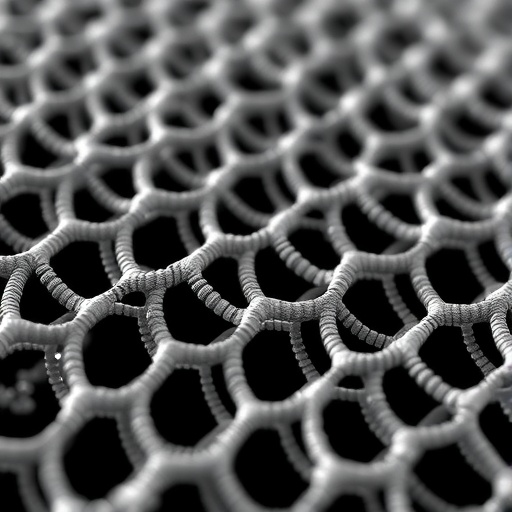
Carbon nanotube films have long been viewed as promising candidates for next-generation impact protection because they are exceptionally lightweight, flexible and compatible with scalable manufacturing. Yet despite their remarkable nanoscale properties, these films have struggled to deliver the mechanical strength and toughness required for demanding real-world applications. A study published in Nano Research now reports a bio-inspired “nano-fishnet” architecture that dramatically improves the ability of carbon nanotube composite films to withstand and absorb mechanical energy.
The research team, led by Yuanyuan Li of Soochow University, designed the material by combining highly aligned carbon nanotubes with p-phenylene benzobisoxazole nanofibers, commonly known as PBO nanofibers. The resulting composite uses a network of load-bearing nanotube bundles and nanoscale connecting points, creating a structure that resembles a fishing net. According to the researchers, this architecture enables more efficient stress transfer, limits crack growth and strengthens the weak interfaces that normally exist between neighboring carbon nanotubes.
Carbon nanotube films are made from networks of nanotubes that can possess outstanding intrinsic strength. However, the performance of a macroscopic film is often controlled not by the strength of individual nanotubes, but by how effectively forces move through the overall network. Entanglement, misalignment, voids and structural defects interrupt this force transfer. The nanotubes interact primarily through relatively weak van der Waals forces, meaning that bundles can slide apart or separate when the material is subjected to a sudden load. These structural limitations have prevented conventional films from reaching their theoretical mechanical potential.
To address this problem, the researchers first processed the nanotubes in chlorosulfonic acid, a medium capable of disentangling and dispersing initially compacted nanotube bundles. The film was then subjected to carefully controlled directional stretching. Repeated stretching cycles caused the nanotubes and bundles to rotate and align along the stretching direction, reducing random entanglement while increasing packing density. The treatment had to be precisely regulated: insufficient stretching would leave the network poorly aligned, while excessive stretching could damage or fracture the film.
This process increased the density of the carbon nanotube film from 0.56 to 0.94 grams per cubic centimeter. The optimized material reached a fracture strength of 1.04 ± 0.06 gigapascals and an elastic modulus of 36.99 ± 1.8 gigapascals before reinforcement. These results established a compact and directionally organized framework into which the PBO nanofibers could be introduced. The aligned nanotubes provided the primary pathways for carrying tensile loads, while the open spaces and defective regions created opportunities for nanoscale reinforcement.
PBO nanofibers were subsequently infiltrated into the oriented carbon nanotube framework. Because of their small dimensions and high aspect ratio, the nanofibers could enter pores and defects that would otherwise act as weak points. They formed bridges between adjacent nanotube bundles, creating connection nodes throughout the film. In the researchers’ nano-fishnet model, the aligned carbon nanotube bundles function as the strands of the net, while the PBO bridges act as its joints. Together, they form a continuous, interlocked structure capable of redistributing stress across a larger area.
The reinforcement mechanism combines physical alignment with chemical and interfacial interlocking. The PBO nanofibers do not simply fill empty spaces; they establish numerous connections across the nanotube network, restricting bundle slippage and improving cohesion. When a crack begins to form, the interconnected architecture can divert or redistribute the applied stress instead of allowing the crack to travel rapidly through a single weak path. This behavior resembles hierarchical structures found in nature, where multiple levels of fibers, interfaces and junctions work together to prevent catastrophic failure.
The resulting PBO–carbon nanotube composite films displayed a major improvement in mechanical performance. Their tensile strength reached 4.92 ± 0.2 gigapascals, while their toughness reached 118.96 ± 9.78 megajoules per cubic meter. The researchers report increases of 3954.39 percent in tensile strength and 1060.59 percent in toughness compared with pristine carbon nanotube films. Toughness is particularly important for impact protection because it measures how much mechanical energy a material can absorb before breaking. A strong but brittle film may resist an initial load yet fail suddenly, whereas a tough film can continue dissipating energy as damage develops.
The study also examines the dynamic mechanical behavior of the composite, including its stress–strain response and damage evolution under rapidly applied loads. By establishing dense, interconnected pathways inside the aligned nanotube network, the PBO nanofibers promote continuous stress redistribution and suppress crack propagation. The researchers say the controllable stretching and infiltration process could provide a scalable route toward advanced protective materials for applications in impact-resistant equipment and other systems where low weight, flexibility and high energy absorption are essential. The work was led by Chenyang Duan of Soochow University, with collaborators from Soochow University and the Suzhou Institute of Nano-Tech and Nano-Bionics.
News Publication Date: 27-Jul-2026
Web References: https://doi.org/10.26599/NR.2026.94908843; Nano Research
References: Duan, Chenyang, et al., “Bioinspired nano-fishnet structural construction for ultra-high dynamic toughness of carbon nanotube composite films,” Nano Research, DOI: 10.26599/NR.2026.94908843.
Keywords
Carbon nanotubes, PBO nanofibers, nano-fishnet structure, composite films, impact protection, dynamic toughness, nanotechnology, crack resistance, bio-inspired materials, Soochow University
Cite Scienmag News
Bethany Barker. (August 6, 2026). Bioinspired Nano-Fishnet Design Gives Carbon Nanotube Composite Films Ultra-High Dynamic Toughness. Scienmag. https://scienmag.com/bioinspired-nano-fishnet-design-gives-carbon-nanotube-composite-films-ultra-high-dynamic-toughness/
Bethany Barker. "Bioinspired Nano-Fishnet Design Gives Carbon Nanotube Composite Films Ultra-High Dynamic Toughness." Scienmag, 6 August 2026, https://scienmag.com/bioinspired-nano-fishnet-design-gives-carbon-nanotube-composite-films-ultra-high-dynamic-toughness/. Accessed 3 September 2026.
Bethany Barker. "Bioinspired Nano-Fishnet Design Gives Carbon Nanotube Composite Films Ultra-High Dynamic Toughness." Scienmag. August 6, 2026. https://scienmag.com/bioinspired-nano-fishnet-design-gives-carbon-nanotube-composite-films-ultra-high-dynamic-toughness/


