


Vanilla extract is one of the most widely used flavoring compounds in food products and cosmetics. The pleasant and sweet smell of this classic flavor is imparted by the chemical compound ‘vanillin’ found in the seed pods of vanilla plants belonging to the orchid family. In plants, vanillin is synthesized by the conversion of ferulic acid by the enzyme – VpVAN. However, laboratory biosynthesis of vanillin from plant-derived VpVAN yields only very small quantities of vanillin, and is, therefore, commercially impractical. Further, although chemically derived vanilla essences are available cheaply, they do not match the flavor of natural vanilla extract, and the demand for the latter continues to remain high. Additionally, climatic restrictions for the cultivation of vanilla plants, and the relatively small yield obtained per plant, have led to a dwindling supply and a surge in the price of natural vanilla extract.

Credit: Professor Toshiki Furuya, Department of Applied Biological Science, Faculty of Science and Technology, Tokyo University of Science
Vanilla extract is one of the most widely used flavoring compounds in food products and cosmetics. The pleasant and sweet smell of this classic flavor is imparted by the chemical compound ‘vanillin’ found in the seed pods of vanilla plants belonging to the orchid family. In plants, vanillin is synthesized by the conversion of ferulic acid by the enzyme – VpVAN. However, laboratory biosynthesis of vanillin from plant-derived VpVAN yields only very small quantities of vanillin, and is, therefore, commercially impractical. Further, although chemically derived vanilla essences are available cheaply, they do not match the flavor of natural vanilla extract, and the demand for the latter continues to remain high. Additionally, climatic restrictions for the cultivation of vanilla plants, and the relatively small yield obtained per plant, have led to a dwindling supply and a surge in the price of natural vanilla extract.
Addressing these challenges, Professor Toshiki Furuya from the Department of Applied Biological Science, Faculty of Science and Technology, Tokyo University of Science, and his graduate students Shizuka Fujimaki and Satsuki Sakamoto, successfully developed an enzyme that generates vanillin from plant-derived ferulic acid. “Ferulic acid, the raw material, is a compound that can be obtained in abundance from agricultural waste such as rice bran and wheat bran. Vanillin is generated simply by mixing ferulic acid with the developed enzyme at room temperature. So, the established technology can provide a simple and environmentally friendly method for producing flavor compounds,” explains Prof. Furuya. Their study was published on May 10, 2024 in Applied and Environmental Microbiology.
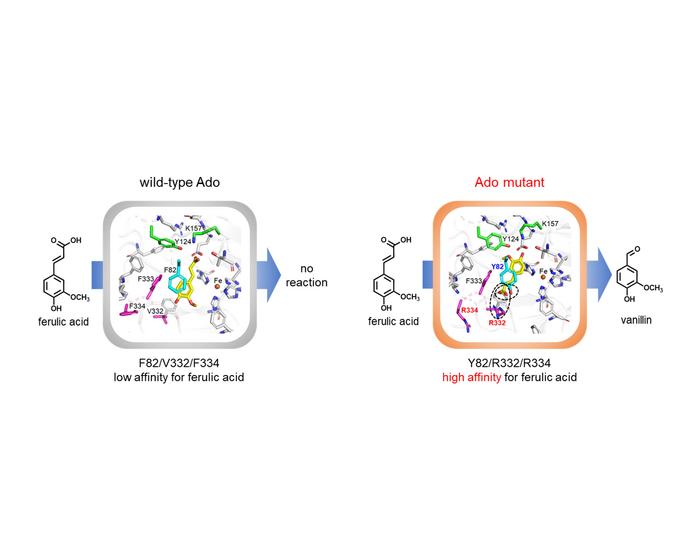
The researchers used genetic engineering approaches to modify the molecular structure of an enzyme – ‘Ado.’ Ado is originally an oxidase enzyme that adds an oxygen atom to the substrate – isoeugenol. In its native state, it does not have the ability to convert ferulic acid into vanillin. Using structural modeling analysis, the researchers were able to predict amino acid changes in Ado which would enable its interaction with ferulic acid. On these lines, they conducted a series of experiments by replacing phenylalanine and valine amino acid residues at specific positions in the structure of Ado, with various other amino acids. They went on to examine the ferulic acid conversion ability of the various engineered mutant proteins.
Following several trials and errors, they found that a mutant protein in which only three specific phenylalanine and valine residues were replaced with tyrosine and arginine, stably reacted with ferulic acid and exhibited high conversion activity. Notably, the engineered enzyme did not require any cofactors for conversion, unlike other oxidases, and produced vanillin on a gram scale per liter of reaction solution, with a higher catalytic efficiency and affinity than that of the wild-type enzyme. The reaction only required mixing of the enzyme, ferulic acid, and air (molecular oxygen), at room temperature, making it a simple, sustainable, and economically scalable process. Furthermore, the molecularly evolved enzyme also exhibited conversion activity towards p-coumaric acid and sinapic acid, which are compounds obtained from the degradation of lignin – a common agricultural waste product.
So far, no microbial or plant-derived enzymes have exhibited the ability to convert ferulic acid to vanillin at an industrial scale. Therefore, the enzyme developed in the current study shows considerable potential for enabling the commercial and economically viable production of natural vanillin.
Explaining the long-term implications of their research, Prof. Furuya states, “Harnessing the potential of microorganisms and enzymes to derive valuable compounds under mild conditions from renewable plant-based resources, offers a sustainable approach to minimizing environmental footprint. Presently, in collaboration with a company, our research endeavors focus on achieving the real-world implementation of vanillin production through the utilization of the newly developed enzyme.”
***
About The Tokyo University of Science
Tokyo University of Science (TUS) is a well-known and respected university, and the largest science-specialized private research university in Japan, with four campuses in central Tokyo and its suburbs and in Hokkaido. Established in 1881, the university has continually contributed to Japan’s development in science through inculcating the love for science in researchers, technicians, and educators.
With a mission of “Creating science and technology for the harmonious development of nature, human beings, and society,” TUS has undertaken a wide range of research from basic to applied science. TUS has embraced a multidisciplinary approach to research and undertaken intensive study in some of today’s most vital fields. TUS is a meritocracy where the best in science is recognized and nurtured. It is the only private university in Japan that has produced a Nobel Prize winner and the only private university in Asia to produce Nobel Prize winners within the natural sciences field.
About Professor Toshiki Furuya from Tokyo University of Science
Dr. Toshiki Furuya is a Professor at the Faculty of Science and Technology of the Department of Applied Biological Science at TUS. He completed his graduation and post-graduation from Waseda University in Tokyo, Japan. He has won many awards, including the 24th Excellent Paper Award by Society of Biotechnology in 2016. His areas of research include applied biochemistry, microbial metabolism, enzyme catalysis, bioproduction, and bioremediation.
Journal
Applied and Environmental Microbiology
Method of Research
Experimental study
Subject of Research
Not applicable
Article Title
Engineering a coenzyme-independent dioxygenase for one-step production of vanillin from ferulic acid
Article Publication Date
10-May-2024
COI Statement
The authors declare no conflict of interest
Cite Scienmag News
Denise Maddox. (May 16, 2024). Bioengineered enzyme creates natural vanillin from plants in one step. Scienmag. https://scienmag.com/bioengineered-enzyme-creates-natural-vanillin-from-plants-in-one-step/
Denise Maddox. "Bioengineered enzyme creates natural vanillin from plants in one step." Scienmag, 16 May 2024, https://scienmag.com/bioengineered-enzyme-creates-natural-vanillin-from-plants-in-one-step/. Accessed 3 September 2026.
Denise Maddox. "Bioengineered enzyme creates natural vanillin from plants in one step." Scienmag. May 16, 2024. https://scienmag.com/bioengineered-enzyme-creates-natural-vanillin-from-plants-in-one-step/

