


Beneficial fungi such as Trichoderma longibrachiatum have long been celebrated as natural allies of farmers, suppressing soil-borne pathogens and stimulating plant growth without the environmental baggage of synthetic agrochemicals. Yet translating this promise from the laboratory bench to the field has always been hampered by a stubborn problem: the fragile propagules of these fungi lose viability rapidly when exposed to heat, desiccation, ultraviolet radiation, and the microbial competition of real soil. Conventional formulations—dusty powders, liquid slurries, and simple seed coatings—often deliver a burst of propagules that dwindles within days, leaving growers to reapply product at considerable cost. A research team at Adamas University in Kolkata, working with the M. S. Swaminathan Research Foundation in Odisha, India, has now engineered a biodegradable hydrogel bead that addresses precisely this weakness, encapsulating the fungus in a three-polymer matrix designed to keep it alive and release it slowly into the rhizosphere.
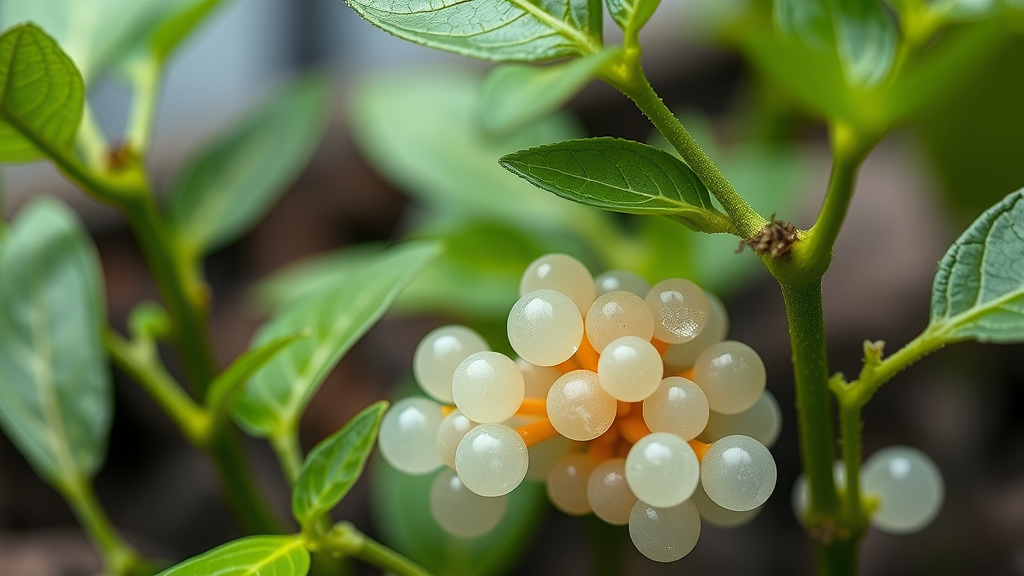
The formulation, described in the journal Polymer Bulletin, blends three inexpensive and environmentally benign polymers: starch, sodium alginate, and poly(vinyl alcohol), commonly abbreviated PVA. Each component plays a distinct structural role. Alginate, a polysaccharide extracted from brown seaweed, forms the load-bearing skeleton of the bead through ionic gelation; when droplets of the polymer-fungal suspension are dropped into a calcium chloride bath, calcium ions cross-link the guluronic acid blocks of adjacent alginate chains, locking the spherical shape in seconds. Starch acts as a filler and nutrient reservoir, providing a slowly degradable carbohydrate that the embedded fungus can metabolize during storage and early colonization. PVA, a synthetic but water-soluble polymer, interpenetrates the alginate network and reinforces the matrix through hydrogen bonding, improving mechanical integrity and moderating water loss.
The physical characterization of the beads reveals why this tri-polymer architecture matters. The finished beads displayed uniform spherical morphology with high moisture retention of 86.17 plus or minus 1.8 percent, a swelling capacity of 233 plus or minus 5.4 percent, and an encapsulation efficiency of 87.0 plus or minus 2.0 percent. Scanning electron microscopy revealed a porous, interconnected internal structure—an architectural feature that is critical for two reasons. First, the pores create diffusion pathways that allow oxygen to reach the entrapped fungus and permit hyphae and conidia to exit gradually as the bead hydrates in soil. Second, the open framework lets water permeate the matrix, sustaining the humid microenvironment that fungal propagules need to remain metabolically active. Fourier-transform infrared spectroscopy confirmed hydrogen-bonding interactions among the three polymers, while X-ray diffraction analysis showed a predominantly amorphous matrix, a desirable trait because amorphous regions absorb water more readily and swell more uniformly than crystalline ones.
Perhaps the most consequential finding concerns shelf life, the persistent Achilles heel of bioinoculant products. The encapsulated formulation maintained 8.0 times ten to the seventh colony-forming units per gram of bead after 45 days of storage, a viability level that many liquid and powder formulations struggle to match over comparable periods. The hydrogel essentially acts as a microclimate in miniature: the hydrated polymer network buffers the fungus against fluctuations in temperature and humidity, while the starch provides a continuous, low-level nutrient supply. In soil, the beads provided sustained availability of viable propagules, releasing the fungus gradually rather than in a single pulse. This sustained-delivery profile matters agronomically because Trichoderma must colonize the root zone over weeks, not days, to exert its full biocontrol and growth-promoting effects.
To test whether the delivery system actually works in a biological context, the researchers grew Capsicum annuum—pepper—under controlled pot conditions and compared three treatments: plants receiving the encapsulated fungus, plants receiving a conventional Trichoderma slurry, and untreated controls. The results at 30 days were striking. Encapsulated treatment increased plant height to 72.3 plus or minus 3.0 centimeters, leaf number to 98.4 plus or minus 3.4, leaf area to 56.8 plus or minus 2.7 square centimeters, and dry biomass to 18.9 plus or minus 0.5 grams. Chlorophyll and carotenoid contents were also improved, indicating enhanced photosynthetic capacity. Because the bead releases viable propagules continuously, the root zone maintains a persistent Trichoderma population that can solubilize nutrients, produce phytohormone-like signals, and prime the plant’s own developmental machinery in ways that a single slurry application cannot sustain.
One of the most intriguing dimensions of the study is its focus on the plant’s antioxidant defense system. When plants perceive beneficial microbes, they often mount a mild, controlled oxidative burst; the ability to manage reactive oxygen species is a hallmark of induced systemic resistance and stress resilience. The researchers measured the activities of four key antioxidant enzymes—superoxide dismutase (SOD), ascorbate peroxidase (APX), guaiacol peroxidase (GPX), and catalase (CAT)—at two time points. At 10 days after treatment, SOD, APX, GPX, and CAT activities had increased by 36.4, 73.0, 72.2, and 54.9 percent, respectively, relative to untreated controls. By 30 days, APX activity showed a remarkable 149.5 percent increase. These enzymatic shifts suggest that the encapsulated fungus triggers a durable priming of the plant’s oxidative stress defenses, equipping pepper plants to better tolerate both biotic attacks and abiotic stresses such as drought and salinity.
The broader significance of this work lies in the convergence of polymer science and agricultural microbiology. Hydrogels have been studied extensively for drug delivery and tissue engineering, but their application as carriers for living agricultural microorganisms raises unique design constraints. The carrier must be simultaneously protective and permeable, structurally robust yet degradable, and cheap enough to be economically viable for commodity crops. The starch–alginate–PVA system satisfies these criteria using materials that are abundant, largely food-grade or biodegradable, and processable with simple ionic gelation equipment that could be scaled for commercial production. The beads could, in principle, be applied at transplanting, mixed into potting media, or broadcast into planting furrows, integrating naturally into existing horticultural workflows for pepper and related solanaceous crops.
The study also contributes to a growing body of evidence that encapsulation is not merely a preservation technique but an active component of bioinoculant efficacy. By controlling the rate at which propagules are released, encapsulation shapes the temporal dynamics of plant–microbe interaction: early release establishes colonization, while continued release replenishes the population as the bead degrades and as roots extend into new soil volumes. The enhanced antioxidant enzyme profile observed in the pepper plants is consistent with this model, as sustained fungal presence likely maintains a continuous low-level elicitation of defense signaling rather than the transient spike produced by a one-time slurry application. For farmers, this could translate into fewer applications, more predictable performance, and better returns on biological inputs.
Challenges remain before such beads reach widespread commercial deployment. Field trials across seasons, soil types, and climates will be needed to confirm that the laboratory and greenhouse performance translates to open-field conditions, where microbial competition, rainfall, and temperature swings are far more variable. Scaling ionic gelation to tonnage quantities, optimizing drying and packaging, and meeting regulatory requirements for biological products are all practical hurdles. Nevertheless, the Indian team’s demonstration—that a simple blend of starch, seaweed-derived alginate, and PVA can keep a beneficial fungus alive for weeks, deliver it steadily into the rhizosphere, and measurably enhance plant growth and antioxidant defense—offers a compelling template. As agriculture seeks to reduce its reliance on synthetic fungicides and fertilizers, smart biopolymer delivery systems of this kind may well become the quiet workhorses of sustainable crop production.
Subject of Research: Encapsulation of the biocontrol fungus Trichoderma longibrachiatum in starch–alginate–PVA hydrogel beads for sustained delivery and plant growth promotion in Capsicum annuum.
Article Title: Development of starch–alginate–PVA hydrogel beads for encapsulation and sustained delivery of Trichoderma longibrachiatum in Capsicum annuum
Article References: Padhan, B., Das, J., Sen, P., & Lenka, K. C. (2026). Development of starch–alginate–PVA hydrogel beads for encapsulation and sustained delivery of Trichoderma longibrachiatum in Capsicum annuum. Polymer Bulletin, 83(11), Article 632. https://doi.org/10.1007/s00289-026-06690-1
Image Credits: AI Generated
DOI: 10.1007/s00289-026-06690-1
Keywords: Trichoderma longibrachiatum, hydrogel beads, encapsulation, starch, sodium alginate, poly(vinyl alcohol), controlled release, Capsicum annuum, bioinoculants, antioxidant enzymes, plant growth promotion, sustainable agriculture
Cite Scienmag News
Roger Howard. (September 21, 2026). Biodegradable Hydrogel Beads Keep Beneficial Fungus Alive and Boost Pepper Growth. Scienmag. https://scienmag.com/biodegradable-hydrogel-beads-keep-beneficial-fungus-alive-and-boost-pepper-growth/
Roger Howard. "Biodegradable Hydrogel Beads Keep Beneficial Fungus Alive and Boost Pepper Growth." Scienmag, 21 September 2026, https://scienmag.com/biodegradable-hydrogel-beads-keep-beneficial-fungus-alive-and-boost-pepper-growth/. Accessed 5 October 2026.
Roger Howard. "Biodegradable Hydrogel Beads Keep Beneficial Fungus Alive and Boost Pepper Growth." Scienmag. September 21, 2026. https://scienmag.com/biodegradable-hydrogel-beads-keep-beneficial-fungus-alive-and-boost-pepper-growth/


