


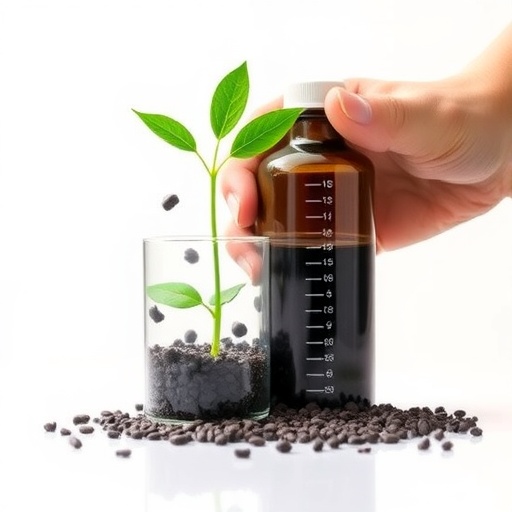
A groundbreaking advancement in water treatment technology has emerged with the development of a biochar-regulated cobalt-manganese spinel catalyst, capable of degrading the pervasive neonicotinoid insecticide imidacloprid with unprecedented efficiency. This innovative catalyst, designated CoMn0.75/BC, leverages the unique properties of biochar to facilitate a non-radical oxidation process, overcoming longstanding challenges in the selective and sustainable degradation of toxic pesticides from contaminated water sources.
Neonicotinoids, especially imidacloprid, have become ubiquitous in modern agricultural practices due to their effectiveness in pest control. However, their persistence and toxicity to aquatic organisms pose serious ecological risks, notably to fragile invertebrate populations. Conventional treatment methods often struggle with the rapid, complete, and selective removal of these compounds, especially in complex water matrices where radical-based oxidation processes can be hindered by variable pH levels and the presence of interfering ions or organic matter.
The newly reported catalyst originates from layered double hydroxides (LDH) and is intricately engineered to contain a cobalt-manganese spinel structure finely tuned by biochar—a biomass-derived porous carbon material. This composite material exhibits an extraordinary capacity to activate peroxymonosulfate (PMS), a potent oxidant commonly employed in advanced oxidation processes (AOPs), enabling the rapid breakdown of imidacloprid. Remarkably, within a mere 40 minutes, the system achieves a 96.9% reduction of imidacloprid at a concentration of 5 mg/L, setting a new benchmark for efficiency in pesticide degradation.
Central to the catalyst’s performance is the role of biochar, which extends beyond being a passive support medium. Its porous architecture promotes the homogenous dispersion of Co-Mn spinel nanoparticles, preventing agglomeration and maintaining high active surface area. The biochar surface is rich in oxygenated functionalities, including carbonyl groups, which actively chelate metal ions and stabilize the formation of high-valent metal–oxo species. These species are identified as primary oxidizing agents in the catalytic cycle, facilitating a non-radical oxidation pathway that guarantees superior selectivity and stability compared to traditional radical-based mechanisms.
This non-radical reactive oxygen species (ROS) pathway is dominated by high-valent metal–oxo intermediates and singlet oxygen (^1O2), both of which confer resilience against common inhibitory factors in natural and wastewater environments. Unlike hydroxyl or sulfate radicals prone to deactivation by chloride and sulfate ions or natural organic matter, these selective oxidants maintain robust reactivity across a broad pH range, demonstrated here from pH 3 to 11. Laboratory tests confirm the catalyst’s efficacy remains largely unaffected by common anions, revealing its suitability for diverse wastewater conditions.
The stability and reusability of CoMn0.75/BC further underscore its potential for real-world application. After five consecutive degradation cycles, the catalyst retained over 91% of its original activity, with negligible leaching of cobalt and manganese ions and no discernible alteration to the spinel crystal lattice. More impressively, a continuous-flow experiment simulating an industrial water treatment setup sustained more than 80% imidacloprid removal over a seven-hour operation window, signaling promise for scalable deployment.
Complementary investigations revealed the biochar’s intrinsic persistent free radicals that enhance singlet oxygen generation during PMS activation, adding another dimension to the composite’s catalytic prowess. This synergistic effect not only broadens the mechanisms available for oxidation but also amplifies overall degradation kinetics, setting the CoMn0.75/BC catalyst apart as a multifunctional system optimized for practical environmental remediation.
Beyond imidacloprid, the catalyst’s versatility extends to other prevalent neonicotinoids such as thiamethoxam, clothianidin, dinotefuran, and nitenpyram, demonstrating a wide spectrum of applicability. This versatility is crucial given the widespread use and environmental dissemination of various neonicotinoids, which collectively contribute to water pollution and associated ecological hazards.
The implications of this research are significant, as it establishes a blueprint for designing next-generation biochar-hybrid catalysts tailored for advanced oxidation pathways that prioritize selectivity, durability, and efficiency. By harnessing biochar’s dual function as a structural regulator and reaction director, the research moves beyond the traditional paradigm of pollutant adsorption or radical indiscriminate oxidation, towards a refined catalytic detoxification process capable of addressing the pressing needs of industrial and agricultural wastewater treatment.
While the current findings are compelling, the authors acknowledge the necessity for extended pilot-scale studies and techno-economic assessments to validate the catalyst’s feasibility and cost-effectiveness in full-scale operations. Such studies will be integral for transitioning this promising technology from laboratory innovation to environmental engineering practice, ultimately contributing to safer water ecosystems and the mitigation of pesticide pollution.
In summary, the introduction of biochar-regulated LDH-derived Co–Mn spinel for non-radical PMS activation represents a transformative advancement in catalytic water treatment. By integrating material science, environmental chemistry, and sustainable resource utilization, this research opens new channels for combating neonicotinoid contamination and exemplifies the potential of biochar in next-generation pollution control technologies.
Keywords
Biochar, cobalt manganese spinel, peroxymonosulfate activation, imidacloprid degradation, non-radical oxidation, high-valent metal–oxo species, singlet oxygen, neonicotinoid insecticides, advanced oxidation processes, wastewater treatment, catalyst stability, environmental remediation
Cite Scienmag News
Bethany Barker. (June 15, 2026). Biochar Revolutionizes Catalyst Chemistry to Accelerate Pesticide Removal from Water. Scienmag. https://scienmag.com/biochar-revolutionizes-catalyst-chemistry-to-accelerate-pesticide-removal-from-water/
Bethany Barker. "Biochar Revolutionizes Catalyst Chemistry to Accelerate Pesticide Removal from Water." Scienmag, 15 June 2026, https://scienmag.com/biochar-revolutionizes-catalyst-chemistry-to-accelerate-pesticide-removal-from-water/. Accessed 4 September 2026.
Bethany Barker. "Biochar Revolutionizes Catalyst Chemistry to Accelerate Pesticide Removal from Water." Scienmag. June 15, 2026. https://scienmag.com/biochar-revolutionizes-catalyst-chemistry-to-accelerate-pesticide-removal-from-water/


