


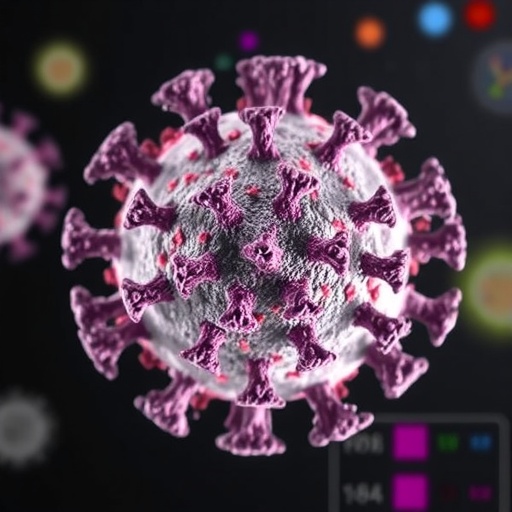
Viral entry proteins are among the most consequential molecules in infectious disease biology. Positioned at the interface between a virus and its host, they recognize cellular receptors, trigger membrane fusion, and determine—often with remarkable specificity—whether infection can begin. Yet identifying these proteins from sequence data remains difficult, especially for newly discovered viruses whose genomes contain few recognizable similarities to experimentally characterized proteins. A new study in BMC Bioinformatics reports that protein language models, particularly the ESM2 family, can help address this challenge by transforming amino-acid sequences into numerical representations that capture biologically meaningful patterns.
The study, led by Jorge F. Beltrán and colleagues, presents a multi-scale benchmark of ESM2 models for binary classification of viral entry proteins. The researchers compared three versions of the model containing approximately 650 million, 3 billion, and 15 billion parameters. These systems were not retrained on the viral-protein dataset. Instead, the investigators used “frozen embeddings”—fixed numerical descriptions generated by ESM2 for each protein sequence—and supplied those representations to conventional machine-learning classifiers. This approach separates the task of learning general protein patterns from the task of distinguishing entry proteins from other viral proteins.
Protein language models are inspired by the way large language models process written text. In a protein sequence, amino acids function like an alphabet, while recurring sequence patterns reflect structural elements, interaction sites, cellular targeting signals, and evolutionary constraints. During training, models such as ESM2 learn to predict missing or masked amino acids from their surrounding context. Although the model is not explicitly told that a sequence belongs to a fusion protein or receptor-binding protein, its internal representation can encode relationships associated with folding, topology, and molecular function. The resulting embedding is a high-dimensional numerical profile that can be analyzed by a separate classifier.
To create the benchmark, the researchers assembled 1,092 reviewed viral proteins from UniProt/Swiss-Prot. The dataset was balanced between viral entry proteins and non-entry proteins, reducing the risk that a classifier could appear accurate simply by favoring the more common class. To limit the influence of closely related sequences, the proteins were clustered with CD-HIT at 40 percent sequence identity. The resulting data were divided into a training set of 873 proteins and an independent test set of 219 proteins. This sequence-redundancy control is important because random splits can produce deceptively high scores when nearly identical proteins occur on both sides of the evaluation.
Five supervised algorithms were tested on the ESM2 embeddings: a support vector machine with a radial basis function kernel, random forest, XGBoost, LightGBM, and a multilayer perceptron. These classifiers differ in how they model decision boundaries. The radial-basis-function support vector machine can separate classes in a transformed feature space, while tree-based methods identify combinations of informative variables through ensembles of decision trees. The multilayer perceptron, by contrast, learns nonlinear transformations through artificial neural-network layers. Comparing several algorithms allowed the researchers to assess whether performance depended primarily on the protein representation or on the choice of downstream classifier.
Performance increased as the ESM2 model grew larger, although the improvement became modest beyond the intermediate scale. The strongest result came from the 15-billion-parameter ESM2 model combined with the radial-basis-function support vector machine. On the independent test set, this configuration achieved 88.6 percent accuracy, a Matthews correlation coefficient of 0.772, and a receiver operating characteristic area under the curve of 0.956. The Matthews correlation coefficient is particularly useful for binary classification because it incorporates true and false positives and negatives into a single measure and remains informative when class distributions are uneven. The ROC-AUC value indicates strong discrimination across a range of classification thresholds.
The 3-billion-parameter model produced nearly the same outcome when paired with the same classifier, reaching 88.1 percent accuracy, an MCC of 0.765, and a ROC-AUC of 0.953. This small difference suggests that most of the useful information for this task was captured before the largest model scale. In practical terms, the 3B model may offer a more attractive balance between accuracy, memory requirements, and computational cost. The findings also illustrate an important feature of protein language models: larger networks can improve biological representation, but their gains may diminish when the dataset is relatively small or when the classification problem is already well represented by an intermediate model.
The ESM2 systems also outperformed traditional sequence-based descriptors. The study evaluated amino-acid composition, dipeptide composition, and pseudo-amino-acid composition, which summarize proteins using frequencies of individual residues, adjacent residue pairs, or combinations of composition and sequence-order information. Such descriptors are computationally efficient and remain useful in many bioinformatics applications, but they discard much of the contextual information present in a full sequence. The best descriptor-based baseline reached an MCC of 0.537 and a ROC-AUC of 0.846 on the independent test set, considerably below the strongest ESM2 configurations. The comparison supports the idea that contextual embeddings can capture signals that simple frequency-based features overlook.
The authors further explored how the method behaved when evaluated across taxonomic boundaries. In a taxid-disjoint analysis using the 650-million-parameter ESM2 model and the support vector machine, the mean MCC was 0.734 and the mean ROC-AUC was 0.929. This experiment was designed to test whether the classifier could retain predictive ability when proteins associated with particular taxonomic identifiers were separated between training and evaluation. The result is encouraging for surveillance applications, where newly encountered viruses may not be represented in the training data. However, the researchers emphasize that the analysis does not establish performance on completely unseen viral families. Taxonomic separation at the identifier level can still leave evolutionary relationships between training and test proteins.
The study’s practical outcome is ViralEntryPred, a web application intended for rapid screening of protein sequences for possible viral entry function. Such a tool could help prioritize candidates for laboratory testing, structural modeling, receptor-binding studies, or vaccine research. It is not a replacement for experimental validation: a computational prediction cannot by itself demonstrate receptor usage, membrane-fusion activity, cellular tropism, or pathogenicity. The results are also bounded by the quality and scope of the curated dataset, the definition of an entry protein, and the possibility that sequence patterns associated with known viral groups may not generalize to deeply divergent organisms. Even with these limitations, the benchmark demonstrates how frozen protein-language-model embeddings can extend functional annotation into regions of viral sequence space where conventional similarity searches provide little guidance. As genomic surveillance expands, intermediate-scale models such as ESM2 3B could become useful components of a broader pipeline for identifying molecular features that shape the earliest and most decisive step of infection: viral entry.
Cite Scienmag News
Kristina Jarvis. (August 25, 2026). Benchmarking ESM2 Across Scales for Predicting Viral Entry Proteins. Scienmag. https://scienmag.com/benchmarking-esm2-across-scales-for-predicting-viral-entry-proteins/
Kristina Jarvis. "Benchmarking ESM2 Across Scales for Predicting Viral Entry Proteins." Scienmag, 25 August 2026, https://scienmag.com/benchmarking-esm2-across-scales-for-predicting-viral-entry-proteins/. Accessed 3 September 2026.
Kristina Jarvis. "Benchmarking ESM2 Across Scales for Predicting Viral Entry Proteins." Scienmag. August 25, 2026. https://scienmag.com/benchmarking-esm2-across-scales-for-predicting-viral-entry-proteins/


