


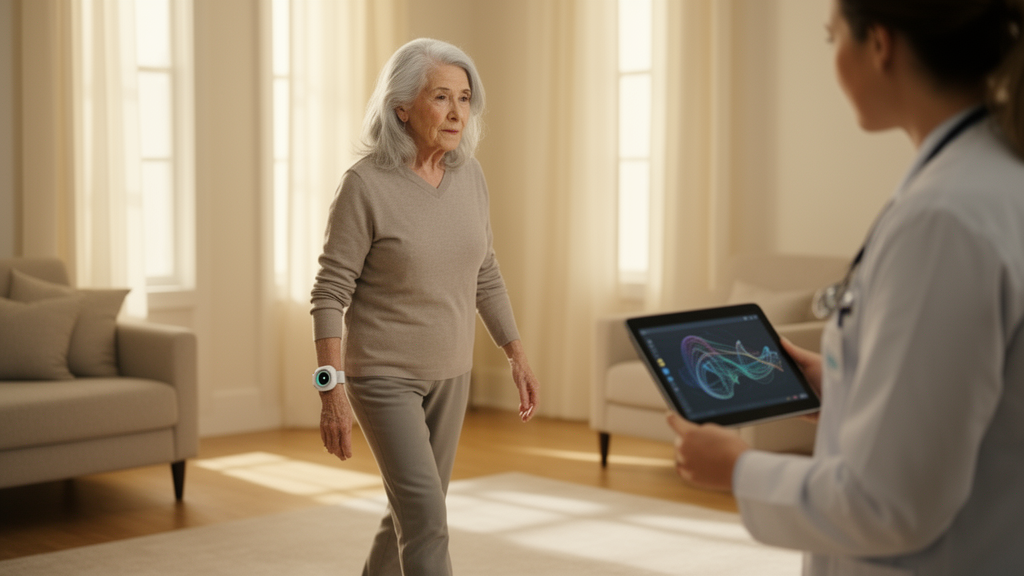
What if the earliest warning signs of aging are not hidden inside our cells, but written in the way we move, breathe, and respond to the world around us? A new commentary published in the journal Aging argues that the answer may lie in a concept most people never think about: behavioral complexity. Written by Jean-Jacques Temprado and Rita Sleimen-Malkoun of Aix Marseille Université, the French National Centre for Scientific Research (CNRS), and the Institute of Movement Sciences in Marseille, the piece appeared in Volume 18 of the journal on September 12, 2026, under the title “Complexity, variability, and the behavioral layer of gerophysics: a commentary on Unfried et al. (2026).” Its central claim is both simple and provocative: measuring complexity at the behavioral level may yield clinically relevant markers of declining adaptability near the transition to frailty.
To understand why this matters, it helps to know what gerophysics is. The term describes an emerging interdisciplinary field that applies concepts from physics, mathematics, and complex systems science to the study of aging. Rather than focusing solely on molecular damage or cellular senescence, gerophysics borrows tools such as dynamical systems theory, entropy, network theory, and stochastic processes to describe how biological systems change over time. A recent report from the Global Conference on Gerophysics, discussed by Unfried and colleagues in the work that prompted this commentary, outlined a framework intended to connect aging processes across biological scales, from individual cells to the whole organism. Temprado and Sleimen-Malkoun argue that this framework, ambitious as it is, remains incomplete without an explicit account of behavior.
The reasoning behind that argument rests on a decades-long insight from the study of living systems: healthy physiological and behavioral systems do not produce perfectly regular signals, nor do they produce pure noise. Instead, they generate complex fluctuations that unfold across multiple time scales. A healthy heartbeat, for example, is not metronomic; it varies in subtle, structured ways. The same is true of posture, gait, and even the timing of daily activity. This structured variability is not a defect. It reflects the flexibility an organism needs to respond to an ever-changing environment. When complexity declines, the authors suggest, patterns become either more predictable or more random, and either shift may signal a reduced capacity for adaptation.
There is already substantial evidence that such complexity measurements are relevant to aging. Studies of brain activity, muscular signals, and movement variability have all shown that the richness of these signals tends to change as people grow older. Previous research has even explored whether alterations in movement patterns can help predict future falls, one of the most consequential health risks in later life. The commentary’s authors argue that these scattered findings should be viewed as interconnected aspects of a single phenomenon rather than isolated observations. If aging erodes the adaptive flexibility of the body, that erosion should leave fingerprints everywhere, from neural oscillations to the way a person walks across a room.
One of the most intriguing points in the commentary concerns how complexity changes across different biological levels. The authors discuss preliminary, unpublished findings suggesting that network entropy may decrease with age even as molecular entropy increases. If that pattern is confirmed by future research, it would carry a major implication: complexity at one biological level cannot necessarily be inferred from measurements at another. A blood test that captures molecular entropy might say nothing about the dynamical richness of a person’s movement or brain rhythms. Behavioral complexity, in other words, may carry information that molecular biomarkers alone cannot provide, which is precisely why the authors want it built into the gerophysics framework from the start.
From this line of thinking emerges the commentary’s most distinctive proposal: the concept of “complexity reserve.” Temprado and Sleimen-Malkoun define it as the residual buffer of dynamical flexibility available before a biological system crosses into irreversible functional decline. The idea extends existing notions of cognitive reserve and physical reserve, which describe how some individuals tolerate brain or body damage better than others, but it shifts the focus to how behavior changes dynamically in response to challenges. Rather than asking how much function a person has at a single moment, complexity reserve asks how much adaptive capacity remains in the system before it tips past a critical threshold.
How might such a reserve actually be measured? The authors sketch two complementary approaches. The first would examine how well individuals maintain organized behavioral patterns when exposed to progressively demanding tasks or environmental changes, effectively stress-testing the system’s flexibility in a controlled way. The second would estimate how close a person’s current functional state is to a transition point at which even a relatively small stressor could disrupt stability. This second approach echoes ideas from dynamical systems theory, in which systems approaching a critical transition often show characteristic warning signs. Either method, if validated, could turn an abstract theoretical concept into something a clinician could assess.
The potential implications for frailty are what make the proposal clinically exciting. Frailty is a condition characterized by reduced physiological reserve and increased vulnerability to stress, and it often precedes falls, hospitalization, and loss of independence. Current assessments typically rely on isolated health measurements taken at a single point in time. The commentary suggests an alternative: continuous behavioral monitoring that could identify declining adaptability before more obvious functional deterioration occurs. Instead of waiting for a person to become visibly frail, clinicians might one day detect the erosion of behavioral complexity early enough to intervene. The authors also raise the possibility that past experiences shape resilience, and that exposure to stimulating environments and varied physical or cognitive challenges could help maintain behavioral flexibility. Complexity reserve might even help explain why individuals respond so differently to exercise programs or environmental enrichment, though the authors are careful to note that these possibilities remain hypotheses requiring empirical validation.
Another forward-looking direction involves a phenomenon known as “complexity matching,” the idea that interactions between systems can be influenced by the similarity of their temporal patterns. When two people converse, for instance, the rhythmic structure of their speech and gestures can become coupled. The authors propose investigating whether exposure to stimuli with fractal-like structures, patterns that repeat similarly across many scales, could help restore aspects of age-related behavioral complexity. They are explicit, however, that this remains a theoretical possibility, not an established intervention for reversing aging-related decline. The distinction matters in a field where hype often outruns evidence, and the commentary’s authors are unusually candid about the limits of their own proposal.
Indeed, intellectual honesty is a defining feature of the piece. The commentary is conceptual rather than experimental. It presents no new clinical trial results and does not demonstrate that behavioral complexity measurements can reliably predict frailty or improve health outcomes. The proposed relationships between behavioral complexity, biological resilience, and responses to interventions will require carefully designed studies, including longitudinal measurements that track the same individuals over time and standardized assessments of adaptive behavior. The authors also caution against assuming that different measures of complexity represent the same underlying biological process. Establishing how molecular, network, and behavioral dynamics relate to one another will be essential before these concepts can be translated into practical assessments or interventions. In science, complexity is an easy word to use and a hard thing to pin down.
Even with those caveats, the commentary represents a potentially valuable addition to the growing field of gerophysics. By integrating measurements of how organisms respond to environmental challenges with molecular and physiological models of aging, researchers may gain a more complete picture of resilience and functional decline than either approach can offer alone. The framework opens new, testable directions for studying how adaptability changes with age, and it suggests that the road to healthier aging may run not only through blood tests and brain scans, but through the rich, fluctuating patterns of everyday behavior. If the authors are right, the way we move through the world may quietly announce, long before symptoms appear, how much adaptive life we have left.
Subject of Research: Behavioral complexity and gerophysics as markers of aging and frailty
Article Title: Behavioral complexity could offer new insights into aging and frailty
Article References: Behavioral complexity could offer new insights into aging and frailty. (n.d.). Original publication
Image Credits: AI Generated
DOI: Not provided
Keywords: aging, frailty, behavioral complexity, gerophysics, dynamical systems, entropy, complexity reserve, movement variability, biomarkers, resilience, physiological rhythms, complexity matching
Cite Scienmag News
Beatrice Stafford. (October 9, 2026). Behavioral Complexity May Reveal Hidden Signs of Aging and Frailty. Scienmag. https://scienmag.com/behavioral-complexity-may-reveal-hidden-signs-of-aging-and-frailty/
Beatrice Stafford. "Behavioral Complexity May Reveal Hidden Signs of Aging and Frailty." Scienmag, 9 October 2026, https://scienmag.com/behavioral-complexity-may-reveal-hidden-signs-of-aging-and-frailty/. Accessed 9 October 2026.
Beatrice Stafford. "Behavioral Complexity May Reveal Hidden Signs of Aging and Frailty." Scienmag. October 9, 2026. https://scienmag.com/behavioral-complexity-may-reveal-hidden-signs-of-aging-and-frailty/


