


Deep in the forests of southern China, entomologists have unearthed a beetle so strange that its closest look-alikes are not other fungus beetles but a group of flamboyant ground beetles famous for cozying up to ants. A new study published in the journal ZooKeys reports the first record of the subfamily Pleganophorinae from mainland China, describing a brand-new species, Trochoideus sinensis, from the provinces of Guangdong and Jiangxi, along with the first Chinese records of two relatives from the island of Hainan. The findings push the worldwide count for this enigmatic little group to twenty-two species and hint at a hidden world of insect partnerships waiting to be documented.
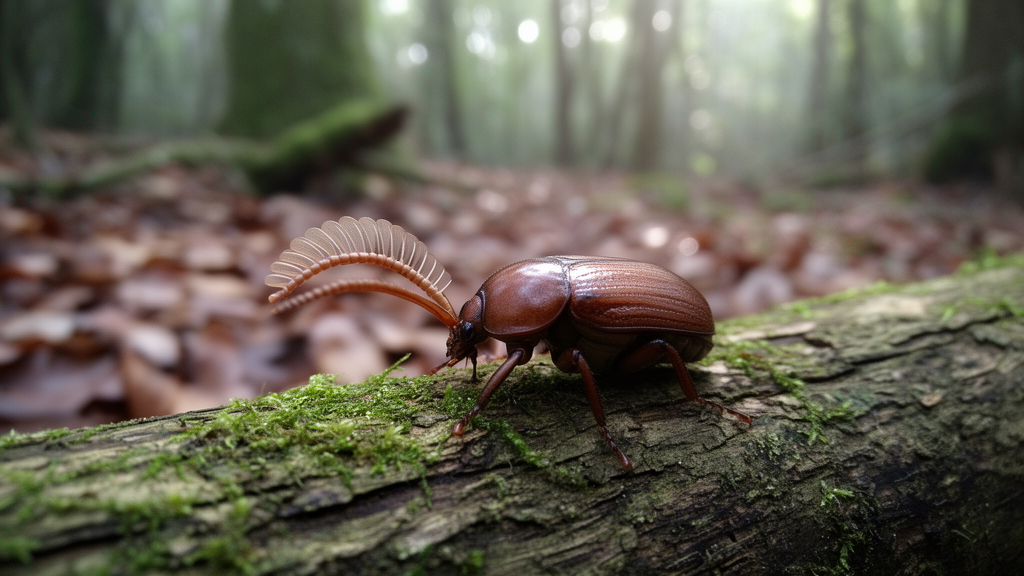
Pleganophorinae is one of the most peculiar corners of the beetle family Endomychidae, commonly known as handsome fungus beetles. Only three genera and twenty-one species were known before this study, scattered across tropical regions and a few pockets of Europe. What sets these beetles apart is their extraordinary antennae. Instead of the ordinary thread-like feelers most beetles carry, males in this group have just four or five antennal segments, with the last one or two dramatically swollen into plates and clubs. The effect is so striking that it superficially resembles the antennae of Paussinae, a subfamily of ground beetles renowned for living inside ant nests. That resemblance has long fueled suspicion that these beetles, too, may be socially parasitic, quietly cohabiting with ants or termites.
Telling the two groups apart comes down to anatomical details on the underside of the body, and the new study provides the clearest comparison yet. In Pleganophorinae, the intercoxal process of the mesoventrite is trapezoidal and moderately separates the middle coxae, while the rear coxae are widely separated and the metaventrite lacks an intercoxal process. In Paussinae, by contrast, those processes are extremely narrow and the coxae almost touch. Other diagnostic features include mandibles that are produced and finely cleft at the tips, stout four-segmented tarsi, and, in some females, antennae with as many as seven segments, a striking sexual dimorphism within a single species.
The new species, Trochoideus sinensis, was collected in substantial numbers: nearly 120 specimens were examined from Chebaling in Guangdong and Jiulianshan in Jiangxi. The beetles are dark brown, elongate-oval, shiny, and between roughly 4.7 and 5.2 millimeters long. Their most telling feature is again the antenna. In males, the fourth antennomere is broadly oval, about 1.4 times as long as wide, while females bear a fourth segment shaped like an elongated triangle that is deeply and widely notched at the tip. Those proportions distinguish the new species from its closest relative, Trochoideus tonkineus, whose males have an elongate-oval fourth segment twice as long as wide and whose females carry an antenna with nearly parallel sides and three teeth at the apex. Coarse punctation on the pronotum and wing covers, plus a weakly arched front edge of the pronotum, complete the separation.
The species epithet derives from the Latin root sin-, a nod to the beetle being known so far only from China. Beyond the new species itself, the study records Trochoideus desjardinsi, a widely traveled species stretching from Africa and South Asia to the Pacific, from Hainan for the first time, and adds Trochoideus tonkineus, previously known only from Vietnam, as new to China. The researchers also provide an identification key to all three Chinese species of Trochoideus, giving future surveyors a practical tool.
The discoveries did not stop at species boundaries. Working through century-old type material at the Natural History Museum in London, the team dissected the syntypes of Dadocerus nitidus, a Bornean species described by the prolific entomologist Gilbert Arrow in 1920. Arrow had guessed the two specimens were probably males without ever examining their genitalia. He was wrong. Both turned out to be females. The study describes the male of D. nitidus for the first time, based on recently collected material from Sabah in Malaysian Borneo, formally corrects the sex assignment, and designates a lectotype and paralectotype to secure the species’ name.
To bolster the morphological work, the authors turned to DNA barcoding. A specimen of the new species was preserved in anhydrous ethanol, and a fragment of the mitochondrial cytochrome c oxidase I gene, the standard barcode region for animals, was amplified using the classic LCO1490 and HCO2198 primers. The resulting sequence, deposited in GenBank, provides a molecular anchor for the new species that can be compared against barcodes of related taxa as future phylogenetic work on the subfamily develops. Pairing careful morphology with sequence data is increasingly the norm in beetle taxonomy, and this study shows why: the antennal oddities that define Pleganophorinae vary dramatically between sexes, and molecular data can help confirm where species boundaries truly lie.
Perhaps the most tantalizing clues come from field ecology rather than the laboratory. Specimens of T. sinensis were captured in a mycophagous insect window trap set on a tree hosting wood-decay fungi, which DNA sequencing of the internal transcribed spacer region identified as Ganoderma applanatum, a Sanghuangporus species, and Stereum ostrea. More intriguing still, adults were observed co-occurring with termites of the genus Nasutitermes beneath the bark of a decaying tree, a scene the authors interpret as a possible symbiotic association. The related T. desjardinsi, meanwhile, has been recorded inhabiting nests of the invasive yellow crazy ant, Anoplolepis gracilipes, and has previously been found alongside other ants and termites, reinforcing the idea that these beetles and social insects are more than casual neighbors.
If confirmed, such a symbiosis would make evolutionary sense of the group’s outlandish antennae. In ant-nest-dwelling paussine beetles, exaggerated antennal structures serve in chemical and tactile communication with their hosts, and the parallel evolution in Pleganophorinae suggests similar pressures may be at work. The genus name itself carries a whiff of this history: Westwood established Trochoideus in 1833 based on a specimen preserved in gum copal that had earlier been described as a paussine ground beetle, Paussus cruciatus. Two centuries later, the beetles are still blurring the line between fungus beetle and social-insect guest.
With Pleganophorinae now firmly on China’s faunal map, the subfamily stands at twenty-two species worldwide, and the stage is set for deeper investigation. The confirmed association of the new species with tree fungi and its apparent proximity to Nasutitermes termites raise immediate questions: do these beetles rear their young inside termite galleries, do they mimic host odors, or do they simply exploit the sheltered, fungus-rich microhabitats that decaying wood provides? Answering them will require live observations, chemical ecology, and broader sampling across southern China and Southeast Asia. For now, the diminutive T. sinensis, lurking under bark beside its termite companions, stands as a reminder that even well-studied beetle families can still yield creatures that rewrite the textbooks on where a species belongs and how it makes its living.
Subject of Research: Taxonomy and ecology of the beetle subfamily Pleganophorinae, including a new species of Trochoideus from China
Article Title: Notes on the subfamily Pleganophorinae , with the description of a new species of the genus Trochoideus Westwood, 1833 ( Coleoptera , Endomychidae ) from China
Article References: Li, P.-P., Bai, M., & Chang, L.-X. (2026). Notes on the subfamily Pleganophorinae, with the description of a new species of the genus Trochoideus Westwood, 1833 (Coleoptera, Endomychidae) from China. ZooKeys, 1290, 293-317. https://doi.org/10.3897/zookeys.1290.183211
Image Credits: AI Generated
DOI: 10.3897/zookeys.1290.183211
Keywords: Pleganophorinae, Trochoideus sinensis, Endomychidae, Coleoptera, new species, China, COI barcoding, symbiosis, termites, fungus beetles, antennal dimorphism, ZooKeys
Cite Scienmag News
Drew Townsend. (October 18, 2026). Beetle With Bizarre Termite-Style Antennas Discovered in Mainland China for the First Time. Scienmag. https://scienmag.com/beetle-with-bizarre-termite-style-antennas-discovered-in-mainland-china-for-the-first-time/
Drew Townsend. "Beetle With Bizarre Termite-Style Antennas Discovered in Mainland China for the First Time." Scienmag, 18 October 2026, https://scienmag.com/beetle-with-bizarre-termite-style-antennas-discovered-in-mainland-china-for-the-first-time/. Accessed 18 October 2026.
Drew Townsend. "Beetle With Bizarre Termite-Style Antennas Discovered in Mainland China for the First Time." Scienmag. October 18, 2026. https://scienmag.com/beetle-with-bizarre-termite-style-antennas-discovered-in-mainland-china-for-the-first-time/


