


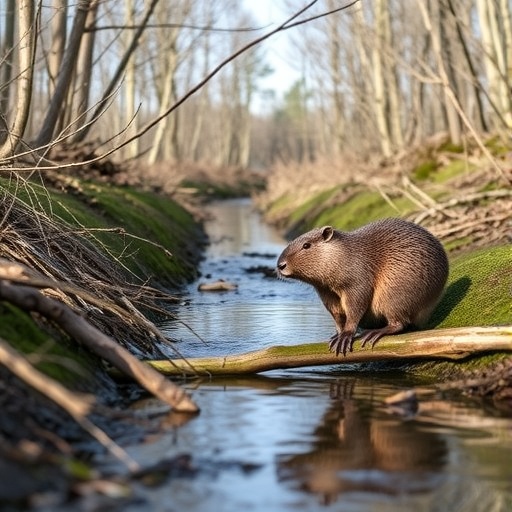
In a groundbreaking interdisciplinary study published in Communications Earth & Environment, researchers have unveiled the remarkable role that beavers play as natural ecosystem engineers capable of converting stream corridors into persistent carbon sinks. This research, spearheaded by an international team from the University of Birmingham, Wageningen University, and the University of Bern, represents a significant leap forward in our understanding of how biological agents influence carbon cycling and climate regulation in freshwater ecosystems.
The study investigates over a decade of beaver-induced environmental changes in a stream corridor in northern Switzerland, harnessing comprehensive data sets including sediment chemistry, hydrology, greenhouse gas flux measurements, and carbon budget modeling. These beaver-engineered wetlands demonstrated carbon storage capacities up to tenfold greater than comparable but unaffected stream systems, with an accumulated carbon mass of 1,194 tonnes over 13 years. This translates to an impressive carbon sequestration rate of approximately 10.1 tonnes of CO₂ equivalent per hectare annually.
At the core of the research is the synthesis of high-resolution hydrological and chemical data. Beaver dams slow water flow, causing sedimentation and the formation of wetlands, which in turn alters the biogeochemical cycling of carbon through both organic and inorganic pathways. By trapping sediments and enhancing wetland area, beavers fundamentally modify the flux of dissolved inorganic carbon beneath the surface, converting systems that might otherwise be carbon-neutral or sources of emissions into long-term sinks. These findings challenge prior assumptions that small headwater streams have limited potential for carbon sequestration.
The temporal dynamics of carbon fluxes within these engineered landscapes show pronounced seasonal variability. During summer months, receding water levels expose previously submerged sediment surfaces, temporarily turning the wetlands into transient CO₂ sources as microbial respiration rates increase. However, evaluating full annual carbon budgets reveals that these seasonal emissions are outweighed by sediment accumulation and woody biomass deposition over time. Methane emissions, often a concern in wetland carbon accounting due to their high global-warming potential, were found to be negligible, comprising less than 0.1% of total greenhouse gases emitted from the studied system.
These ecological processes underscore a vital nexus between wildlife conservation and climate change mitigation. The successful rewilding and recolonization of beaver populations across Europe – following decades of habitat restoration and legal protection – represent an unintentional yet potent nature-based climate solution. By engineering landscapes that amplify carbon retention, beavers contribute ecosystem-level services vital for carbon management, potentially offsetting national emissions without human-driven interventions or significant financial input.
Sediment cores analyzed in the study revealed that beaver wetlands contain substantially higher concentrations of both inorganic and organic carbon compared to adjacent forest soils. In particular, sediments held up to 14 times more inorganic carbon and eight times more organic carbon. Moreover, organic matter from riparian deadwood accounted for nearly 50% of stable long-term carbon storage, emphasizing the intertwined relationship between terrestrial vegetation and aquatic carbon cycling mediated by beaver activity.
Several challenges remain for integrating these findings into broader climate strategy frameworks. The durability of beaver dams emerges as a critical factor because wetland persistence and carbon storage capacity depend on intact impoundments. The risk of dam breach or disturbance could reverse accumulated carbon gains by re-exposing buried sediments to oxidation. Understanding the balance between ecosystem dynamics and anthropogenic pressures will be essential for harnessing beaver-driven carbon sinks at scale.
Scaling the Swiss case study to national floodplain areas suitable for beaver recolonization, the research team estimates that these wetlands could abate between 1.2% and 1.8% of Switzerland’s annual carbon emissions. This remarkable potential for passive carbon sequestration presents a compelling addition to existing land management and conservation policies, elevating ecological engineering by wildlife as a practicable climate mitigation tool.
The sophisticated methodology employed integrated field hydrology, extensive chemical profiling, and long-term modeling—advancing the frontier of carbon budget quantification in freshwater ecosystems. This holistic approach ensures that multi-seasonal fluxes of CO₂, CH₄, and dissolved inorganic carbon are accurately accounted for, providing an unprecedentedly detailed carbon budget for an actively beaver-engineered stream corridor.
Authors such as Dr. Joshua Larsen highlight the transformative implication that beavers hold for future land-use planning and rewilding initiatives. By restoring some of nature’s most dynamic ecosystem engineers, we may unlock powerful natural mechanisms for carbon sequestration capable of supplementing human-driven climate actions. This research thus bridges conservation biology, hydrology, and climate science to reveal a promising pathway for ecosystem-based solutions.
Looking ahead, researchers emphasize the importance of continued, ecosystem-scale studies to monitor how expanding beaver populations will shape future carbon cycles in freshwater and floodplain environments. As beavers increasingly recolonize European landscapes, their influence on greenhouse gas fluxes, sediment dynamics, and carbon sequestration will be an essential focus for developing resilient climate adaptation strategies.
This pioneering contribution to the field of carbon ecology not only enhances scientific knowledge but also potentially reshapes how policymakers integrate wildlife conservation with climate goals, advocating for strategies that bolster natural processes rather than relying solely on technical interventions. In doing so, beavers emerge as unlikely yet vital allies in the global effort to curb atmospheric CO₂ concentrations.
News Publication Date: 18-Mar-2026
Web References:
https://www.nature.com/articles/s43247-026-03283-8
References:
Hallberg, L., Larsen, A., Larsen, J.R., et al. (2026). Beavers can convert stream corridors to persistent carbon sinks. Communications Earth & Environment. DOI: 10.1038/s43247-026-03283-8.
Cite Scienmag News
Denise Maddox. (March 18, 2026). Beavers Transform Stream Corridors into Long-Term Carbon Storage Sites. Scienmag. https://scienmag.com/beavers-transform-stream-corridors-into-long-term-carbon-storage-sites/
Denise Maddox. "Beavers Transform Stream Corridors into Long-Term Carbon Storage Sites." Scienmag, 18 March 2026, https://scienmag.com/beavers-transform-stream-corridors-into-long-term-carbon-storage-sites/. Accessed 4 September 2026.
Denise Maddox. "Beavers Transform Stream Corridors into Long-Term Carbon Storage Sites." Scienmag. March 18, 2026. https://scienmag.com/beavers-transform-stream-corridors-into-long-term-carbon-storage-sites/


