


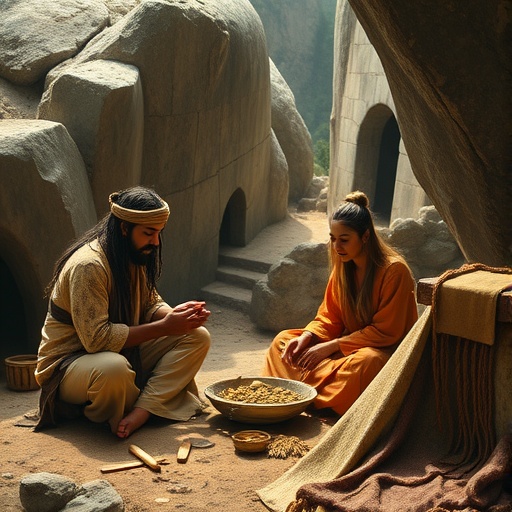
The Andean region, known for its rich cultural tapestry and archaeological significance, continues to be a focal point of exploration and academic inquiry. Recent research by C. Mesía-Montenegro sheds light on the Kotosh religious tradition, an ancient practice rooted deep within the Andes. This study is significant not only for its archaeological findings but also for its innovative application of Bayesian reasoning to uncover the intricate relationships between rituals, time, and cultural beliefs in this context.
Bayesian reasoning, a statistical method that allows for the updating of probabilities based on new evidence, has emerged as a crucial tool in the field of archaeology. By applying this method, Mesía-Montenegro provides a framework that enhances our understanding of how religious practices were developed and maintained through time, particularly within the Kotosh tradition. This study enables a nuanced analysis of the temporal aspects of rituals, suggesting that time was not merely a linear progression but rather an essential component of the Kotosh worldview.
The Kotosh religious tradition, which dates back to the Kotosh culture flourishing between 1800 and 600 BCE, was characterized by its complex rituals and distinctive architectural features. The site itself includes significant structures that serve both community and religious functions. These constructions were not only physical manifestations of belief systems but were also integral to the social fabric of Andean societies. Mesía-Montenegro’s work emphasizes how these structures served as a stage for ritual performances that were deeply intertwined with the community’s understanding of time and the cosmos.
Ritual practices within the Kotosh tradition reveal a sophisticated relationship with deities, ancestors, and the environment. Rituals were often performed in cycles and included offerings, music, and dance, highlighting a communal engagement that reinforced social cohesion. Mesía-Montenegro posits that the timing of these rituals was meticulously calculated, with specific periods deemed auspicious for various ceremonies. This temporal precision speaks volumes about the Kotosh people’s understanding of seasonal rhythms and celestial events, thus framing their religious practice within a broader contextual narrative.
Moreover, the study delves into the symbolic significance of the rituals, which extended beyond mere worship. They served as a means of communicating with supernatural entities and asserting control over natural forces. In this sense, the Kotosh tradition can be viewed as a response to the environmental challenges that ancient communities faced in the Andes. By performing rituals and adhering to specific calendrical practices, the Kotosh people aimed to align themselves with these forces, ensuring agricultural productivity and community stability.
The integration of Bayesian reasoning aids in reconstructing the past, allowing researchers to make informed hypotheses based on archaeological data. Mesía-Montenegro employs this approach to assess the likelihood of various events occurring within the Kotosh timeframe. This method not only enhances the validity of historical interpretations but also opens new avenues for investigating cultural evolution concerning time and ritual. The implications of this research extend beyond Kotosh, encouraging a broader application of Bayesian reasoning across archaeological disciplines.
The findings from this study contribute to ongoing discussions about the significance of rituals in ancient societies. Mesía-Montenegro argues that understanding the temporal dynamics of rituals offers fresh insights into the socio-political organization of the Kotosh tradition. The interplay between time and ritual indicates a level of sophistication in their societal structures, where the calendar held profound significance in governance, resource allocation, and community identity.
Furthermore, the research emphasizes the transitional nature of religious practices. As societies evolve, so too do their beliefs and rituals. The Kotosh tradition encapsulates this dynamism, showcasing how rituals may adapt over time while still maintaining core elements of the original belief system. Mesía-Montenegro’s work thus challenges researchers to consider not just the static representations of ancient practices but the fluid, evolving nature of cultural traditions.
The implications for contemporary society are equally fascinating. As we navigate our own complexities in time and ritual—whether through modern religious practices or cultural celebrations—this research invites reflection on how our understanding of time continues to shape belief systems. It becomes evident that, just as the Kotosh people engaged with their environment through ritualized time, so too do modern societies establish connections with their pasts through the continued practice of rituals.
In conclusion, Mesía-Montenegro’s exploration of the Kotosh religious tradition illuminates how time, ritual, and Bayesian reasoning interweave to deepen our understanding of ancient Andean cultures. The research not only contributes to archaeological scholarship but also posits significant questions about the relationship between time, culture, and the human condition. It paves the way for future investigations that may draw parallel insights between ancient practices and contemporary beliefs, offering a broader context for understanding human behavior in relation to the passage of time.
This research is a testament to the depth and richness of Andean traditions while showcasing the potential of interdisciplinary approaches in archaeology. As scholars continue to explore the ancient world through modern lenses, the lasting legacy of civilizations like Kotosh reminds us of the intricate relationships between belief, time, and the enduring human spirit.
Mesía-Montenegro, C. Time, ritual, and bayesian reasoning: charting the Andean Kotosh religious tradition.
Archaeol Anthropol Sci 17, 244 (2025). https://doi.org/10.1007/s12520-025-02370-9
Cite Scienmag News
Courtney Benton. (December 2, 2025). Bayesian Insights into Andean Kotosh Rituals. Scienmag. https://scienmag.com/bayesian-insights-into-andean-kotosh-rituals/
Courtney Benton. "Bayesian Insights into Andean Kotosh Rituals." Scienmag, 2 December 2025, https://scienmag.com/bayesian-insights-into-andean-kotosh-rituals/. Accessed 4 September 2026.
Courtney Benton. "Bayesian Insights into Andean Kotosh Rituals." Scienmag. December 2, 2025. https://scienmag.com/bayesian-insights-into-andean-kotosh-rituals/


