


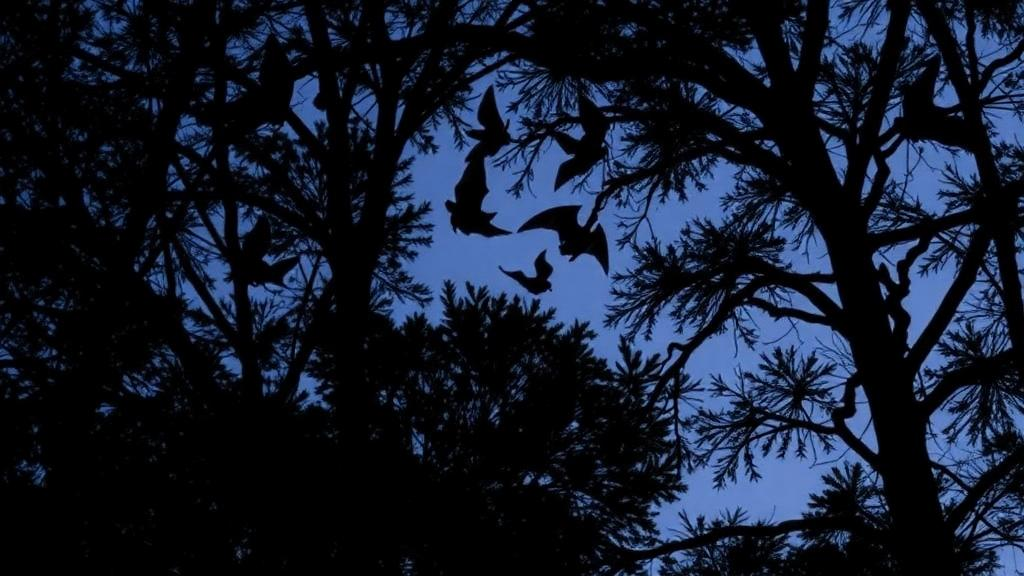
Deep in the hills southeast of Santiago, inside one of the world’s 36 recognized biodiversity hotspots, an eight-month acoustic survey has revealed that the bats of Chile’s endangered sclerophyllous forest do not simply switch on for the reproductive season and stay on. Their activity rises and falls in two distinct waves, collapses during the hottest month of summer, and shifts species by species in ways that could reshape how scientists monitor and protect these animals. The study, published in Neotropical Biology and Conservation, is the first to describe monthly variation in bat species richness and activity during the breeding season in the remnants of this temperate Mediterranean forest, an ecosystem that has lost at least 70 percent of its original coverage and remains poorly represented in Chile’s national system of protected wild areas.
The research team worked in Las Torcazas de Pirque Nature Sanctuary, an 827-hectare reserve spanning altitudes from 900 to 2,500 meters in the Metropolitan Region of central Chile. The sanctuary sits in the ecoregion of Sclerophyllous Forest and Scrubland, the middle zone of the Central Chilean Winter Rainfall-Valdivian Forests hotspot, which harbors many endemic plant and animal species. The climate is cold temperate with winter rain, average monthly temperatures ranging from 7.5 degrees Celsius in July to 21.5 degrees Celsius in January, and roughly 648 millimeters of annual rainfall concentrated in the winter months. Southern exposure slopes carry dense, humid sclerophyllous forest with a native shrub understory, while northern slopes hold thorny scrub with perennial and annual herbs.
Six bat species are known from the sclerophyllous forest of central Chile, and the survey recorded all of them: the Brazilian free-tailed bat Tadarida brasiliensis, the Valparaiso myotis Myotis arescens, the cinnamon red bat Lasiurus varius, the southern hoary bat Lasiurus villosissimus, and two big-eared brown bats, Histiotus montanus and Histiotus macrotus. All are native, and one, Myotis arescens, is endemic to central Chile, having only recently been recognized as a full species rather than a subspecies of M. chiloensis. The sanctuary concentrates an important part of the country’s threatened bat species, making the site a natural laboratory for understanding how these animals use what little forest remains.
Between September 2013 and April 2014, covering austral spring, summer and fall, the researchers surveyed twelve sampling sites monthly, each more than 150 meters from any other to promote independence. Sites were placed on trails, which bats typically use as flight paths. Surprises were avoided around the full moon, since lunar light suppresses bat activity, and sampling ran after sunset within six hours, matching the peak foraging window of insectivorous bats. On each night the team visited the same six sites three times in random order, recording echolocation calls for ten minutes per visit with an EchoMeter 3 ultrasonic detector, its microphone angled upward at 45 degrees and set 1.5 meters above the ground. In total, 48 effective hours of acoustic recording produced 710 files, of which 330 were classified as genuine bat calls.
The seasonal pattern that emerged was anything but flat. No bats were recorded in September, at the tail of winter, but species richness peaked in October and November during spring. It then dropped sharply in January, the height of mid-summer, before rebounding in February and March at the end of summer, though slightly below the spring maximum. By April, only one species remained detectable. Bat activity followed the same rhythm, with a first peak in October and November and a second in March. The assemblage structure shifted in parallel: during spring, Shannon diversity and Pielou evenness were significantly higher, meaning more species recorded in similar relative abundances, whereas from late summer into autumn both indices declined significantly, ending with the absolute dominance of Myotis arescens.
Species-specific timing added another layer of complexity. The first activity peak appeared in November for M. arescens, L. varius, H. macrotus and H. montanus, but for T. brasiliensis and L. villosissimus it arrived a month later, in December. The researchers suggest this gap could reflect the greater body mass of these two open-space flyers, which may allow longer torpor periods, or their greater sensitivity to cold night air. Migration cannot be ruled out either, since both are classified as possible migratory species. Only M. arescens showed a clear second peak, with twice the activity of its spring maximum, likely reflecting intensified feeding to build fat reserves for winter torpor as well as births; unpublished capture data from the study area show that 45 percent of M. arescens caught in summer were young bats.
Temperature proved to be the dominant driver, but with a twist. Total bat activity correlated positively with average monthly air temperature, yet the relationship was non-linear. Above roughly 15 degrees Celsius, activity increased, with the greatest activity concentrated between 16 and 19 degrees Celsius. Beyond that range, activity fell, explaining the abrupt decline in richness and activity during January, the hottest month. The authors attribute this drop to the risk of hyperthermia: flying bats generate substantial metabolic heat, and when ambient temperatures climb too high, dissipating that heat becomes difficult. For aerial insectivores in temperate zones, temperature governs both insect availability and the bats’ own energy balance, since they must maintain stable body temperature outside torpor while paying high costs for flight and echolocation.
Habitat variables mattered too, but selectively. Canopy cover, measured at the microhabitat level with 12-meter transects, negatively affected only T. brasiliensis and L. varius. For the free-tailed bat, the explanation lies in its low maneuverability and low-frequency echolocation calls, which restrict insect capture under dense canopies. For L. varius, which forages within the forest, excessively dense cover likely obstructs flight paths. Distance to the nearest water body negatively influenced T. brasiliensis and L. villosissimus, pointing to the importance of aquatic habitats as feeding grounds in dry Mediterranean forests, where insect life cycles are tied to water and its surrounding vegetation. Both species are fast, energetically economical open-space flyers, well suited to commuting toward water sources during the dry summer months.
The conservation implications are direct. Because bat diversity and activity vary so strongly with survey date and habitat features, single-snapshot surveys risk severely underestimating the species present. The authors argue that multiple surveys across the reproductive season are essential, and that in this region sampling should be concentrated in spring rather than summer. This matters particularly for environmental impact assessments in Chile, which the researchers describe as methodologically deficient, extremely limited in time, and often scheduled during periods unfavorable for bats. For high-impact projects such as wind farms, the seasonal patterns documented here could inform when and how bat surveys are designed, improving protection for communities inhabiting a biodiversity hotspot where the sclerophyllous forest has suffered some of the greatest surface losses of any natural ecosystem and where the natural history of its bats has only recently begun to be studied.
Subject of Research: Ecology and conservation biology
Article Title: Seasonal variation of bat activity in an endangered temperate forest in the Chilean biodiversity hotspot
Article References: Escobar, M. A. H., & Villaseñor, N. R. (2024). Seasonal variation of bat activity in an endangered temperate forest in the Chilean biodiversity hotspot. Neotropical Biology and Conservation, 19(4), 475-494. https://doi.org/10.3897/neotropical.19.e131710
Image Credits: AI Generated
DOI: 10.3897/neotropical.19.e131710
Keywords: Seasonal, variation, activity, endangered, temperate, forest, Chilean, biodiversity, hotspot, scientific research
Cite Scienmag News
Margaret Porter. (October 17, 2026). Bats in Chile’s endangered forest peak twice a season, revealing hidden survey windows. Scienmag. https://scienmag.com/bats-in-chiles-endangered-forest-peak-twice-a-season-revealing-hidden-survey-windows/
Margaret Porter. "Bats in Chile’s endangered forest peak twice a season, revealing hidden survey windows." Scienmag, 17 October 2026, https://scienmag.com/bats-in-chiles-endangered-forest-peak-twice-a-season-revealing-hidden-survey-windows/. Accessed 17 October 2026.
Margaret Porter. "Bats in Chile’s endangered forest peak twice a season, revealing hidden survey windows." Scienmag. October 17, 2026. https://scienmag.com/bats-in-chiles-endangered-forest-peak-twice-a-season-revealing-hidden-survey-windows/


