


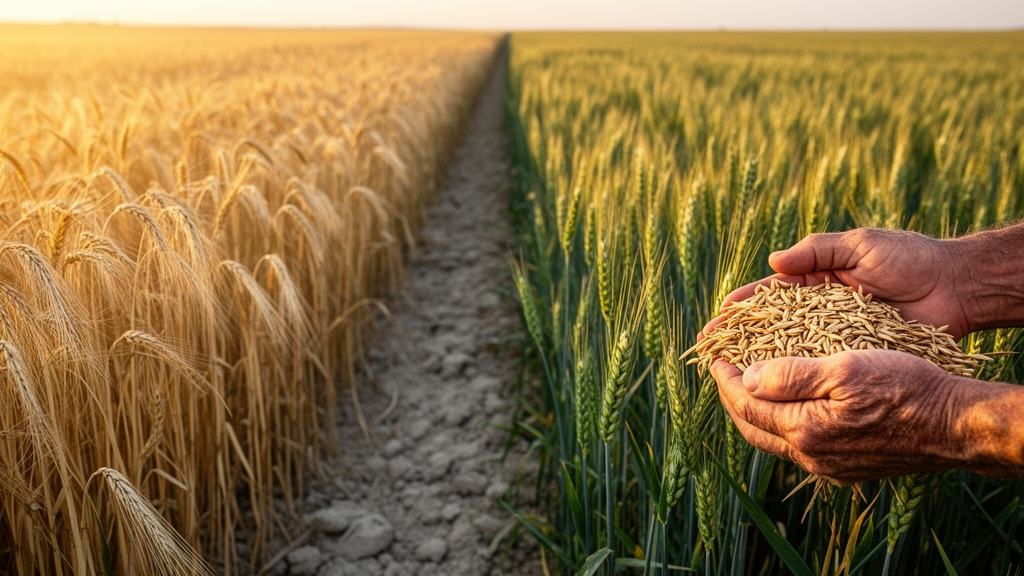
For decades, farmers have held a quiet conviction: when the going gets tough, barley outperforms wheat. Drought, thin soils, marginal fields—the popular wisdom says barley shrugs off stress that would leave wheat struggling. Now, one of the most comprehensive field experiments ever conducted on the two cereal crops has put that belief to a rigorous statistical test, and the results are more nuanced than the folklore suggests. Barley does indeed pull ahead of wheat in the leanest environments, but the advantage evaporates—and even reverses—when conditions improve. And in a twist with major implications for human nutrition, wheat grain consistently packs a denser mineral payload than barley across nearly every nutrient measured.
The study, published in the Journal of Agriculture and Food Research, was led by Curtis B. Adams of the USDA Agricultural Research Service together with Christopher W. Rogers, Juliet M. Marshall, and Kurtis L. Schroeder of the University of Idaho. Rather than comparing the two species as monoliths, the team dissected them into their market classes: three classes of spring barley (feed, food, and malt) and three classes of spring wheat (hard red, hard white, and soft white). These classes exist because selective breeding has pushed each species toward distinct end uses—malt barley must stay below a 13.0 percent grain protein ceiling for premium pricing, while hard red spring wheat is bred to exceed a 14.0 percent protein floor. Those breeding targets, the researchers suspected, might shape not only grain chemistry but also how each class responds to environment.
The experimental scale was formidable. The six crop classes were grown side by side at seven locations across northern and southern Idaho—Aberdeen, Ashton, Craigmont, Genesee, Idaho Falls, Rupert, and Soda Springs—spanning elevations from 823 to 1,760 meters, in the 2018 and 2019 growing seasons. The sites ranged from fully irrigated fields receiving complete evapotranspiration replacement to dryland plots relying solely on precipitation, and soil organic matter ranged from 9 to 40 grams per kilogram. Each class was managed with its own best practices under randomized complete block designs with four replicates, and three varieties per class were selected to create a balanced dataset of 14 distinct environments. At physiological maturity, aboveground biomass was sampled from non-border plots, hand-threshed into grain and residue, and analyzed for carbon, nitrogen, phosphorus, potassium, calcium, magnesium, sulfur, zinc, and manganese using Dumas combustion and ICP-OES at a proficiency-certified laboratory.
The headline yield finding vindicates part of the folk wisdom. When grain yields were regressed against a quantitative modeled estimate of each environment’s productivity, the slopes of the species-level relationships diverged significantly. In the lowest-yielding conditions, barley systems were modeled to produce up to 0.62 megagrams per hectare more grain than wheat. But at the high-yielding end of the spectrum, wheat was modeled to exceed barley by up to 0.36 megagrams per hectare. The pattern echoes a 2024 analysis of Argentine variety trials by Gimenez and colleagues, which found barley out-yielded early-maturing wheat in stressful environments while late-flowering wheat slightly out-yielded barley in productive ones. It contrasts, however, with a 2023 synthesis by Slafer and Savin covering worldwide comparisons, which detected no consistent species advantage at any yield level.
Adams and colleagues argue that these discrepancies resolve once breeding investment is taken into account. In their Idaho data, the species-level yield interaction was actually driven by class-level nuance: food barley trended low while malt barley trended consistently high, and the white wheat classes exhibited greater environmental responsiveness, yielding relatively poorly in lean fields but strongly in productive ones. Malt barley has received extensive breeding attention in Idaho; food barley comparatively little. The researchers suggest that the comparative performance of wheat and barley in any given region depends on the relative breeding investment in the germplasm being compared, the broader non-yield goals of that breeding, and the biochemical traits—like grain protein—that classes are selected to differ in. Regional species differences, they note, may simply offset one another when data are pooled worldwide.
The mineral nutrition results may prove even more consequential than the yield findings. Grain nitrogen concentration differed dramatically and predictably among classes, with hard red wheat highest, feed and malt barley lowest, and soft white wheat the only wheat class overlapping with barley. Beyond nitrogen, wheat grain generally accumulated higher concentrations of phosphorus, magnesium, sulfur, zinc, and manganese than barley, while barley grain carried more potassium. The manganese contrast was the most striking: barley grain Mn was low and nearly steady across environments, increasing only 5.38 milligrams per kilogram from low to high environmental Mn index, while wheat grain Mn was far greater overall and highly responsive, climbing 44.1 milligrams per kilogram across the same range. The species gap widened from roughly 13 to 50 milligrams per kilogram as environmental Mn availability increased. The researchers speculate that differences in rhizosphere acidification—a mechanism underlying luxury Mn uptake in known hyperaccumulator species—might explain the divergence.
These grain chemistry differences carry direct health implications. Mineral bioavailability depends on more than density alone, but the results suggest whole-grain wheat offers a greater source of nutritional minerals than barley, a finding consistent with earlier regional surveys from Finland and Manitoba showing wheat among the highest and barley the lowest in Mn among temperate cereals. The consistently higher grain magnesium in wheat—averaging 0.27 grams per kilogram more—also matches established whole-grain nutritional data. For populations facing mineral deficiencies, the species choice in a cropping system could thus matter for reasons entirely separate from yield or market price.
The residue story, by contrast, is one of remarkable similarity with important exceptions. Wheat and barley produced statistically identical amounts of residue, and their residue nitrogen concentrations and carbon-to-nitrogen ratios were nearly equal across environments. Since residue C/N governs microbial decomposition rates, nitrogen mineralization, and soil carbon sequestration, the findings suggest residue management can be broadly similar between the species. But other residue nutrients diverged sharply. Wheat residue carried about 7.59 grams per kilogram more potassium than barley—potassium being by far the most concentrated nutrient in residue of either crop—while barley residue accumulated more phosphorus, calcium, and zinc, with barley concentrations rising disproportionately as environmental nutrient indices increased. Earlier work by the same team estimated that wheat and barley residues extract averages of 28.4 and 23.9 kilograms of potassium per hectare, respectively, for every megagram of grain yield, underscoring the severe economic cost if residue is harvested and the nutrients within it must be replaced by fertilizer.
Perhaps the most unexpected discovery was a positive covariance between residue productivity and residue nutrient concentrations. This is counter to the well-documented negative tradeoff between grain yield and grain nutrient concentration in small grains, which the study also confirmed in the grain fraction. In the residue, biomass production and nutrient density rose together in the same environments, meaning nutrient extraction through residue is even higher in productive systems than simple averaging would predict. The variance deconstruction analysis showed that residue nutrient concentrations and residue production each contributed substantially—often more than 100 percent combined before a large negative covariance term offset them—while for grain, yield was typically the dominant driver of nutrient uptake, contributing 64 to 84 percent of variance for most nutrients. The exception was grain manganese, for which concentration, not yield, was the largest contributor to uptake variance.
Principal component analysis of whole-crop data revealed further structure in how nutrients associate. In both species, phosphorus, magnesium, and zinc stoichiometries clustered together, as did nitrogen, potassium, and sulfur—patterns the researchers attribute to favorable nutrient balance, nitrogen sufficiency from fertilizer inputs, and the well-known coordination between N and K uptake. Manganese stood negatively related to nearly all other nutrients, especially in barley, hinting at a possible Mn-P antagonism. All carbon-to-nutrient ratios declined as environmental nutrient availability rose, though at different rates. Taken together, the study delivers a dual message: the barley-beats-wheat-in-bad-years perception holds only at the environmental margins and depends heavily on which classes are being compared, while the mineral density advantage of wheat grain—tempered by barley’s potassium edge and its residue phosphorus and zinc accumulation—gives growers, breeders, and nutritionists a far richer basis for deciding which cereal belongs in which field, and for whom.
Subject of Research: Agricultural Science
Article Title: Comparative class-wise wheat and barley system yields, and mineral nutrient concentrations, stoichiometry, and uptake across wide environmental ranges
Article References: Adams, C. B., Rogers, C. W., Marshall, J. M., & Schroeder, K. L. (2026). Comparative class-wise wheat and barley system yields, and mineral nutrient concentrations, stoichiometry, and uptake across wide environmental ranges. Journal of Agriculture and Food Research, Article 103376. https://doi.org/10.1016/j.jafr.2026.103376
Image Credits: AI Generated
DOI: 10.1016/j.jafr.2026.103376
Keywords: wheat, barley, crop yield, mineral nutrients, grain nutrition, stoichiometry, crop residue, agronomy, Comparative, class-wise, system, yields
Cite Scienmag News
Alan Morgan. (October 18, 2026). Barley Beats Wheat in Lean Fields, but Wheat Packs More Minerals in the Grain. Scienmag. https://scienmag.com/barley-beats-wheat-in-lean-fields-but-wheat-packs-more-minerals-in-the-grain/
Alan Morgan. "Barley Beats Wheat in Lean Fields, but Wheat Packs More Minerals in the Grain." Scienmag, 18 October 2026, https://scienmag.com/barley-beats-wheat-in-lean-fields-but-wheat-packs-more-minerals-in-the-grain/. Accessed 18 October 2026.
Alan Morgan. "Barley Beats Wheat in Lean Fields, but Wheat Packs More Minerals in the Grain." Scienmag. October 18, 2026. https://scienmag.com/barley-beats-wheat-in-lean-fields-but-wheat-packs-more-minerals-in-the-grain/


