


Just as one side of a seesaw rises while the other falls, in the realm of metallic materials, “strength” and “elongation” typically conflict with each other. However, a collaborative team from POSTECH and Northwestern University has recently introduced a groundbreaking technology that enhances both properties.

Credit: POSTECH
Just as one side of a seesaw rises while the other falls, in the realm of metallic materials, “strength” and “elongation” typically conflict with each other. However, a collaborative team from POSTECH and Northwestern University has recently introduced a groundbreaking technology that enhances both properties.
A research team, consisting of Professor Hyoung Seop Kim from the Graduate Institute of Ferrous & Eco Materials Technology and the Department of Materials Science and Engineering, Professor Yoon–Uk Heo from the Graduate Institute of Ferrous & Eco Materials Technology, and PhD candidate Hyojin Park from the Department of Materials Science and Engineering at POSTECH, collaborated with Dr. Farahnaz Haftlang from Northwestern University’s Department of Materials Science & Engineering. Together, they have tackled a long-standing issue in metals research—trade-off between strength and elongation. Their breakthrough involves designing an alloy that boasts both high strength and high elongation. This pioneering research has been featured in the online edition of the international journal “Nature Communications.”
Yield strength is the minimum stress at which a material, like metal, starts to deform. To enhance a material’s durability and structural safety, its yield strength must be increased, typically by reinforcing its microstructure with “precipitates”—tiny particles embedded within the metal. However, in this process, the precipitate often differs in structure from the base metal, leading to a reduction in elongation as strength increases. This trade-off between “strength” and “elongation” has traditionally made it challenging to improve both properties simultaneously.
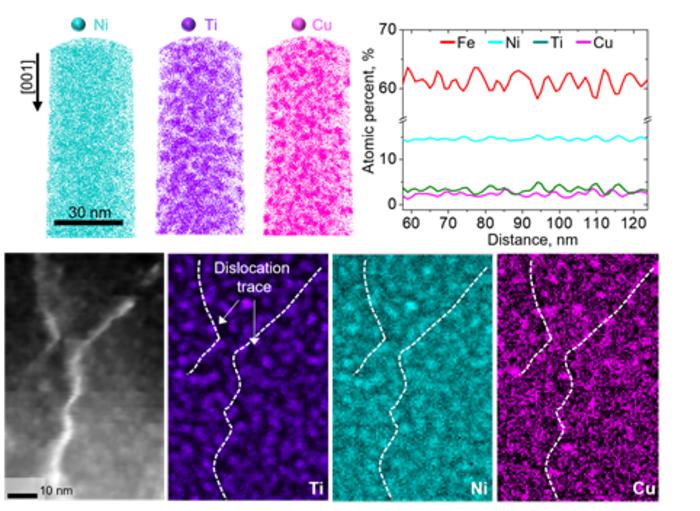
POSTECH Professor Hyoung Seop Kim’s team has introduced a novel approach to address this issue, known as “Spinodal Decomposition.” This process involves the spontaneous separation of a solid solution into two distinct phases, resulting in nanoscale structures with regularly arranged atoms.
In this study, copper (Cu) and aluminum (Al) were added to an iron-based medium-entropy alloy to trigger periodic spinodal decomposition at the nanoscale. This process led to spinodal hardening, a phenomenon that enhances resistance to structural deformation. Consequently, the resulting microstructure boosts the material’s strength. The resulting microstructure, with its uniformly arranged features, effectively distributes strain throughout the material. This distribution helps minimize localized deformation, thereby increasing overall strength while preserving elongation.
Experiments revealed that alloys produced using the team’s method demonstrated superior structural integrity compared to traditional alloys, achieving a yield strength of 1.1 GPa (gigapascals). This represents a 187 percent improvement over the alloy without spinodal decomposition. Remarkably, even with this increased yield strength, the alloy maintained nearly the same elongation (28.5%) as before. This advancement enables both improved strength and elongation.
POSTECH Professor Hyoung Seop Kim remarked, “We have explored the mechanical properties of spinodal structures in alloys with complex compositions.” He added, “Our high-strength, high-elongation alloy technology has the potential to enhance products across various industries including aerospace, automotive, energy, and electronics by making them lighter and more durable.”
The research was conducted with support from the Nanomaterial Technology Development Program of the Ministry of Science and ICT and the National Research Foundation of Korea, and the SRC/ERC.
Journal
Nature Communications
Article Title
Periodic spinodal decomposition in double–strengthened medium–entropy alloy
Article Publication Date
9-Jul-2024
Cite Scienmag News
Bethany Barker. (July 29, 2024). Balancing the seesaw: Simultaneously enhancing strength and elongation in metallic materials. Scienmag. https://scienmag.com/balancing-the-seesaw-simultaneously-enhancing-strength-and-elongation-in-metallic-materials/
Bethany Barker. "Balancing the seesaw: Simultaneously enhancing strength and elongation in metallic materials." Scienmag, 29 July 2024, https://scienmag.com/balancing-the-seesaw-simultaneously-enhancing-strength-and-elongation-in-metallic-materials/. Accessed 9 September 2026.
Bethany Barker. "Balancing the seesaw: Simultaneously enhancing strength and elongation in metallic materials." Scienmag. July 29, 2024. https://scienmag.com/balancing-the-seesaw-simultaneously-enhancing-strength-and-elongation-in-metallic-materials/

