


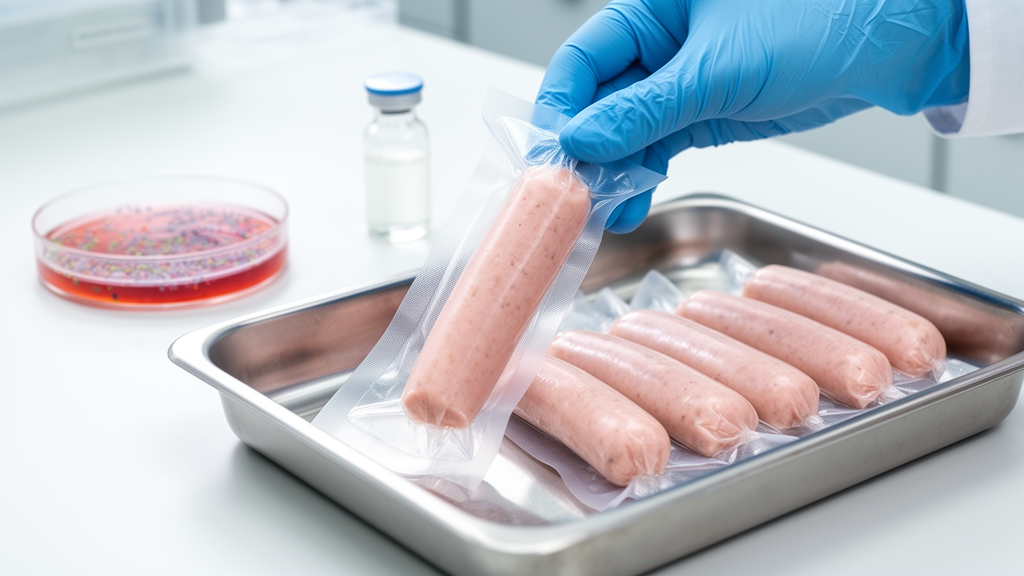
Fish sausages treated with an antimicrobial peptide produced by a bacterium isolated from the gut of a carp may soon rival synthetic preservatives such as sodium benzoate, according to a new study from researchers at the University of Dschang in Cameroon. The team, writing in Frontiers in Aquaculture, systematically optimized the formulation of a fish sausage preserved with a bacteriocin from Lactococcus lactis FO1 and found that a carefully tuned combination of the peptide and salt delivered better microbiological control than the chemical preservative, while keeping the product’s sensory qualities intact for nearly a month of refrigerated storage.
The work responds to a well-documented tension in modern food production. Fish and fishery products supply roughly 60 percent of the world’s animal protein, prized for their omega-3 fatty acids, easily digestible proteins, essential amino acids, minerals such as iron, phosphorus, zinc and copper, and vitamins. Yet fish is among the most perishable foods on the market. External factors including storage temperature and handling materials, and internal factors such as endogenous proteases, lipases, pH and the resident spoilage flora, conspire to degrade the product rapidly after capture. To combat this, the agri-food industry has long leaned on chemical preservatives like sodium nitrate and sodium benzoate, compounds that have been linked to eye irritation, asthma, digestive and behavioral disorders, insomnia, hyperactivity in children and, in some studies, colorectal cancer.
Consumer preferences have shifted decisively toward products with fewer or no chemical additives, and European legislation, notably Directive (EC) No. 1107/2009, has banned many synthetic preservatives outright. That regulatory and market pressure has pushed researchers toward lactic acid bacteria and their ribosomally synthesized antimicrobial peptides, known as bacteriocins, which can limit the growth of spoilage organisms and pathogens in fishery products. Previous studies in Cameroon, Senegal and elsewhere have demonstrated the preservative power of these peptides in shrimp, fish fillets and fish pâté. But biopreserved products often suffer from a frustratingly short optimal shelf life, which is precisely the problem the Cameroonian team set out to solve through formulation optimization.
The bacteriocin-producing strain Lactococcus lactis FO1 and an indicator strain were isolated from the gastrointestinal tract of carp collected from fish farmers in Bâtie, in western Cameroon. The researchers grew the bacterium in MRS broth, harvested the culture after 14 hours at 37 degrees Celsius, and collected the cell-free supernatant by centrifugation. After neutralizing the supernatant to pH 7.0 and sterilizing it by filtration, they partially purified the bacteriocin through two precipitation steps, first with ammonium sulfate and then with a chloroform-methanol mixture. Protein concentration rose from 25.7 micrograms per milliliter in the crude supernatant to 169 micrograms per milliliter after the second precipitation, with specific activity climbing from 31.12 to 37.86 arbitrary units per microgram and a purification yield of 40 percent. The peptide belongs to class I bacteriocins, which bind to the membrane of susceptible bacteria via the disaccharide-pyrophosphate of lipid II, disrupting peptidoglycan transport and synthesis, and creating pores that collapse the cytoplasmic acid-base balance and cause cell death.
With the peptide in hand, the team turned to a central composite design, a statistical framework that allows researchers to probe the effects of multiple variables simultaneously with a manageable number of experiments. Thirteen experimental runs, with five replications at the central point, tested combinations of bacteriocin volume and sodium chloride concentration across coded ranges. The responses evaluated were bacterial load, pH and moisture content. The bacterial loads of total aerobic mesophilic flora ranged from 2.37 to 1.61 log10 CFU per gram, Staphylococcus sp. from 1.90 to zero, and Vibrio sp. from 2.16 to zero across the trials. The lowest loads emerged when bacteriocin volume reached 2 milliliters and NaCl concentration hit 5 percent. The data were fitted to a second-degree polynomial model, and analysis of variance revealed that the linear effect of NaCl influenced the mesophilic flora load, while the linear effect of bacteriocin drove the loads of Vibrio sp. and Staphylococcus aureus. Quadratic effects and the interaction between the two factors also shaped the responses, and the model’s coefficients of determination ranged from 83.27 percent for pH to 95.57 percent for moisture content, with mean absolute deviation values of zero across all responses.
The optimization converged on a precise prescription: 327.015 micrograms of bacteriocin per 50 grams of product, equivalent to 1.935 milliliters of the partially purified preparation, combined with 5.02 percent NaCl. Validation experiments confirmed that the predicted and experimental values under these conditions agreed closely, with no significant difference between them. The optimized formulation, dubbed BIO Opti, was then pitted against three rivals in a 28-day shelf-life trial at 8 degrees Celsius: a non-optimized bacteriocin-salt sausage called BIO, a sausage preserved with sodium benzoate at 1 gram per kilogram called CHE, and a control with no preservative at all.
The microbiological results were striking. By day 28, the total aerobic mesophilic flora in BIO Opti had fallen from 2.71 to 1.56 log10 CFU per gram, compared with 1.75 for BIO, 1.93 for CHE and a worrying 4.96 for the control. The optimized sausage eliminated Staphylococcus sp. and Vibrio sp. entirely by the end of storage, dropping from 2.12 and 1.91 log10 CFU per gram respectively to zero, while the non-optimized and sodium benzoate samples retained measurable loads of both organisms. Salmonella sp. and Escherichia sp. were undetectable from day zero in all samples. The optimized formulation differed significantly from the non-optimized version, the sodium benzoate sausage and the control for these pathogen loads, and all preservative-treated samples differed significantly from the control. The loads of Vibrio sp. in the treated samples remained well below the U.S. recommended limit for Vibrio parahaemolyticus of 100,000 CFU per gram.
Physicochemical parameters told a complementary story. The moisture content of BIO Opti declined from 63.65 to 61.55 percent over the storage period, significantly lower than the 62.55 percent of BIO, the 66.46 percent of CHE and the 66.30 percent of the control. The pH of the optimized sample barely moved, from 6.80 to 6.82, while the sodium benzoate and control samples drifted upward to 7.03 and 7.05 respectively. The researchers attribute the salt’s effect to a dual mechanism: it reduces water activity, starving microorganisms of the free water they need for growth, and it modifies the pH of the medium in ways that can favor or inhibit particular bacteria. Water also acts as a solvent or reactant in chemical and enzymatic reactions, affecting viscosity and enzyme action, so controlling it shapes both microbial and biochemical spoilage pathways.
Sensory evaluation by a panel of 15 trained assessors, using a five-point scale from very poor to very good, found that the bacteriocin-treated sausages maintained their color, texture and odor characteristics after 28 days at 8 degrees Celsius, and performed at least as well as the sodium benzoate product. There was no significant difference between the treated samples on any sensory parameter, suggesting that the bacteriocin does not alter the organoleptic profile of the food, a critical requirement for any candidate preservative. The team notes that the gradual decline in sensory scores during storage likely reflects metabolic byproducts from the residual microbial flora, enzymatic browning, oxidation and the slow increase in water content and pH over time.
Taken together, the results position the optimized bacteriocin formulation as a credible natural alternative to synthetic preservatives in fish sausages. The optimization extended the optimal shelf life beyond what previous biopreservation studies had achieved, and the combination of 327.015 micrograms of peptide and 5.02 percent salt per 50 grams of product delivered microbiological control superior to sodium benzoate, with the added benefit of a more stable pH and moisture profile. The findings arrive at a moment when regulators and consumers alike are demanding cleaner labels and safer additives, and they suggest that peptides from lactic acid bacteria, once rigorously optimized, can hold their own against the chemical preservatives that have dominated food processing for decades.
Subject of Research: Bio-preservation potential of Lactococcus lactis FO1 bacteriocin in fish sausage with optimizing production condition
Article Title: Bio-preservation potential of Lactococcus lactis FO1 bacteriocin in fish sausage with optimizing production condition
Article References: Fotso Techeu, U. D., Kenfack Momo, H., Foko Kouam, E. M., Tchamani Piame, L., Kaktcham, P. M., & Zambou Ngoufack, F. (2026). Bio-preservation potential of Lactococcus lactis FO1 bacteriocin in fish sausage with optimizing production condition. Frontiers in Aquaculture, 5, Article 1900301. https://doi.org/10.3389/faquc.2026.1900301
Image Credits: AI Generated
DOI: 10.3389/faquc.2026.1900301
Keywords: biopreservation, bacteriocin, Lactococcus lactis, fish sausage, food safety, Frontiers in Aquaculture, Bio-preservation, potential, Lactococcus, lactis, fish, sausage
Cite Scienmag News
Daisy Hatcher. (October 17, 2026). Bacteriocin from Lactococcus lactis FO1 Optimizes Fish Sausage Shelf Life. Scienmag. https://scienmag.com/bacteriocin-from-lactococcus-lactis-fo1-optimizes-fish-sausage-shelf-life/
Daisy Hatcher. "Bacteriocin from Lactococcus lactis FO1 Optimizes Fish Sausage Shelf Life." Scienmag, 17 October 2026, https://scienmag.com/bacteriocin-from-lactococcus-lactis-fo1-optimizes-fish-sausage-shelf-life/. Accessed 17 October 2026.
Daisy Hatcher. "Bacteriocin from Lactococcus lactis FO1 Optimizes Fish Sausage Shelf Life." Scienmag. October 17, 2026. https://scienmag.com/bacteriocin-from-lactococcus-lactis-fo1-optimizes-fish-sausage-shelf-life/


