


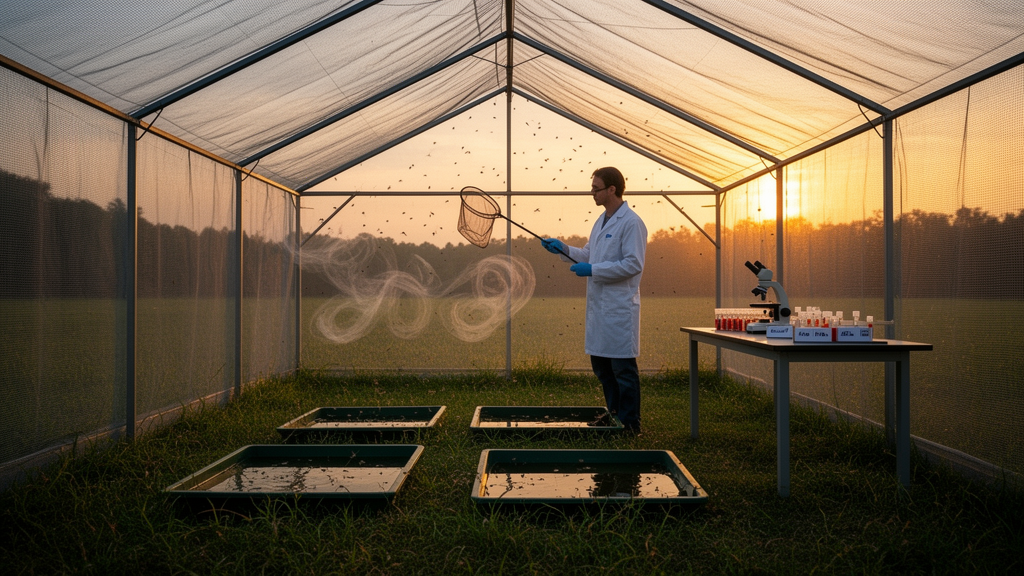
A semi-field study of the malaria mosquito Anopheles coluzzii reports that exposure to the bacterium Chromobacterium anophelis and its cell-free supernatant sharply reduced both survival and reproductive behavior, with the strongest effects seen at the highest doses tested.
C. anophelis is an entomopathogenic bacterium originally isolated from malaria mosquitoes. Under laboratory conditions it has previously shown both larvicidal and adulticidal effects, but its influence on mosquito reproductive behavior and survival under semi-field conditions had remained insufficiently explored, according to the researchers behind the new work.
In the study, mosquitoes were exposed to varying concentrations of bacterial suspensions (Ca) or of the bacterium’s cell-free supernatant (Sup) through sugar feeding. Survival probability was monitored daily for 14 days, and behavioral and reproductive parameters were recorded during dusk swarming events.
Exposure to both the bacterial suspensions and the supernatant significantly reduced mosquito survival. In the highest-dose treatment groups, complete mortality was observed within 10 days.
Swarm size was markedly reduced in the Ca_10p6 and Sup_30% treatments, which the authors describe as indicating strong behavioral impairment. Mating attempts and insemination rates were also substantially lower in these high-exposure groups.
In some cases, males were observed to participate in swarms and attempt mating but failed to inseminate females. The researchers suggest this points to physiological disruption beyond simple behavioral suppression.
By contrast, control mosquitoes and low-dose treatments (Sup_10% and Ca_10p5) maintained relatively high survival and reproductive performance, indicating that the effects were dose-dependent.
The analyses included Kaplan–Meier survival estimates, analysis of variance, and behavioral comparisons across seven treatment groups.
The authors conclude that C. anophelis and its metabolites impair both survival and reproductive success in An. coluzzii through a combination of lethal and sublethal effects. They suggest that microbial agents of this kind could help disrupt mosquito reproductive behavior and reduce vector population replacement.
The team notes that its data identify C. anophelis and its cell-free supernatant as candidates for further evaluation as complementary tools for mosquito vector control. The findings come from a semi-field experimental design, and the authors frame the work as an early step requiring further evaluation rather than a demonstrated field intervention.
Subject of Research: Effects of Chromobacterium anophelis bacteria on the survival, swarming and mating of Anopheles coluzzii mosquitoes under semi-field conditions.
Article Title: Influence of Chromobacteriumanophelis bacteria on Anopheles coluzzii mosquito swarming behavior and its reproductive potential
Article References: Gnambani, J. E., Millogo, D., Lamy, D. L., Ilboudo, S., Diabaté, A., & Bilgo, E. (2026). Influence of Chromobacteriumanophelis bacteria on Anopheles coluzzii mosquito swarming behavior and its reproductive potential. Parasites & Vectors. https://doi.org/10.1186/s13071-026-07613-9
Image Credits: AI Generated
DOI: 10.1186/s13071-026-07613-9
Keywords: Chromobacterium anophelis, Anopheles coluzzii, mosquito vector control, malaria, swarming behavior, insemination, bacterial symbionts, cell-free supernatant, semi-field experiment, survival, reproductive success, entomopathogenic bacteria
Cite Scienmag News
Drew Townsend. (October 27, 2026). Bacterial symbiont Chromobacterium anophelis disrupts mosquito swarming and mating in semi-field tests. Scienmag. https://scienmag.com/bacterial-symbiont-chromobacterium-anophelis-disrupts-mosquito-swarming-and-mating-in-semi-field-tests/
Drew Townsend. "Bacterial symbiont Chromobacterium anophelis disrupts mosquito swarming and mating in semi-field tests." Scienmag, 27 October 2026, https://scienmag.com/bacterial-symbiont-chromobacterium-anophelis-disrupts-mosquito-swarming-and-mating-in-semi-field-tests/. Accessed 27 October 2026.
Drew Townsend. "Bacterial symbiont Chromobacterium anophelis disrupts mosquito swarming and mating in semi-field tests." Scienmag. October 27, 2026. https://scienmag.com/bacterial-symbiont-chromobacterium-anophelis-disrupts-mosquito-swarming-and-mating-in-semi-field-tests/


