


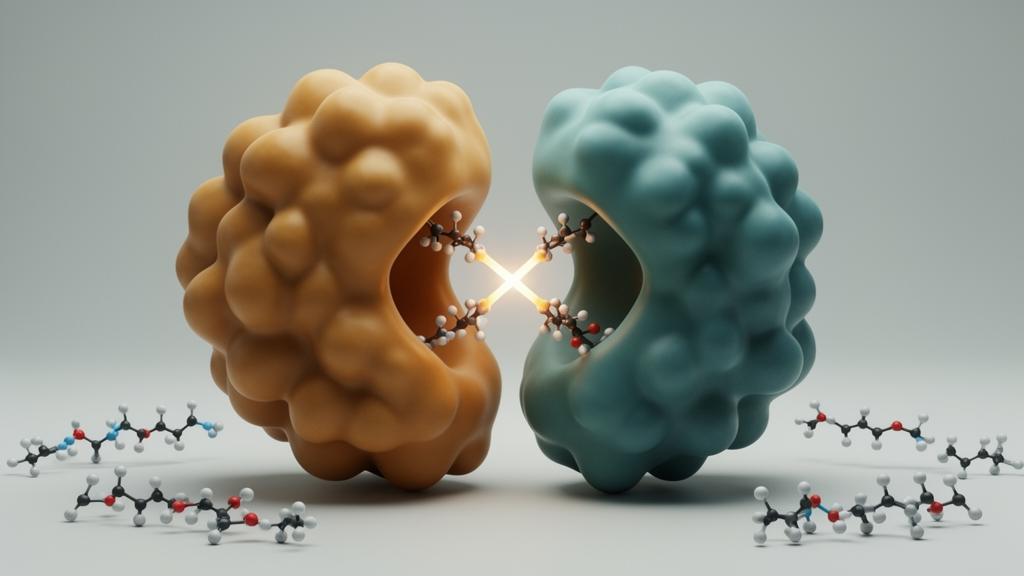
A bacterial cytochrome P450 enzyme has shown chemists something remarkable: it can forge a chemical bond between two amino acids in a way that nature never asked it to, and it can do so even when large stretches of its target peptide are rewritten. The enzyme, called KwwB, comes from the bacterium Kitasatospora sp. GAS204B and belongs to a rapidly growing family of peptide-modifying enzymes known as P450 cyptide synthases. In a study published in The Journal of Antibiotics, researchers report that KwwB installs a non-native cross-link between the carbon at position 3 of tyrosine and the nitrogen at position 1 of tryptophan, and that it tolerates mutations across nearly the entire leader peptide region of its substrate. The findings, verified through large-scale expression, nuclear magnetic resonance spectroscopy and a systematic mutagenesis campaign, add a versatile new tool to the expanding toolbox for engineering cyclic peptides.
Cyptides are a class of ribosomally synthesized and post-translationally modified peptides, or RiPPs, distinguished by biaryl cyclophane structures: rigid, ring-like architectures formed when two aromatic amino acid side chains are stitched together. These cross-links, which can be carbon-carbon, carbon-nitrogen or carbon-oxygen bonds, are installed by P450 enzymes during biosynthesis and can span regions containing anywhere from two to six amino acids. The chemical value of such cyclization is hard to overstate. Cyclic peptides resist proteolytic degradation, cross cell membranes more readily than their linear counterparts, and bind their targets with higher affinity. The commercial track record reflects these advantages, with an average of one cyclic peptide drug reaching approval every year. Identifying promiscuous macrocyclases, enzymes that can close rings on many different substrates, has therefore become a central strategy in natural product-based drug discovery.
KwwB first came to light through a sequence similarity network analysis of P450-RiPP enzymes, a computational approach that groups thousands of related proteins into clusters based on amino acid sequence. In its native context, KwwB acts on a precursor peptide called KwwA, catalyzing a Trp-C5 to Trp-N1 cross-link to form the characteristic biaryl cyclophane. Two other enzymes from the same phylogenetic cluster, SmiP from Streptomyces microflavus NA06532 and ScaP from Streptosporangium canum CGMCC 4.2126, generate the same linkage. Intriguingly, KwwB operates on a precursor sequence that differs considerably from the substrates of its relatives, particularly in the amino acids flanking the cross-linking residues, hinting at unusual substrate flexibility from the start.
The team’s earlier work had already revealed a surprise: when the first tryptophan of KwwA was swapped for tyrosine, creating a YxW motif, KwwB still produced a single cross-linked product. The structure of that product, however, remained undetermined. Resolving it required scale. The researchers coexpressed a His-tagged, SUMO-fused variant of the precursor peptide, KwwA W1Y, together with KwwB in Escherichia coli, growing 48 liters of culture to obtain just 3.0 milligrams of a mixture of two peptide fragments after affinity purification and trypsin digestion. That modest yield underscores a familiar reality of natural products chemistry: structural elucidation of trace modified peptides demands patience, precision and considerable fermentation capacity.
The structural assignment hinged on two-dimensional NMR spectroscopy performed in DMSO-d6 at 600 MHz. In the unmodified fragment, the tyrosine ring displays magnetically equivalent nuclei, but in the cross-linked fragment those equivalences vanish, immediately signaling meta- or ortho-substitution. Key heteronuclear multiple bond correlation experiments, which detect long-range couplings between protons and carbons, linked the tyrosine H2 and H6 protons to the tyrosine beta carbon, establishing that the substitution sits at the meta position, carbon 3. On the tryptophan side, the telltale downfield proton signal of the indole N1 nitrogen, clearly visible at 10.81 parts per million in the unmodified fragment, was absent in the modified one, indicating that this nitrogen had been substituted. A decisive nuclear Overhauser effect correlation between Tyr1-H2 and Trp3-H2 confirmed the spatial proximity of the two rings, sealing the assignment: KwwB had forged a Tyr-C3 to Trp3-N1 bond, a linkage not native to its own biosynthetic pathway.
Additional NOESY correlations revealed the three-dimensional geometry of the new cyclophane. The tyrosine H2, tryptophan H2 and the alpha proton of the intervening phenylalanine all lie on the same face of the molecule, while the remaining aromatic protons of both residues point to the opposite face. Notably, the NMR signatures of these cross-linked residues closely match those of Tyr-C3 to Trp-N1 linkages generated by other P450 enzymes, including the native products of SlpB, SalP and MpoB, and the non-native product of P450Blt. From a purely synthetic standpoint, this particular cross-link is achievable in the laboratory through Larock macrocyclization, but the enzymatic route offers direct access from genetically encoded precursors, a significant practical advantage for building libraries of modified peptides.
The researchers also probed the chemistry underlying the reaction. When tyrosine was replaced with phenylalanine, which lacks the para-hydroxyl group, in either the W1F or W3F variants, no cross-linking occurred at all. This result aligns with the proposed mechanism for biaryl cyclophane formation, in which the P450 enzyme abstracts a hydrogen atom not only from the aromatic ring but also from the hydroxyl group of tyrosine, a second hydrogen abstraction that appears essential for driving the coupling. The hydroxyl is not merely a passive bystander; it is an active participant in the radical chemistry that stitches the rings together.
The second half of the study tackled a question that has received far less attention than C-terminal tolerance: can P450 cyptide synthases accept mutations in the leader peptide, the N-terminal segment that guides the enzyme to its substrate? Drawing on a sequence logo of precursors associated with KwwB-like enzymes, the team identified the N-terminal residues as the most conserved region, particularly positions -11, -10 and -4, the latter occupied by an invariant proline. They then constructed 30 precursor variants, each carrying a single mutation at positions -11 through -2, substituting every native residue with alanine, asparagine, lysine or proline to systematically cover non-polar, polar, charged and rigid amino acid chemistries. After coexpression with KwwB, purification, digestion and liquid chromatography-mass spectrometry analysis, the verdict was striking: cross-linking was detected in every variant except those mutated at position -4.
The failure of the P-4A, P-4K and P-4N variants points to the conserved proline as a linchpin of the reaction. The researchers speculate that the rigid ring structure of proline creates a sharp bend or kink in the precursor peptide, a geometric feature that appears necessary for positioning the core residues correctly within the enzyme active site. Supporting this idea, when additional rigidity was introduced in the form of consecutive proline pairs at positions -5/-4 or -4/-3, cross-linked products were still detected, suggesting that local structural rigidity, rather than the specific identity of the residue, may be what matters. An attempt to visualize the enzyme-substrate complex with AlphaFold 3 yielded a low-confidence model that offered no mechanistic insight, leaving the precise role of the -4 proline an open question for future structural work.
The practical implications are considerable. Among all tested variants, the R-2P mutant, which replaces an arginine near the cleavage site with proline, delivered the highest cross-linking yield, while K-5A and R-2A performed worst, offering immediate guidance for anyone engineering KwwB substrates. Because the leader peptide tolerates such extensive rewriting, the enzyme could accept chimeric precursors in which leader sequences from unrelated RiPP pathways are fused to foreign core peptides, a strategy already proven with thioamidated biarylitides. Combined with the demonstrated ability to install non-native Tyr-C3 to Trp-N1 cross-links at engineered YxW motifs, KwwB emerges as a genuinely promiscuous biocatalyst, one that could help chemists access cyclophane architectures that remain beyond the reach of total synthesis and accelerate the design of next-generation cyclic peptide therapeutics.
Subject of Research: Enzymatic biaryl cyclophane cross-linking of RiPP precursor peptides by the P450 cyptide synthase KwwB
Article Title: P450 cyptide synthase KwwB catalyzes non-native cross-link at Tyr-C3–Trp-N1 and tolerates leader peptide mutations
Article References: Kumari, G. S., Khan, A. H., Haedar, J. R., Kiselov, V., Romanuks, V., Smits, G., Donadio, S., & Phan, C.-S. (2026). P450 cyptide synthase KwwB catalyzes non-native cross-link at Tyr-C3–Trp-N1 and tolerates leader peptide mutations. The Journal of Antibiotics. https://doi.org/10.1038/s41429-026-00961-9
Image Credits: AI Generated
DOI: 10.1038/s41429-026-00961-9
Keywords: P450 enzyme, RiPPs, cyptides, biaryl cyclophane, macrocyclization, KwwB, leader peptide, post-translational modification, NMR spectroscopy, cyclic peptides, biocatalysis, natural products
Cite Scienmag News
Ophelia Keating. (October 8, 2026). Bacterial Enzyme KwwB Forges Unusual Peptide Cross-Links and Shrugs Off Leader Mutations. Scienmag. https://scienmag.com/bacterial-enzyme-kwwb-forges-unusual-peptide-cross-links-and-shrugs-off-leader-mutations/
Ophelia Keating. "Bacterial Enzyme KwwB Forges Unusual Peptide Cross-Links and Shrugs Off Leader Mutations." Scienmag, 8 October 2026, https://scienmag.com/bacterial-enzyme-kwwb-forges-unusual-peptide-cross-links-and-shrugs-off-leader-mutations/. Accessed 8 October 2026.
Ophelia Keating. "Bacterial Enzyme KwwB Forges Unusual Peptide Cross-Links and Shrugs Off Leader Mutations." Scienmag. October 8, 2026. https://scienmag.com/bacterial-enzyme-kwwb-forges-unusual-peptide-cross-links-and-shrugs-off-leader-mutations/


