


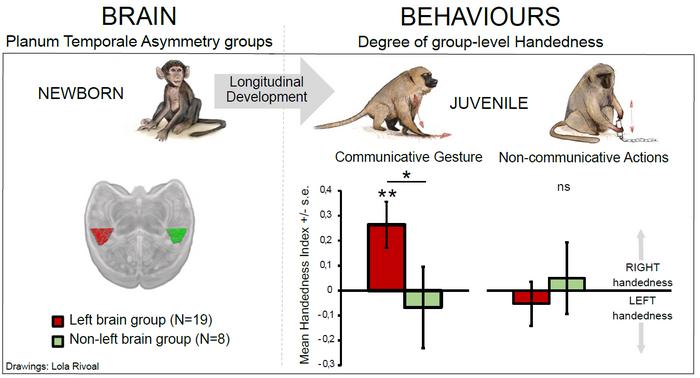
By studying the brain anatomy of newborn baby baboons, a research group including several CNRS scientists1 was able to predict what hand they would use to communicate after they had been weaned.

Credit: © Centre de recherche en psychologie et neurosciences / CNRS / Aix-Marseille Université.
By studying the brain anatomy of newborn baby baboons, a research group including several CNRS scientists1 was able to predict what hand they would use to communicate after they had been weaned.
These researchers had already found that nearly 70% of newborn baboons, like human babies, had early asymmetry in the planum temporale (PT) area of the brain. The PT, which is also a key area for language in humans, was larger in the left brain hemisphere2 than in the right in this group of baby baboons. In the new study, which will be published in Nature Communications on the 5 June 2024, the scientists found that as these baboons grew up, they tended to develop a right-hand preference for gestural communication. This tendency was independent of their right- or left-handedness for other, non-communicative actions such as manipulating objects to extract food. In contrast, the remaining 30% of young baboons – those who were showing no brain asymmetry for the PT or an asymmetry toward the right when newborn – had an equal likelihood of later communicating preferentially with their left or right hand. This discovery implies that PT asymmetry is not just a neuroanatomical requirement for language development in humans but also one for the development of gestural communication in monkeys, suggesting a shared evolutionary heritage which could date back to their common ancestor 25 million years old.
The scientists based their conclusions on behavioral observations that they made on a group of young baboons previously examined for early brain asymmetry based on MRI3 images obtained at birth. In this work, they identified the hand that the baboons preferentially used to make the most common gestures of their communication repertoire, namely rubbing or slapping a hand on the ground to threaten other baboons.
This study casts a new light on the links between gesture and language in the evolution of primates by demonstrating their cerebral prewiring. This “gestural” path could have promising clinical implications for brain surgery patients, notably to determine the dominant hemisphere for language based on simple communicative gestures’ measurements, to minimize risks of post-operative aphasia.
- From the Centre de recherche en psychologie et neurosciences (Aix-Marseille Université / CNRS), Institut de neurosciences de la Timone (Aix-Marseille Université / CNRS), and Station de primatologie (CNRS).
- Early Left-Planum Temporale Asymmetry in Newborn Monkeys (Papio anubis): A Longitudinal Structural MRI Study at Two Stages of Development.
Becker, Y., Sein, J., Velly, L., Giacomino, L., Renaud, L., Lacoste, R., Anton, J.-L., Nazarian, B., Berne, C., & Meguerditchian, A. Neuroimage. 4 December 2020
Doi: 10.1016/j.neuroimage.2020.117575.
Un cerveau « prêt-pour-apprendre-à-parler » chez les bébés singes ? | CNRS Biologie (in French) - Magnetic Resonance imaging (MRI) is a noninvasive observation technique.
Journal
Nature Communications
Method of Research
Observational study
Subject of Research
Animals
Article Title
Planum Temporale asymmetry in newborn monkeys predicts the future development of gestural communication’s handedness
Article Publication Date
5-Jun-2024
Cite Scienmag News
Cassandra Pierce. (June 7, 2024). Baby baboon brain anatomy predicts which hand they will use to communicate. Scienmag. https://scienmag.com/baby-baboon-brain-anatomy-predicts-which-hand-they-will-use-to-communicate/
Cassandra Pierce. "Baby baboon brain anatomy predicts which hand they will use to communicate." Scienmag, 7 June 2024, https://scienmag.com/baby-baboon-brain-anatomy-predicts-which-hand-they-will-use-to-communicate/. Accessed 3 September 2026.
Cassandra Pierce. "Baby baboon brain anatomy predicts which hand they will use to communicate." Scienmag. June 7, 2024. https://scienmag.com/baby-baboon-brain-anatomy-predicts-which-hand-they-will-use-to-communicate/

