


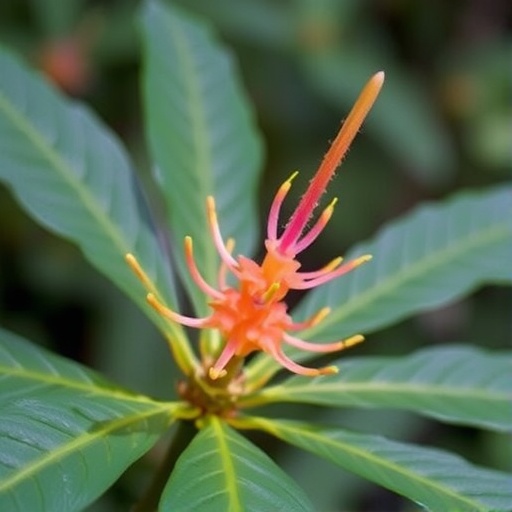
The intricate world of plant biology continues to unveil its mysteries, particularly concerning the role of vitamins in regulating growth and development. A recent groundbreaking study conducted by a team of researchers, led by Jiang et al., has spotlighted the importance of B vitamins in the inflorescence of Areca Catechu, commonly known as the betel nut palm. This dual-omics analysis not only elaborates on the metabolic pathways involved but also sets the stage for future research in nutritional biochemistry and horticultural advancements. The study reveals a complex interplay between B vitamins and plant metabolism, which has significant implications for agricultural practices and food production.
Research in plant sciences has increasingly focused on understanding how vitamins influence plant health and development. B vitamins are well-known for their roles in human nutrition, but their impact on plants is less understood. The research highlights how vitamin B metabolism governs critical processes such as flowering, fruiting, and overall plant vigor. The study meticulously maps these interactions within the inflorescence of Areca Catechu, providing valuable insights that pave the way for improved agricultural strategies and crop management.
A sophisticated dual-omics approach combining genomics and metabolomics was employed to dissect the intricate relationships between B vitamins and metabolic pathways in Areca Catechu. Genomics offers insights on gene expression profiles, while metabolomics reveals the biochemical compounds present in the plant. This method provides a holistic view of the biochemical processes that underpin plant development, allowing scientists to draw connections between genetic predispositions and observable traits.
One of the key findings of the study is the identification of specific genes associated with B vitamin metabolism. These include genes that not only facilitate the synthesis of B vitamins but also regulate their utilization within the plant. The upregulation or downregulation of these genes can significantly impact plant health, influencing growth patterns and reproductive success. The research underscores the necessity for further explorations into gene-environment interactions that may affect these pathways.
Moreover, the study provides compelling evidence that B vitamins play a mitigating role in stress responses in Areca Catechu. Under varying environmental conditions, the presence of these vitamins seems to enhance the plant’s resilience, suggesting an evolutionary advantage. This resilience could prove crucial in the face of climate change, where adaptive strategies become more critical for sustaining crop yields and biodiversity.
The metabolomic data generated in the study also highlights an array of secondary metabolites that are closely linked to B vitamin pathways. These metabolites, which include phenolics and flavonoids, have been known to play pivotal roles in plant defense mechanisms and may also possess antioxidant properties. Understanding how these compounds are regulated by B vitamins can lead to advancements in breeding programs aimed at enhancing phytochemical profiles in crops.
The implications of this research extend beyond mere academic curiosity; they touch on the practical aspects of agricultural productivity. With the global population on the rise, optimizing crop yields through nutritional biochemistry becomes essential. Farmers could potentially enhance their crop performance by ensuring adequate levels of B vitamins in the soil, pointing to new fertilization strategies that incorporate these findings. The research sets a precedent for utilizing dual-omics approaches in other crops to uncover similar metabolic networks.
Additionally, this study could influence how we understand nutritional supplements for plants. The findings might suggest that supplementing B vitamins could augment growth and potentially increase stress resistance, leading to higher quality produce. By strategically managing B vitamin levels, it might be possible to engineer crops that not only withstand adverse climatic conditions but also maintain high nutritional quality.
Despite the promising findings, the research sets the stage for further investigation. The complex interactions between various vitamins and other metabolic pathways require extensive study. Scientists must delve deeper into how these interactions manifest on a larger scale and what consequences they may have for whole-plant physiology. The integration of additional omics data and the employment of advanced bioinformatics tools will be essential in this exploration.
Public interest in plant-based nutrition continues to grow, making studies like Jiang et al.’s particularly relevant to the discourse on sustainable agriculture. The findings may ultimately lead to the development of crops that are not only more resilient but also richer in essential nutrients. This aligns with global initiatives aimed at improving food security and health outcomes, especially in regions where malnutrition is prevalent.
The concept of enhancing crop resilience through vitamins is becoming increasingly vital. Environmental pressures demand innovative solutions that transcend traditional agricultural methods. Research such as this offers hope for developing crops that can thrive in less than ideal conditions while contributing positively to human dietary requirements.
In conclusion, the dual-omics analysis conducted by Jiang et al. reveals critical insights into the metabolism of B vitamins in Areca Catechu. The interplay between genetics and biochemistry in regulating plant development could redefine agricultural practices and food production approaches. As research progresses, it will be exciting to see how these findings contribute to the future of sustainable agriculture and nutrition.
Cite Scienmag News
Daisy Hatcher. (August 30, 2025). B Vitamins’ Role in Areca Catechu Inflorescence Revealed. Scienmag. https://scienmag.com/b-vitamins-role-in-areca-catechu-inflorescence-revealed/
Daisy Hatcher. "B Vitamins’ Role in Areca Catechu Inflorescence Revealed." Scienmag, 30 August 2025, https://scienmag.com/b-vitamins-role-in-areca-catechu-inflorescence-revealed/. Accessed 4 September 2026.
Daisy Hatcher. "B Vitamins’ Role in Areca Catechu Inflorescence Revealed." Scienmag. August 30, 2025. https://scienmag.com/b-vitamins-role-in-areca-catechu-inflorescence-revealed/


