


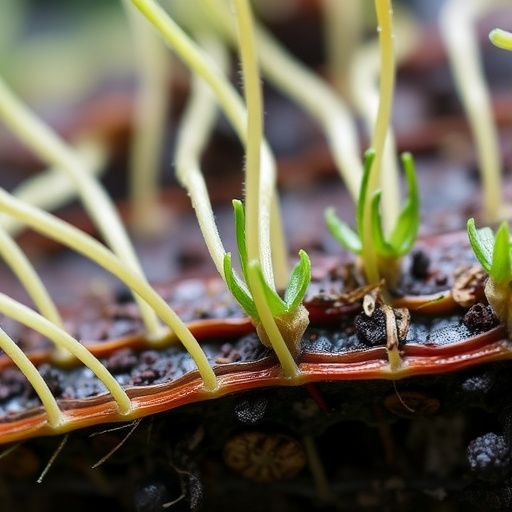
In a groundbreaking study set to revolutionize our understanding of plant resilience, researchers have unveiled a sophisticated cellular mechanism that equips Arabidopsis thaliana, a widely studied model plant, with the ability to withstand debilitating salt stress. This newly elucidated process hinges on the selective activation of autophagy—an intracellular degradation system—specifically within root-hair-forming cells, offering a finely tuned adaptation strategy that holds promise for improving crop tolerance in increasingly saline environments.
Salt stress represents one of the most challenging abiotic stresses confronting agriculture worldwide, impairing plant growth and productivity by disrupting ionic and osmotic balance. Plants possess a repertoire of physiological and molecular tools to mitigate these effects, yet the role of autophagy—a conserved catabolic pathway by which cells recycle damaged organelles and proteins—has remained largely uncharted in the context of cell-type-specific responses. The recent work by Zhao, Gao, Xiang, and colleagues dives deep into this cellular process, characterizing how autophagy within root-hair progenitor cells is indispensable for enabling survival under high salinity.
This study employed a combination of sophisticated genetic engineering, cell biological assays, and physiological analyses to unravel the contribution of autophagy in root hair cells. By selectively inhibiting autophagy in these cell types, the researchers demonstrated a marked decline in the plant’s capacity to tolerate salt stress. This contrasted sharply with plants in which autophagy was inhibited in other cell types, underscoring a uniquely critical role of autophagy in root-hair-forming cells. Root hairs, as microscopic extensions of root epidermal cells, dramatically increase the surface area for water and nutrient absorption, positioning them as crucial interfaces between the plant and the challenging soil environment.
At the molecular level, the study illuminated how the autophagic process mitigates salt-induced cellular damage by targeting and degrading malfunctioning organelles and misfolded proteins generated under stressful conditions. This selective clearance promotes cellular homeostasis and prevents the accumulation of toxic aggregates that could otherwise compromise root hair development and function. Intriguingly, the research team pinpointed key regulatory proteins and signaling pathways that orchestrate autophagy activation in these specialized cells, revealing a complex interplay between environmental cues and cellular machinery.
The implications of these findings extend far beyond Arabidopsis, offering a blueprint for engineering salt tolerance in economically important crops. As saline soils expand due to irrigation practices and climate change, the prospect of enhancing autophagy specifically within root hair cells emerges as an innovative strategy to bolster plant resilience. Such targeted interventions could augment nutrient uptake efficiency, maintain root architecture integrity, and ultimately support higher yields in suboptimal growing conditions.
Furthermore, the study challenges prevailing paradigms that view autophagy as a uniform process across tissues, highlighting instead a nuanced model where cellular context dictates the functional outcome of autophagic activity. This conceptual shift invites researchers to explore similar cell-type-specific autophagy mechanisms in other plant systems and stress scenarios, potentially uncovering new layers of regulatory sophistication and adaptation.
Employing advanced microscopy and live-cell imaging techniques, the researchers provided compelling visual evidence of autophagic flux within root hair cells under salt stress. These dynamic observations captured the formation of autophagosomes and their subsequent fusion with vacuoles, confirming the active degradation process in situ. Such real-time insights underscore the value of integrating cutting-edge imaging with molecular genetics to decode complex cellular workflows.
Complementary transcriptomic analyses further enriched the study by identifying a suite of autophagy-related genes (ATGs) selectively upregulated in root hair cells during salt exposure. This gene expression profile framed a tightly regulated autophagy network, poised to respond swiftly to environmental perturbations. Moreover, the interplay with hormonal signaling pathways, including abscisic acid, was dissected to reveal multi-dimensional regulatory circuits.
Importantly, the functional importance of autophagy was not limited to survival but extended to developmental adaptations. Root hair density and length were modulated in response to salt stress, facilitated by autophagic remodeling of cellular components. These morphological changes optimize soil exploration and resource acquisition, underscoring autophagy’s role as a mediator linking environmental stress perception to developmental plasticity.
The study also touched upon potential cross-talk between autophagy and reactive oxygen species (ROS) management, given that salt stress often leads to oxidative damage. Autophagy-mediated turnover of damaged mitochondria and peroxisomes—key organelles involved in ROS metabolism—was proposed as a mechanism to maintain redox balance and prevent oxidative stress exacerbation. This integrated view positions autophagy at the nexus of multiple stress mitigation pathways.
Moving forward, the researchers advocate for leveraging genome editing tools such as CRISPR-Cas9 to selectively enhance autophagic capacity in root hair cells across diverse crop species. Such precision breeding initiatives could complement traditional stress tolerance approaches, paving the way for resilient agriculture tailored to increasingly hostile environmental challenges.
The discovery of cell-type-specific autophagy as a cornerstone of salt stress tolerance represents a paradigm shift with far-reaching consequences. By dissecting this subtle but essential cellular strategy, the study not only addresses a fundamental question in plant biology but also offers actionable insights to confront pressing global food security issues.
In sum, the study by Zhao et al. epitomizes the power of integrated physiological, genetic, and imaging approaches to unravel how plants orchestrate intracellular quality control in a cell-type-dependent manner. This refined understanding of autophagy opens new frontiers in plant stress biology and shines a spotlight on root hairs as critical sentinels in plant-environment interactions.
As future research delves deeper into this cell-specific autophagic landscape, it will be vital to explore the translational potential of these findings across a range of crops and environmental scenarios. The promise of customizing autophagy-mediated stress responses offers a tantalizing glimpse of next-generation agricultural innovations, leveraging nature’s own cellular housekeeping to nurture a more resilient green future.
Cite Scienmag News
Juliet Wilcox. (May 7, 2026). Autophagy in Root Hairs Crucial for Salt Tolerance. Scienmag. https://scienmag.com/autophagy-in-root-hairs-crucial-for-salt-tolerance/
Juliet Wilcox. "Autophagy in Root Hairs Crucial for Salt Tolerance." Scienmag, 7 May 2026, https://scienmag.com/autophagy-in-root-hairs-crucial-for-salt-tolerance/. Accessed 4 September 2026.
Juliet Wilcox. "Autophagy in Root Hairs Crucial for Salt Tolerance." Scienmag. May 7, 2026. https://scienmag.com/autophagy-in-root-hairs-crucial-for-salt-tolerance/


