


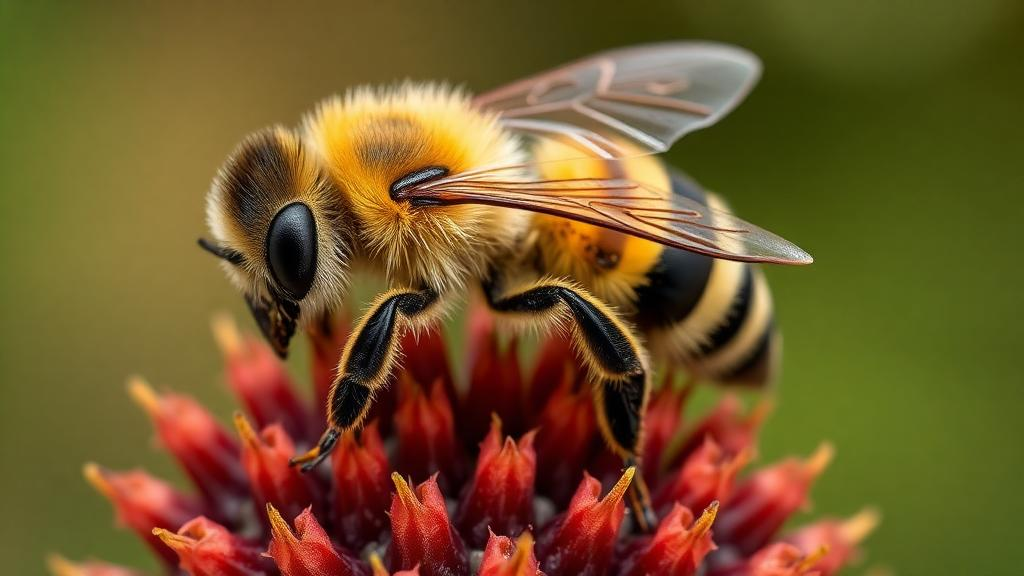
Australia is home to one of the most remarkable bee faunas on Earth, with an estimated 1,760 to 3,000 native species, of which 1,730 have so far been formally described. Because the continent has been biogeographically isolated for tens of millions of years, the overwhelming majority of these species occur nowhere else, and entire families and subfamilies, such as the Stenotritidae and the Euryglossinae, are endemic. Yet a comprehensive new review published in Ecology and Evolution warns that this extraordinary diversity is threatened less by any single driver than by a profound shortage of knowledge. Fifteen years after a landmark review concluded that the major constraint on native bee conservation was a severe shortage of information and expertise, the authors find that the situation remains largely unchanged, even as habitat loss, climate change, invasive species and pesticides intensify.
The scale of the global context makes the Australian gap especially concerning. Long-term monitoring in Germany recorded a 76 percent decline in flying insects over 27 years, while studies in Puerto Rico documented losses of 75 to 98 percent across 35 years. A recent global analysis suggests the number of bee species recorded has fallen by roughly a quarter since the 1990s, a figure that may partly reflect changes in reporting but could signal a genuine erosion of bee diversity. Australia, with few long-term insect datasets, cannot currently say whether similar declines are underway among its own bees. Only three native species hold formal federal threatened listings under the Environment Protection and Biodiversity Conservation Act, and the review argues the true number warranting protection is far higher.
The plight of already-listed species illustrates how precarious life can be for specialised bees in a modified landscape. Leioproctus douglasiellus survives in just three locations within the Perth metropolitan area, occupying a mere 0.2 square kilometres and visiting only two plant species, both of which are themselves listed as priority flora. Neopasiphae simplicior has been found at five sites, but recent surveys failed to detect it at two of them. Hesperocolletes douglasi was presumed extinct until a single specimen surfaced in 2015 in a woodland remnant of Western Australia’s Southwest Floristic Region; despite subsequent searching, no further individuals have been found. Perhaps most striking is Pharohylaeus lactiferus, rediscovered after more than a century without a record, which still lacks any formal conservation listing despite meeting the relevant criteria.
Fire has emerged as a particularly acute threat. Modelling of the catastrophic 2019 and 2020 bushfires found that nine native bee species qualified for listing as Vulnerable and two as Endangered based on habitat loss alone, while two-thirds of Australia’s bee species could not be assessed at all because there were insufficient collection records. The large carpenter bee Xylocopa aerata, which vanished from mainland South Australia and Victoria through a combination of land clearing and burning, now persists only on Kangaroo Island, around Sydney and along the Great Dividing Range. Conservationists had installed artificial nesting stalks on Kangaroo Island after 2007 fires, enabling nearly 300 females to reproduce, but the January 2020 blaze destroyed more than 150 of these nests and left only about 5 percent of the island’s habitat intact.
The review also weighs the contested role of the introduced European honeybee, which dominates many Australian bee assemblages. Evidence for competitive harm is mixed but mounting: hive introductions have reduced native bee flower visits, honeybee presence lowered the fecundity of the native bee Hylaeus alcyoneus, and competition can skew offspring sex ratios toward males. Recent work shows the impact depends on context, with negative associations strongest where floral resources are abundant, niche overlap high and habitats are residential gardens, and where vulnerable species are floral specialists or larger-bodied bees. Honeybees may also transfer pathogens to native species through shared flowers, a concern sharpened by the recent arrival of the Varroa destructor mite, whose establishment could cost Australian crop pollination between 0.63 and 1.31 billion dollars over three decades.
Urbanisation presents a genuinely two-sided picture. On the country’s east coast, results diverge: native bees in Melbourne preferred less urbanised sites, yet bee hotels in Sydney were occupied regardless of urbanisation intensity, and stingless bees in Queensland actually foraged more successfully in city environments. Western Australian studies tell a more consistent story of harm, with remnant bushland supporting richer, more specialised assemblages than residential gardens. Generalist species, including the honeybee and certain native Amegilla, Exoneura and Lasioglossum, dominate gardens, while specialist Euryglossinae, Leioproctus and Megachile cling to bushland remnants. Because over half of Australia’s bee species are pollen specialists, or oligolectic, relying on narrow lineages of native plants, introduced flora that displaces native vegetation can strip away the very resources these bees cannot substitute.
Pesticides add another layer of risk that is poorly quantified locally. Neonicotinoids, among the most widely used insecticides worldwide, impair learning, navigation and foraging in honeybees and bumblebees, reduce wild bee density and nesting, and cut reproductive output in solitary species. Yet nearly all risk assessments rest on the eusocial honeybee, whose biology differs radically from the solitary lifestyle that characterises most of the world’s 20,000 bee species, including the vast majority of Australia’s fauna. The review notes with concern that Australia continues to deploy neonicotinoids such as imidacloprid that other countries have restricted or banned over pollinator risks, while dedicated studies on native Australian bees remain scarce.
Not every anthropogenic influence is negative, and the review documents surprising winners. The wide-ranging Ceratina australensis is projected to expand under climate change. Leioproctus plumosus nests readily in suburban gardens, Hylaeus ruficeps kalamundae has adapted to nesting in human materials at densities never seen in nature, and the stingless bee Tetragonula carbonaria forages more successfully in urban environments than in macadamia plantations or natural vegetation. Freshly burnt landscapes can temporarily boost bee abundance and species richness by exposing the bare ground that most Australian bees, roughly 60 to 83 percent of species, need for nesting burrows. These gains, however, accrue mainly to generalists, and the authors caution that Australia’s long co-evolutionary history between plants and pollinators means Northern Hemisphere management prescriptions, such as soil nutrient enrichment, can backfire by favouring invasive weeds.
The economic and cultural stakes are substantial. Wild pollinators contribute an estimated 20 to 25 million Australian dollars annually to dryland lucerne seed production, and native species show genuine promise as managed crop pollinators: nine blue-banded bees, Amegilla chlorocyanea, in a caged trial of 100 plants outperformed a nucleus hive of 500 honeybee workers, and native species capable of buzz pollination, including Xylocopa, Amegilla and Lipotriches, are well suited to tomatoes and similar crops. Stingless bees already pollinate macadamias, blueberries, raspberries and lychees. Beyond agriculture, sugarbag bees have held deep significance for First Nations peoples for more than 65,000 years, with beeswax used in rock art for at least four millennia and honey and wax woven into diet, medicine, ceremony and toolmaking, knowledge that the review describes as amounting to a semi-domestication long before European arrival.
The authors’ roadmap is unambiguous. They call for urgent investment in taxonomy, with an estimated 300 to 500 species still undescribed and synonymisation rates revealing shaky foundations; for long-term monitoring using methods matched to species, since pan and vane traps miss many taxa while targeted netting captures both abundance and foraging data; for behavioural research on the learning, memory and decision-making that underpin bees’ capacity to adapt; and for expanded citizen science, building on initiatives such as the Wild Pollinator Count, which logged more than 20,000 insect observations in a single week in 2020. Distribution modelling can anticipate where threats will bite hardest before they become unmanageable. With Australia holding the worst mammal extinction record of any country over the past two centuries, the review warns that bees may be following a similar trajectory unseen, and that the window for building the knowledge base needed to prevent it is closing fast.
Subject of Research: Conservation of Australian native bees under environmental and anthropogenic change
Article Title: The Future of Native Bees in Australia Under Environmental and Anthropogenic Change
Article References: Howard, S. R., & Prendergast, K. S. (2026). The Future of Native Bees in Australia Under Environmental and Anthropogenic Change. Ecology and Evolution, 16(10), Article e74363. https://doi.org/10.1002/ece3.74363
Image Credits: AI Generated
DOI: 10.1002/ece3.74363
Keywords: native bees, Australia, pollinators, biodiversity, habitat loss, climate change, bushfires, European honeybee, pesticides, urbanisation, stingless bees, conservation
Cite Scienmag News
Margaret Porter. (October 2, 2026). Australia’s Unique Native Bees Face an Uncertain Future as Pressures Mount. Scienmag. https://scienmag.com/australias-unique-native-bees-face-an-uncertain-future-as-pressures-mount/
Margaret Porter. "Australia’s Unique Native Bees Face an Uncertain Future as Pressures Mount." Scienmag, 2 October 2026, https://scienmag.com/australias-unique-native-bees-face-an-uncertain-future-as-pressures-mount/. Accessed 5 October 2026.
Margaret Porter. "Australia’s Unique Native Bees Face an Uncertain Future as Pressures Mount." Scienmag. October 2, 2026. https://scienmag.com/australias-unique-native-bees-face-an-uncertain-future-as-pressures-mount/


