


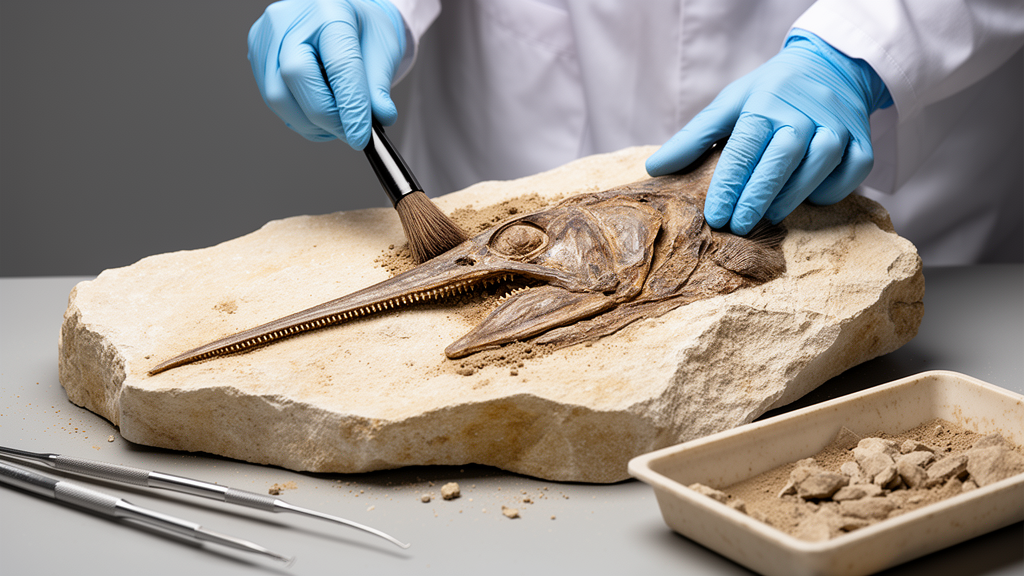
A remarkable new fossil discovery from the Caucasus has upended a two-decade-old assumption about the geography of Cretaceous seas. A nearly complete articulated skull of Protosphyraena, a large swordfish-like predatory fish, unearthed in the Albian rocks of the Republic of Dagestan, Russia, is strikingly similar to material from Australia that palaeontologists had long treated as an endemic Southern Hemisphere genus. The finding, published in the journal Fossil Record, suggests that this formidable ocean predator was already roaming the world’s oceans roughly 100 million years ago, not only as a genus but potentially as a single species spanning both hemispheres.
Protosphyraena belongs to the Pachycormiformes, an extinct order of Mesozoic ray-finned fishes that achieved extraordinary ecological diversity during the Jurassic and Cretaceous. The group ranged from gigantic suspension feeders to fast-swimming pelagic hunters, and Protosphyraena represents the most derived macropredatory form among them. Its most distinctive features are an elongate, sword-like rostrum and pectoral fins armed with a serrated leading edge, adaptations that made it one of the most recognisable predators of the Cretaceous seas. The genus is best known from the Upper Cretaceous of North America and England, but its Early Cretaceous origins have remained frustratingly obscure, largely because most specimens consist of isolated teeth, fin fragments and rostra.
The problem at the heart of the new study is a taxonomic tangle that has persisted for nearly twenty years. In 2007, palaeontologist Benjamin Kear described a partial skull from the Albian Toolebuc Formation of Australia as Australopachycormus hurleyi, an endemic pachycormiform genus. Several subsequent authors questioned this endemism and suggested that Australopachycormus was simply a species of Protosphyraena, but direct comparison proved impossible. The Northern Hemisphere Albian record consisted only of isolated pectoral fins and teeth, while diagnostic cranial material existed solely in Australia. With no anatomical overlap between coeval specimens from the two hemispheres, the debate remained frozen.
That changed in autumn 2025, when researchers discovered the anterior parts of jaws weathering out of grey clayey marls of the Khadzhalmakhi Formation near the Chindircero ski resort in Dagestan. Subsequent excavations recovered the remainder of the skull, a specimen catalogued as SGM-2169-1 and measuring approximately 37 centimetres in preserved length. The specimen was donated to the Vernadsky State Geological Museum in Moscow and prepared by sandblasting. Two fragments of pectoral fins, collected in the 2010s from a nearby locality, complete the Dagestan material. The fish layer from which the skull was extracted corresponds to the uppermost Albian, the Stoliczkaia dispar ammonite biozone and nannofossil subzone NC10A, making it one nannofossil subzone younger than the Australian specimens.
The anatomical detail preserved in the new skull is what makes the comparison possible. The premaxilla bears seven alveoli with six large blade-like teeth in functional position, tightly packed, plus at least four smaller teeth further back. The maxilla carries a single row of very small teeth that become so reduced posteriorly that they are visible only from the internal side of the bone. The dentary is elongate and slender, with a height-to-length ratio of approximately 0.125, and its teeth are small, conical and oriented perpendicular to the oral margin, with no additional lateral marginal teeth. The parasphenoid is covered with small shagreen-like denticles, and the posterior neurocranium preserves paired opisthotics, prootics, exoccipitals and a large wedge-shaped basioccipital, with foramina for the facial, glossopharyngeal and vagus nerves.
When the researchers compared these features with the type species Protosphyraena ferox from the Cenomanian-Turonian of England and with the Australian P. hurleyi, the similarities were overwhelming. The Dagestan skull shares with both taxa an elongated skull with a high dentary length-to-height ratio, moderately small perpendicular dentary teeth, the absence of additional lateral dentary denticles, and six large premaxillary teeth in functional position. The specimen is also very close in size to one of the Australian P. hurleyi specimens, QMF49220, for which individual bone measurements exist: the premaxilla measures 8.76 centimetres in the Australian specimen and 9.2 centimetres in the Dagestan skull, while the maximum depth of the maxilla is 2.06 versus 2.3 centimetres.
The only autapomorphy originally proposed for Australopachycormus, rostrodermethmoid teeth directed obliquely backwards, has been shown to be inconsistent, since the same condition occurs in several Protosphyraena species, including the type species P. ferox. Other characters proposed by Kear, such as a single row of dentary teeth, are also observed in P. ferox. The researchers found small partially resorbed alveoli in the posterior coronoid of a type-series specimen of P. ferox, suggesting that the difference in coronoid dentition between the two taxa may simply reflect ontogeny, especially given that known P. ferox specimens are nearly twice as large as those of P. hurleyi. At present, the only clear differences between P. ferox and P. hurleyi appear to be geographic and stratigraphic occurrence, leading the authors to suggest that the two species may be potential synonyms, probably representing an anagenetic lineage.
Additional evidence came from previously undescribed material in the Albian Gault Formation of England, studied in the collections of the Sedgwick Museum in Cambridge and the Natural History Museum in London. Among the Gault specimens, one premaxilla is highly similar to those of P. ferox, P. hurleyi and the Dagestan skull, and the only known rostrum from the formation closely resembles that of P. ferox, although it appears more slender with less pronounced ornamentation, potentially indicating the condition present in the Australian P. hurleyi. The Gault material also reveals that several pachycormiform taxa coexisted in the late Albian of Western Europe: two distinct hypural plate morphotypes, pectoral fins with different serration patterns, and two fragmentary fins lacking serration and leading-edge ornamentation that may belong to a more basal protosphyraenid or a derived asthenocormine such as Rhinconichthys.
The biogeographic implications are profound. The endemism hypothesis had spawned a claim that Australia was the source region for longirostrine protosphyraenids, with the first billed pachycormiforms evolving there and subsequently spreading across the Tethys Ocean to populate the Northern Hemisphere. But this is difficult to reconcile with the known evolutionary history of the group, since the putative Late Jurassic ancestor of Protosphyraena, Orthocormus, is known exclusively from Europe. The new findings contradict the assumed endemism of Australian protosphyraenines and the hypothesised provincialism of large marine vertebrates between the hemispheres during the Albian. This is not unexpected, the authors note, given that during the Albian both the Caucasus and the Australian Eromanga Sea were connected with the Tethys Ocean, providing dispersal corridors for wide-ranging pelagic predators.
The study also highlights how much remains to be learned about this tangled genus. Differences in pectoral fin serration patterns among Australian specimens suggest that several Protosphyraena species may have coexisted in the Albian of Australia, mirroring the diversity of fin morphotypes in the English Chalk. Historically, most isolated protosphyraenine remains from the English Chalk have been attributed to P. ferox by default, a practice the authors say clearly requires revision. The researchers point to undescribed material in the Kronosaurus Korner Museum in Richmond, Queensland, as potentially helping to unravel the knot of fragmented and non-overlapping specimens. For now, the Dagestan skull stands as the first articulated Protosphyraena skull from the Albian of the Northern Hemisphere, and as decisive evidence that the endemism of Australia’s swordfish-like pachycormiforms never was.
Subject of Research: Early Cretaceous palaeobiogeography and taxonomy of the pachycormiform fish Protosphyraena
Article Title: Endemism that never was? Australian swordfish-like pachycormiform in the Northern Hemisphere
Article References: Kanarkina, A., Zverkov, N. G., Khapisov, O. K., & Bolshiyanova, J. A. (2026). Endemism that never was? Australian swordfish-like pachycormiform in the Northern Hemisphere. Fossil Record, 29(1), 249-268. https://doi.org/10.3897/fr.29.191551
Image Credits: AI Generated
DOI: 10.3897/fr.29.191551
Keywords: Protosphyraena, Pachycormiformes, Albian, Cretaceous, palaeobiogeography, endemism, Dagestan, Australia, Tethys Ocean, fossil fish, never, Australian
Cite Scienmag News
Violet Maxwell. (October 17, 2026). Australian swordfish-like fossil fish was never endemic, new skull reveals. Scienmag. https://scienmag.com/australian-swordfish-like-fossil-fish-was-never-endemic-new-skull-reveals/
Violet Maxwell. "Australian swordfish-like fossil fish was never endemic, new skull reveals." Scienmag, 17 October 2026, https://scienmag.com/australian-swordfish-like-fossil-fish-was-never-endemic-new-skull-reveals/. Accessed 17 October 2026.
Violet Maxwell. "Australian swordfish-like fossil fish was never endemic, new skull reveals." Scienmag. October 17, 2026. https://scienmag.com/australian-swordfish-like-fossil-fish-was-never-endemic-new-skull-reveals/


