


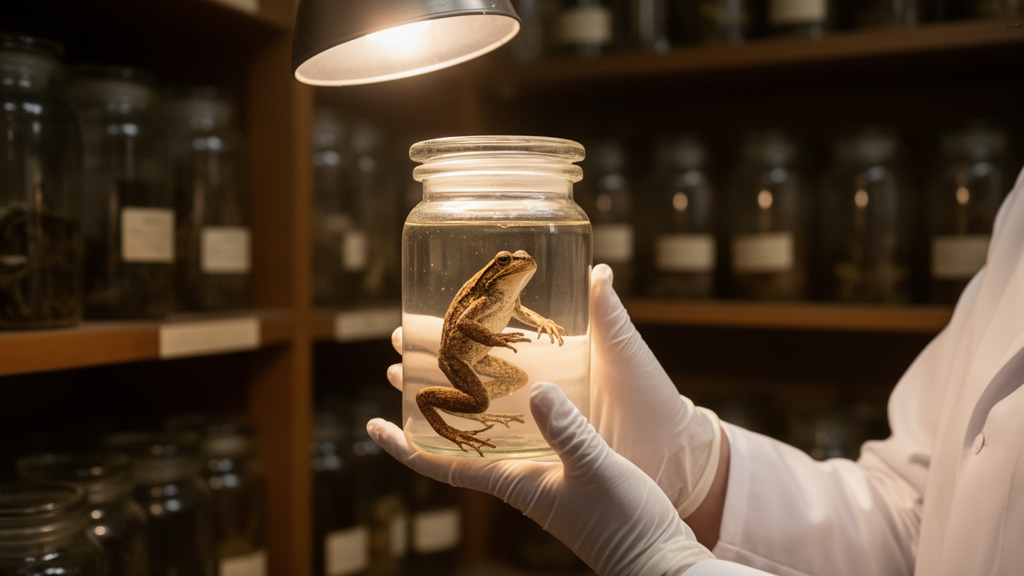
For nearly half a century, one of wildlife epidemiology’s most stubborn cold cases has sat unsolved in the drawers of a natural history museum. In the late 1970s, frogs began vanishing from the Boracéia Biological Station in Brazil’s Atlantic Forest, a global hotspot of amphibian biodiversity. Some scientists blamed climate change, others pointed to extreme weather events, but no one could prove what had wiped out entire species from a site that had been studied intensively for years. Now, a team from the Smithsonian’s National Zoo and Conservation Biology Institute and Pennsylvania State University has cracked the case using an unlikely witness: more than 370 frog specimens collected decades ago and preserved in the Smithsonian’s National Museum of Natural History. Their findings, published in the journal Molecular Ecology, show that the deadly amphibian chytrid fungus invaded the site precisely when the disappearances began, finally linking the pathogen to one of the region’s most enigmatic die-offs.
The culprit, Batrachochytrium dendrobatidis, is a microscopic fungal pathogen that causes chytridiomycosis, a disease that has become synonymous with catastrophic amphibian loss worldwide. Believed to have originated in Asia, the fungus likely swept across the globe during the 1970s and 1980s, yet scientists did not formally describe it until 1999. By that time, hundreds of amphibian species had already been pushed to the brink of extinction or beyond, and because so many of those declines occurred before anyone knew the pathogen existed, establishing responsibility has been extraordinarily difficult. Jack Boyette, an NZCBI graduate fellow and doctoral candidate at Pennsylvania State University who led the study, described the problem bluntly: after almost 50 years, researchers still are not confident what caused many historical amphibian die-offs, making these declines some of the most enduring cold cases in wildlife epidemiology.
The breakthrough came from the foresight of a collector who could never have imagined how his work would be used. William Ronald Heyer, a former curator of amphibians and reptiles at the National Museum of Natural History, conducted five field campaigns at Boracéia: two in the 1970s, before the sudden amphibian declines, and three in the 1980s, during the aftermath of the die-offs. That timing created a rare natural experiment, allowing researchers to trace the pathogen’s arrival across the critical window when the community collapsed. Boyette and his colleagues sampled the preserved specimens to determine when the chytrid fungus first appeared at the site and how infection prevalence changed through time, effectively reconstructing an outbreak that unfolded before the pathogen had even been named.
The results were stark. Specimens collected prior to 1979 showed no evidence of chytrid infection whatsoever, while more than half of the specimens from the 1980s tested positive. The regional invasion of the pathogen coincided exactly with the unexplained amphibian disappearances, providing the most direct evidence yet that the fungus, rather than environmental factors alone, drove the losses. While the researchers acknowledge that climate or extreme weather could have played some role, the temporal alignment between the pathogen’s arrival and the die-offs implicates chytrid as the primary force behind the catastrophe.
Perhaps the most surprising finding was the pattern of infection itself. The species that suffered the most dramatic declines showed no detectable infections in the museum specimens, while the species that never declined were heavily infected. This apparent paradox, the researchers hypothesize, reflects natural variation in disease tolerance across the amphibian community. The species that did not decline may have naturally tolerated the fungus, becoming infected without suffering mass mortality, which is why their carcasses were readily collected and preserved. By contrast, the species that declined most dramatically may have been so susceptible that infected frogs died before Heyer could collect them, leaving few infected individuals in the historical record. The dead, in other words, were largely absent from the sample because they died too fast to be caught.
These patterns suggest the chytrid fungus spread rapidly through the amphibian community at Boracéia, illuminating how quickly an emerging disease can sweep through a population of naive hosts that has never encountered the pathogen before. Michael Campana, a genomicist at NZCBI who participated in the study, emphasized that museum collections are a game changer for researchers seeking to reconstruct historical disease impacts. Collectors could not have anticipated how important their specimens would become to modern conservation challenges, he noted, but without them, scientists would never be able to detect pathogens that went unnoticed for decades or reconstruct disease outbreaks that would otherwise remain mysteries.
The team did not rely solely on historical material. Between 2022 and 2024, they returned to Boracéia six times alongside researchers from the University of São Paulo to sample modern amphibian populations. Of the 17 species represented in Heyer’s collection, only 12 could still be found at the site. The fate of the other five remains uncertain, though their continued absence raises concerns that they may have been lost locally, a sobering reminder that the historical die-off may have left permanent scars on the community.
Yet the modern story at Boracéia is ultimately one of resilience. Most amphibian species appear to have recovered since the early 1980s, and while the chytrid fungus still infects frogs at the site, the current infection patterns suggest the evolution of widespread pathogen tolerance among the species that historically declined. That tolerance likely promoted their persistence and recovery in the decades since the collapses, demonstrating that host populations can adapt to a pathogen that once devastated them. Understanding how that adaptation occurred is now a central question for the researchers.
The implications extend well beyond a single field station in São Paulo. Reconstructing historical disease dynamics may help researchers anticipate future disease outcomes, a capability that has become urgently relevant as another fungal pathogen, Batrachochytrium salamandrivorans, threatens salamander populations in Europe and could pose a serious risk to salamanders in North America. The researchers caution that the site-specific nature of the study means the results cannot be extrapolated across the broader Atlantic Forest, but they argue that the work solves the mystery of Boracéia’s disappearing frogs and provides a blueprint for other researchers to conduct similar disease retrospectives using museum collections worldwide.
The investigation is far from over. The team is now using DNA extracted from the museum samples to investigate the genomic mechanisms that shaped historical amphibian responses to chytrid, while other ongoing projects aim to fill gaps in historical specimen records using ancient environmental DNA. Together, these efforts promise a more detailed picture of chytrid emergence, spread and impact over the past century, deepening understanding of the pathogen’s historical toll on biodiversity and helping scientists anticipate its future moves in a world where fungal pathogens remain a major and growing threat to wildlife.
Subject of Research: Museum specimen analysis links the chytrid fungus to historical amphibian declines at Brazil's Boracéia Biological Station
Article Title: Museum specimens reveal pathogen behind decades-old mystery of disappearing frogs
Article References: Museum specimens reveal pathogen behind decades-old mystery of disappearing frogs. (n.d.). Original publication
Image Credits: AI Generated
DOI: Not provided
Keywords: amphibian declines, chytrid fungus, Batrachochytrium dendrobatidis, museum specimens, Atlantic Forest, Brazil, conservation genomics, wildlife epidemiology, Boracéia Biological Station, Smithsonian, disease tolerance, Molecular Ecology
Cite Scienmag News
Margaret Porter. (October 17, 2026). Museum Specimens Solve 50-Year Mystery of Brazil’s Vanishing Frogs. Scienmag. https://scienmag.com/museum-specimens-solve-50-year-mystery-of-brazils-vanishing-frogs/
Margaret Porter. "Museum Specimens Solve 50-Year Mystery of Brazil’s Vanishing Frogs." Scienmag, 17 October 2026, https://scienmag.com/museum-specimens-solve-50-year-mystery-of-brazils-vanishing-frogs/. Accessed 17 October 2026.
Margaret Porter. "Museum Specimens Solve 50-Year Mystery of Brazil’s Vanishing Frogs." Scienmag. October 17, 2026. https://scienmag.com/museum-specimens-solve-50-year-mystery-of-brazils-vanishing-frogs/


