


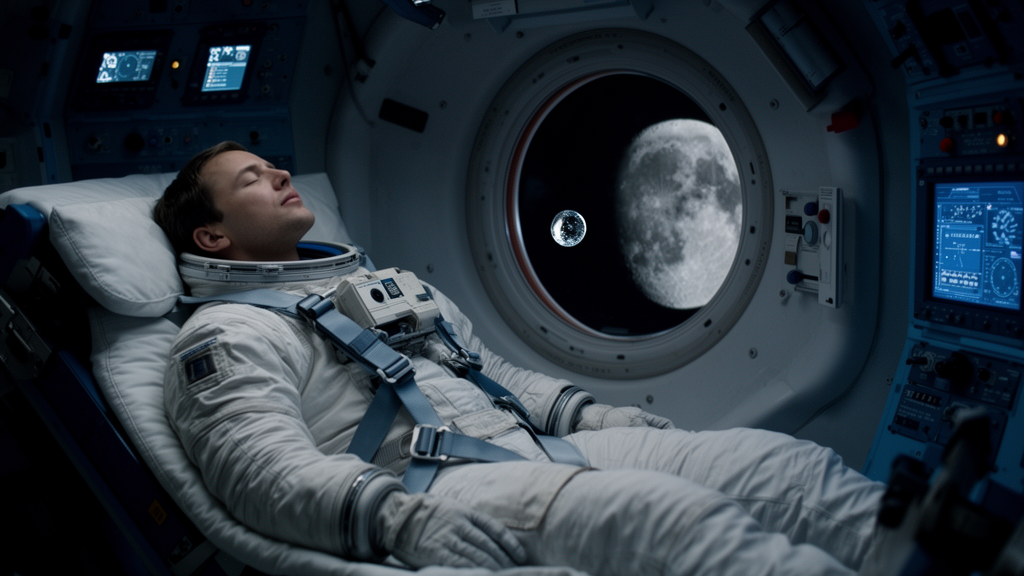
When the International Space Station completes one of its 90-minute orbits, its crew crosses a sunrise and a sunset in orbit even as interior lights, computer screens, and cabin windows determine what their retinas actually receive. That mismatch between orbital reality and biological time is one of many reasons why sleep in space has never been simple. A new narrative review published in Frontiers in Space Technologies argues that sleep loss and circadian misalignment are not peripheral annoyances of spaceflight but an integrated threat to astronaut health, cognition, and mission reliability — and that no single countermeasure currently available is sufficient on its own.
The review, written by Merel Goedegebure of KU Leuven and Sarah Baatout of the Belgian Nuclear Research Center SCK CEN, synthesizes decades of evidence from shuttle missions, Mir, the ISS, and ground-based analogs such as the Mars500 isolation study. Its central conclusion is deliberately provocative for mission planners: sleep should be treated as a mission-critical system variable, on a par with oxygen generation or radiation shielding, rather than dismissed as an individual medical complaint to be handled with a sleeping pill.
The biological machinery behind that argument is well established. Human sleep timing is governed by the interaction of two processes: a homeostatic process that builds sleep pressure during wakefulness and dissipates it during sleep, and a circadian process that generates an approximately 24-hour rhythm promoting wakefulness and sleep at different biological phases. Restorative sleep occurs when high homeostatic pressure coincides with the circadian sleep window. The master pacemaker for that rhythm is the suprachiasmatic nucleus of the hypothalamus, which synchronizes molecular clocks — built from feedback loops involving proteins encoded by genes such as CLOCK, BMAL1, PER, and CRY — throughout the body, coordinating sleep with temperature, hormones, metabolism, and immunity. Light detected by intrinsically photosensitive retinal ganglion cells is the dominant timing signal that keeps this system aligned with the outside world, which is precisely the signal spaceflight scrambles.
What does the data actually show? Across shuttle and ISS studies, astronauts have commonly obtained roughly six to six and a half hours of sleep per 24 hours, below the sleep opportunity generally considered necessary for sustained alertness and health. Circadian misalignment has been linked to even shorter sleep and heavier use of hypnotic medication. During six-month ISS missions, sleep deficiency was associated with poorer neurobehavioral performance and elevated stress, and simply spending longer in orbit did not reliably normalize sleep. Recent work on sleep architecture suggests the story is more subtle still: some REM measures recover across long-duration flight even as NREM, or deep sleep, is reduced. Because total sleep time alone can conceal such architectural changes, the review cautions against reading headline sleep numbers as the whole picture.
The drivers of this shortfall are layered. The orbital environment delivers multiple external light-dark transitions each day, while schedule shifts, night operations, pre-sleep screen exposure, and irregular wake times weaken circadian entrainment. Workload matters just as much: on the ISS, heavier workload has been associated with shorter sleep, and a schedule that nominally allocates eight hours for sleep may still fail to provide genuine sleep opportunity when crews must finish delayed tasks, talk to the ground, or recover from stress. Noise from life-support systems, temperature discomfort, light leakage, limited privacy, and awkward sleeping restraints add arousal and fragmentation. The authors stress that these factors are modifiable and should not be accepted as unavoidable features of spaceflight. Whether microgravity itself independently disrupts sleep — through fluid shifts, vestibular adaptation, or altered respiratory mechanics — remains uncertain, because gravity effects are inseparable from concurrent schedule and habitat changes in orbital studies.
The operational consequences are stark. Sleep-deficient astronauts show reduced vigilant attention, slower psychomotor responses, impaired executive control, and more lapses, and simulated missions restricted to five-hour sleep opportunities produced worse performance than eight-hour opportunities. Deficits may be most dangerous during monotonous routine tasks, when low stimulation lets attention drift, and during emergencies demanding rapid integration of unfamiliar information. Mood, stress reactivity, and interpersonal functioning also degrade, effects that can propagate through a small, isolated crew. Critically, circadian misalignment compounds risk independently: a task performed during the biological night may be impaired even after apparently adequate sleep, which is why the review argues that fatigue models must weigh sleep duration, prior wake time, circadian phase, workload, and individual response together rather than relying on any single fatigue indicator.
Terminology is another fault line the review works hard to clarify. Short sleep, poor sleep quality, and fatigue do not by themselves constitute a clinical disorder. Insomnia disorder requires persistent sleep difficulty despite adequate opportunity, associated daytime impairment, and formal diagnostic assessment; circadian rhythm sleep-wake disorders require evidence that symptoms stem from misalignment between endogenous timing and the required schedule. Most spaceflight studies report sleep disturbance rather than diagnoses, and the field lacks a harmonized framework combining clinical interviews, validated questionnaires, objective measures, circadian phase markers, and operational context. The authors flag this as a major gap, alongside unresolved questions about sex-specific responses and interactions between sleep and other spaceflight hazards such as radiation and altered metabolism.
On countermeasures, the review delivers a sober but practical assessment. The foundation remains protected sleep opportunity and workload control, because no lighting system or drug can reliably compensate for chronic schedule-driven restriction. Timed light is the most powerful practical circadian tool: short-wavelength-enriched light boosts alertness and suppresses melatonin, while dimmer, short-wavelength-reduced light before sleep supports biological night. The ISS Solid-State Lighting Assembly already allows variable lighting, but shared habitats complicate individualized delivery. Environmental optimization — quieter sleeping quarters, stable temperature, comfortable restraints, controlled caffeine timing — is low-risk and broadly applicable. Strategic naps can restore acute alertness if their timing and duration avoid sleep inertia. Hypnotics, though widely used in orbit, show that faster sleep onset does not necessarily translate into longer or better sleep, and residual sedation, impaired balance, altered pharmacokinetics, and the need to respond instantly to alarms all raise safety concerns. Melatonin is distinguished from conventional hypnotics because it can shift circadian phase as well as promote sleep, but only when its timing is coordinated with light exposure and endogenous circadian phase.
The most forward-looking section describes what the authors call adaptive, precision fatigue-risk management. Wearable-derived sleep estimates, personal light exposure, heart-rate variability, distal skin temperature, and cognitive testing could feed personalized schedules and countermeasures, potentially augmented by artificial intelligence that remains interpretable and functional without ground connectivity. More speculative still, multi-omics profiling — longitudinal transcriptomic, epigenomic, proteomic, metabolomic, and microbiome measurements — could identify individual response signatures, though the authors insist this is a research framework, not a validated countermeasure, given small samples, batch effects, and confounding exposures. Closed-loop habitat control that adjusts personal lighting, temperature, acoustic masking, and alert timing would require crew override, transparent decision rules, privacy safeguards, and staged validation in laboratories, analogs, and flight. Dietary and microbiome-directed approaches, including animal evidence for Gastrodia elata, remain hypotheses requiring controlled trials before any operational claim.
The bottom line for lunar and Martian ambitions is that sleep must be engineered into the habitat from the outset, with lighting, acoustics, private sleep volume, and monitoring infrastructure treated as components of life-support architecture. The review calls for a core sleep dataset standardized across missions — scheduled and actual sleep opportunity, validated wearable measures, sleep diaries, light exposure, workload, medication and caffeine use, and repeated neurobehavioral testing — plus polysomnography and circadian phase markers in selected campaigns. Progress, the authors conclude, is limited less by a shortage of proposed countermeasures than by heterogeneity in how they are measured and tested. If humanity is to survive the months-long transit to Mars with its cognitive machinery intact, sleep will need to stop being a private struggle and start being a system the spacecraft actively protects.
Subject of Research: Sleep and circadian rhythm disruption in astronauts and its countermeasures during human spaceflight
Article Title: Sleep and circadian disruption during human spaceflight: mechanisms, operational consequences, and countermeasures
Article References: Goedegebure, M., & Baatout, S. (2026). Sleep and circadian disruption during human spaceflight: mechanisms, operational consequences, and countermeasures. Frontiers in Space Technologies, 7, Article 1958668. https://doi.org/10.3389/frspt.2026.1958668
Image Credits: AI Generated
DOI: 10.3389/frspt.2026.1958668
Keywords: astronaut sleep, circadian rhythm, human spaceflight, International Space Station, sleep deficiency, fatigue risk management, hypnotics, melatonin, timed light exposure, wearable monitoring, long-duration missions, Mars missions
Cite Scienmag News
Denise Maddox. (October 15, 2026). Astronaut Sleep Loss Emerges as a Mission-Critical Hazard for Moon and Mars Flights. Scienmag. https://scienmag.com/astronaut-sleep-loss-emerges-as-a-mission-critical-hazard-for-moon-and-mars-flights/
Denise Maddox. "Astronaut Sleep Loss Emerges as a Mission-Critical Hazard for Moon and Mars Flights." Scienmag, 15 October 2026, https://scienmag.com/astronaut-sleep-loss-emerges-as-a-mission-critical-hazard-for-moon-and-mars-flights/. Accessed 15 October 2026.
Denise Maddox. "Astronaut Sleep Loss Emerges as a Mission-Critical Hazard for Moon and Mars Flights." Scienmag. October 15, 2026. https://scienmag.com/astronaut-sleep-loss-emerges-as-a-mission-critical-hazard-for-moon-and-mars-flights/


