


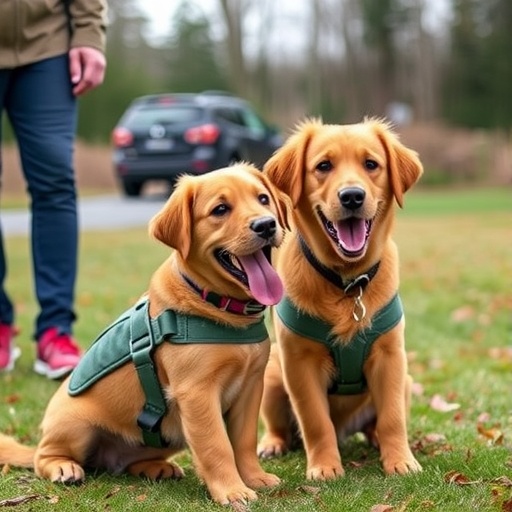
In a groundbreaking exploration of interspecies bonds, recent research conducted by the University of Turku and Aalto University delves into the profound and intricate dynamics between humans and assistance dogs, revealing new dimensions of caregiving beyond conventional understandings. This study transcends the simplistic notion that assistance dogs merely perform practical tasks, presenting them instead as active agents of caregiving—partners in a silent, trust-based dialogue that continually shapes health and emotional well-being.
Assistance dogs have long been recognized for their ability to assist individuals with disabilities in daily routines. However, this research highlights their role as unsung caregivers capable of interpreting subtle physiological and emotional cues from their human companions. The dogs’ vigilance enables them to anticipate health fluctuations, such as detecting glycemic changes in diabetic individuals, thereby preempting medical crises with timely interventions. The responsiveness of these animals challenges traditional caregiving hierarchies, positioning dogs not only as helpers but as autonomous collaborators intimately attuned to human needs.
Central to the study is the concept of mutual trust and nonverbal communication that facilitates this caregiving partnership. The researchers found that humans and assistance dogs develop a nuanced system of interpreting gestures, movements, and subtle behavioral signals. This embodied communication transcends words and emerges as a continuous, dynamic exchange where both parties adjust their actions responsively. Such fluid interaction underscores the relational complexity often absent in mechanistic or human-centric care models.
According to Suvi Satama, Assistant Professor of Management and Organisation at the University of Turku, caregiving between humans and dogs is enacted through “bodily interaction,” where minute gestures and the animal’s sensitivity to human states create a responsive caregiving loop. This phenomenon reflects an embodied practice of care that is relational rather than hierarchical, emphasizing reciprocity and shared vulnerability between species.
The ethnographic methodology of the study encompassed interviews, observations, and photographic documentation of thirteen assistance dog-human pairs, facilitating an in-depth understanding of the quotidian experience of interspecies caregiving. This methodological approach allowed the researchers to capture the often-invisible labor performed by dogs, including emotional support that is intangible yet critically beneficial to human welfare.
A particularly striking feature of the study is the inversion of the traditional care model. Humans, who typically represent the caregivers, are sometimes reliant on their dogs’ judgment, indicating a form of care that is reciprocal rather than unidirectional. For example, when a diabetic person depends on their dog’s alert to monitor their blood sugar levels, the dog effectively assumes a professional caregiving role. This dynamic disrupts anthropocentric frameworks and invites a reconceptualization of caregiving to include nonhuman agents as legitimate caregivers.
The researchers further posit that recognizing animals as “agential caregivers” exposes previously obscured power dynamics and subtle dimensions of care that go unnoticed in human-only interactions. These power structures are not rigid but relational and fluctuating, informed by the ongoing, interspecies negotiation of needs and care responsibilities.
Importantly, the study also revealed that assistance dogs are not mere passive participants but demonstrate their own agency, selectively engaging or disengaging from their duties. An illustrative anecdote from the research captures a visually impaired meeting where a dog deviated from instructions to explore scents, highlighting its capacity for independent decision-making. Such moments challenge perceptions of animals solely as obedient laborers and affirm their complex subjectivity.
Beyond human-animal dyads, the implications of this research extend to broader societal and ethical reflections on animals’ roles in workplaces and organizations. It compels a reevaluation of ethical frameworks to consider animal well-being, autonomy, and diverse contributions in professional contexts traditionally reserved for humans.
The study forms part of the PAWWS (People and Animal Wellbeing at Work and in Society) research project, which investigates the collaboration and mutual well-being of humans and animals in occupational settings. This interdisciplinary project aims to illuminate the roles animals occupy in societal structures, the ethical considerations involved, and how these interactions can inform more inclusive and ethical work environments.
By foregrounding assistance dogs as co-caregivers, the research invites a paradigm shift in how care is conceptualized—not merely as a human duty but as a dynamic, interspecies relational practice that benefits from recognizing the sensitivity, intelligence, and agency of animals. Such insights could transform rehabilitation programs, caregiving policies, and our broader cultural understanding of attachment and dependency.
Ultimately, this research offers compelling evidence that care is an emergent property of embodied relationship and trust, crafted through constant, nonverbal negotiation between human and animal partners. Recognizing this could foster more humane and effective caregiving practices that appreciate the unique contributions of assistance dogs beyond their conventional roles.
News Publication Date: 20-Mar-2026
Web References: http://dx.doi.org/10.1177/00187267261428980
Cite Scienmag News
Courtney Benton. (April 14, 2026). Assistance Dogs Decode Human Needs Through Non-Verbal Communication. Scienmag. https://scienmag.com/assistance-dogs-decode-human-needs-through-non-verbal-communication/
Courtney Benton. "Assistance Dogs Decode Human Needs Through Non-Verbal Communication." Scienmag, 14 April 2026, https://scienmag.com/assistance-dogs-decode-human-needs-through-non-verbal-communication/. Accessed 3 September 2026.
Courtney Benton. "Assistance Dogs Decode Human Needs Through Non-Verbal Communication." Scienmag. April 14, 2026. https://scienmag.com/assistance-dogs-decode-human-needs-through-non-verbal-communication/


