

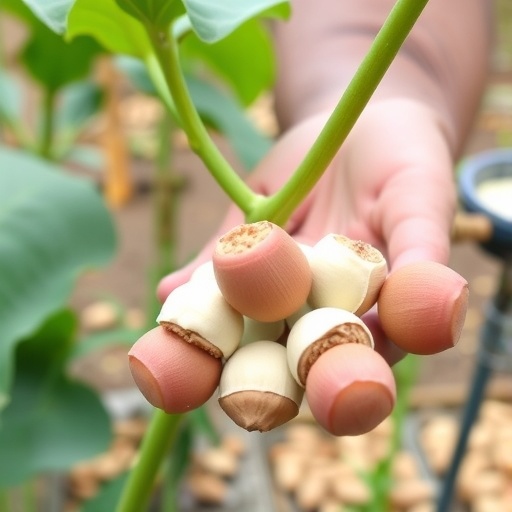
In recent years, the effects of salinity on agricultural productivity have garnered significant attention, particularly in light of climate change and increasing soil salinization. Researchers have turned their focus towards identifying and enhancing salinity tolerance in crops, which is crucial for sustaining agricultural yield in salt-affected regions. A compelling study led by Chowdhury et al. in 2025, titled “Evaluation of combining ability and genetic analysis for salinity tolerance in a 7 × 7 F1 half-diallel population of groundnut (Arachis hypogaea L.)”, aims to deepen our understanding of groundnut genetics and salinity management.
Groundnut, also known as peanut, is a vital legume crop that contributes significantly to the food and economic security of many countries. Its adaptability to various climates and soils is remarkable; however, salinity stress poses a serious challenge to its cultivation in many regions. The aggressive expansion of salt-affected land has prompted researchers to investigate the genetic factors that contribute to salinity tolerance in groundnut, seeking robust breeding solutions that can be employed by farmers globally.
Chowdhury and colleagues conducted their research within a 7 x 7 F1 half-diallel population, a sophisticated genetic analysis technique that allows for a thorough examination of combining ability amongst various genotypes. By studying the interactions between different groundnut varieties, the researchers aimed to pinpoint specific genetic attributes that confer salinity tolerance, providing actionable insights for breeders aiming to develop resilient crop varieties.
Through rigorous experimentation that involved controlled salinity conditions, the study examined how these groundnut varieties responded under duress. Results indicated significant variability in the salinity tolerance levels among the tested genotypes, suggesting that certain varieties possess innate genetic advantages that could be harnessed through selective breeding. This variability is crucial as it underscores the potential for enhancing the genetic base of groundnut, allowing for increased resilience in the face of escalating environmental stressors.
The use of genetic markers in the evaluation of combining ability is part of a broader trend within agricultural research that aims to employ molecular techniques to facilitate traditional breeding methods. By aligning genetic performance data with phenotypic expressions, the research team could draw connections that are vital for advancing breeding programs tailored towards salinity tolerance.
Additionally, the investigation highlighted several traits associated with enhanced performance under saline conditions. Key physiological and biochemical traits, such as osmotic adjustment, ion homeostasis, and the production of compatible solutes, were analyzed to provide comprehensive insights into how these traits influence salinity tolerance. Understanding the underlying mechanisms behind these traits can lead researchers to candidate genes that might be manipulated to improve salinity tolerance in groundnut and potentially other crops.
One standout finding from the study was the identification of specific parental combinations that demonstrated superior combining ability for salinity tolerance. Such insights are not merely academic; they hold the potential to influence breeding selections for improved crop performance significantly. When breeders focus on these parental lines, they can create more resilient progeny that will thrive even in challenging saline environments.
Moreover, the implications of this research extend beyond groundnut alone. The salinity tolerance mechanisms elucidated in this study may inform breeding strategies for other major crops impacted by salinity stress. As agricultural demands increase, such translatable findings can support food security initiatives in saline-prone areas globally, fostering resilience in agricultural practices.
The relevance of this work cannot be overstated, as it aligns with ongoing global discussions surrounding sustainable agricultural practices and environmental stewardship. By equipping farmers with salinity-tolerant groundnut varieties, the potential for increased agricultural productivity becomes feasible, alleviating some pressures imposed by climate change and land degradation.
The findings from Chowdhury et al.’s work encourage further research into the genetic basis of salinity tolerance across a broader range of crops. Collaborations that merge genetic research with practical breeding efforts can facilitate the speedy progress needed to address urgent challenges facing global food production. As we stand on the brink of new biotechnological advancements, the research community must continue to prioritize studies like this that bridge scientific inquiry with tangible agricultural benefits.
As the implications of genetic research continue to unfold, a world of possibilities lies ahead for crops with the potential for enhanced abiotic stress tolerance. Such advancements signal hope for farmers struggling with salinity-affected soils and assure consumers of accessible food supplies amidst adverse climatic conditions.
The future of groundnut and, by extension, food security appears prompts significant focus on the ongoing intersection of genetics and plant breeding within agricultural science. The examination of salinity tolerance in groundnut offers a compelling blueprint for addressing both local and global agricultural challenges.
In conclusion, the exploration of salinity tolerance not only opens avenues for enhanced crop development but also serves as a testament to the innovative spirit of agricultural research. By continuing to investigate the genetic underpinnings of crop resilience, we pave the way for a more sustainable and food-secure future.
Subject of Research: Salinity tolerance in groundnut (Arachis hypogaea L.)
Article Title: Evaluation of combining ability and genetic analysis for salinity tolerance in a 7 × 7 F1 half-diallel population of groundnut (Arachis hypogaea L.)
Article References: Chowdhury, M.A.H., Bhuiyan, M.S.R., Shah-E-Alam, M. et al. Evaluation of combining ability and genetic analysis for salinity tolerance in a 7 × 7 F1 half-diallel population of groundnut (Arachis hypogaea L.). Discover. Plants 2, 327 (2025). https://doi.org/10.1007/s44372-025-00387-x
Image Credits: AI Generated
DOI: https://doi.org/10.1007/s44372-025-00387-x
Keywords: Salinity tolerance, groundnut, genetic analysis, breeding, climate resilience.


