


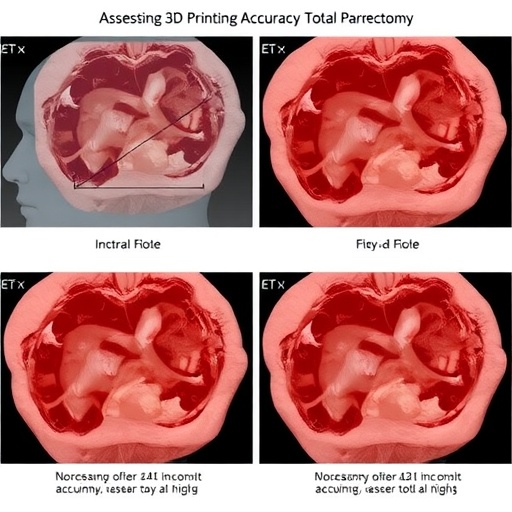
In the realm of advanced surgical techniques, the integration of 3D printing technology is transforming paradigms of surgical precision and patient outcomes. A seminal study led by Dr. Qi Shi and a team of researchers, published in the journal 3D Printing in Medicine, explores the critical question of accuracy in total sacrectomy procedures that employ 3D printed models for excision and reconstruction. This investigation, which meticulously analyzed nine consecutive cases, unveils the potential of 3D printing to enhance surgical planning and realization in complex orthopedic surgeries involving the sacrum, a pivotal structure in the vertebral anatomy.
The sacrum, located at the base of the spine, plays an indispensable role in supporting the weight of the upper body and facilitating the transfer of forces between the spine and pelvis. Pathologies such as malignancies or traumatic injuries necessitating total sacrectomy present formidable challenges, often complicating the surgical approach and the subsequent reconstruction of the anatomic structure. This dynamic study seeks to investigate whether preoperative 3D printed models can significantly enhance the surgical team’s efficiency and accuracy in executing such delicate procedures.
By utilizing patient-specific imaging techniques, the study developed precise 3D models that mirrored the patients’ unique anatomical configurations. This bespoke representation of the sacrum not only illuminated the internal structure for the surgical team but also facilitated a comprehensive understanding of the potential challenges that might arise during the excision process. In addition, the importance of personalized surgical models becomes evident when considering the anatomical variability seen in individual patients, which can profoundly influence the surgical approach and outcomes.
The procedure involved in total sacrectomy is inherently complex, often requiring the dissection of critical neurovascular structures. The advantage of employing 3D printed models lies in the ability to rehearse surgical maneuvers before stepping into the operating room, significantly diminishing the learning curve associated with such intricate surgeries. As the study progressed, the researchers documented the impact of these models in real-time, capturing not only the surgical time but also the occurrence of any intraoperative complications stemming from misjudgments regarding anatomical positioning.
Elaborate preoperative planning is essential to mitigate the risks inherent to sacrectomy, with the consequence of minimizing damage to surrounding tissues being paramount. The applications of 3D printing extend beyond merely creating a visual aid; they allow the surgeons to grasp the spatial relationships between various anatomical structures comprehensively. Every angle, curve, and intersection can be analyzed meticulously, thereby refining the surgical strategy and ultimately enhancing patient safety.
Findings from this research underscore the applicability of 3D printing technology in achieving greater accuracy and precision in surgical excision. Notably, the validation of the study’s results across multiple cases strengthens the inference that these models can facilitate more predictable surgical planning. The precision achieved in the actual excision correlated favorably with the preoperative 3D models, signifying a leap forward towards individualized surgical solutions that cater to the patient’s distinct needs.
Furthermore, the analysis of postoperative outcomes revealed that patients who underwent surgery with the aid of 3D printed models experienced fewer complications. This pivotal finding not only highlights the safety profile of this innovative approach but also reinforces the argument that personalized surgical techniques can lead to improved recovery trajectories. Enhacing patient satisfaction is equally paramount; thus, aligning surgical outcomes with patient-centered expectations becomes a reality when leveraging advanced technologies like 3D printing.
The role of interdisciplinary collaboration in the success of such surgeries cannot be overstated. Surgeons, radiologists, and biomedical engineers must work cohesively to ensure that the transition from digital model to physical artifact is seamless. This collaborative synergy fosters innovation and ultimately serves to enhance the capabilities of surgical teams facing complex clinical scenarios. With a growing recognition of the potential of 3D printing, many institutions are beginning to adopt this technology not only for spinal surgeries but across various specialties, heralding a new chapter in personalized medicine.
Looking toward the future, the implications of this research extend beyond immediate surgical applications. As technology continues to evolve, the availability of faster and less expensive 3D printing resources holds the potential for widespread adoption across hospitals and clinics worldwide. With continual refinements in biocompatibility and mechanical properties of 3D printed materials, the next evolution may see the introduction of custom-printed implants that could replicate the functionality of the sacral anatomy, thus expediting recovery and enhancing the quality of life for patients.
In summary, the groundbreaking study conducted by Shi et al. encapsulates the immense value of integrating 3D printing technology into surgical practice, particularly within the nuanced realm of total sacrectomy. Through their meticulous validation of surgical accuracy across multiple cases, they have substantiated the premise that personalized preoperative planning can pioneer significant advancements in patient care and surgical outcomes. This research envisions a medical landscape where surgical precision is not an accolade of the few but a standard accessible to all patients, regardless of their individual anatomical challenges.
This paradigm shift towards adopting cutting-edge technologies reinforces the vital objective of fostering innovation in surgical practices. As we look forward to the continued proliferation of 3D printing in medicine, the implications for the field of surgery remain profound. Clinicians and scientists alike are tasked with pushing the boundaries of what is possible, aiming for an era where surgical interventions are not only more successful but also more humane.
Thus, the investigation spearheaded by Shi et al. serves as both a testament to the extraordinary potential of modern medical technology and a clarion call for further exploration and collaboration among surgical disciplines. The journey towards optimization in surgical techniques has just begun, promising a cascade of improvements in how we manage and treat complex pathologies in the years to come.
Cite Scienmag News
Denise Maddox. (January 16, 2026). Assessing 3D Printing Accuracy in Total Sacrectomy. Scienmag. https://scienmag.com/assessing-3d-printing-accuracy-in-total-sacrectomy/
Denise Maddox. "Assessing 3D Printing Accuracy in Total Sacrectomy." Scienmag, 16 January 2026, https://scienmag.com/assessing-3d-printing-accuracy-in-total-sacrectomy/. Accessed 3 September 2026.
Denise Maddox. "Assessing 3D Printing Accuracy in Total Sacrectomy." Scienmag. January 16, 2026. https://scienmag.com/assessing-3d-printing-accuracy-in-total-sacrectomy/


