


Mosquito-borne diseases are among the most climate-sensitive threats to human health, and a new review argues that the world’s response must be just as sensitive to the many forces that shape their spread. In a paper published today in Science Advances, researchers at Monash University examine how ecological, epidemiological and socioeconomic factors drive the transmission of malaria and dengue, the two mosquito-borne diseases that together impose an enormous global burden. Their central message is that prevention, spanning vector control, vaccine deployment and cuts to greenhouse gas emissions, is critical to counter a growing burden of disease in a changing climate.
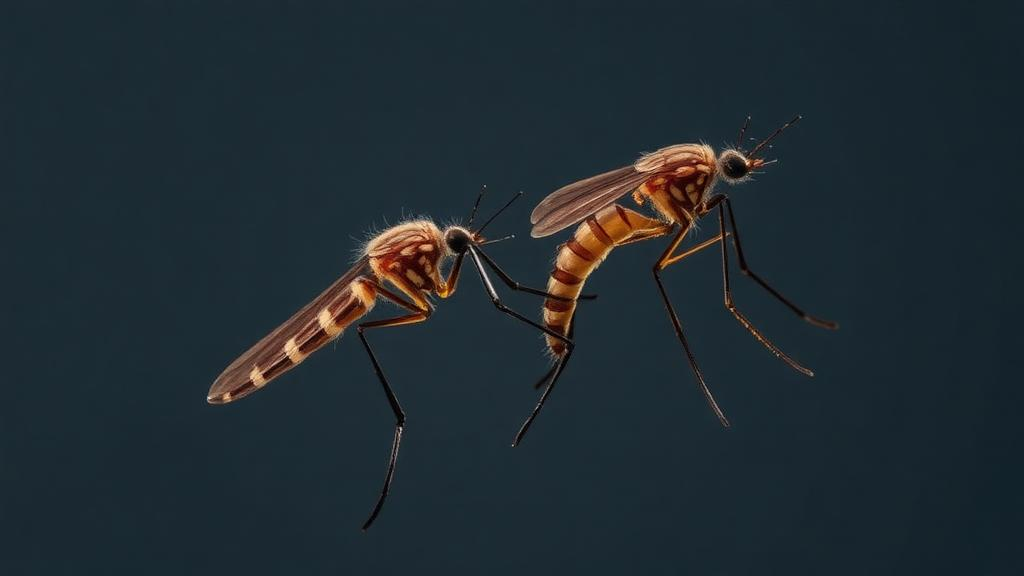
The scale of the problem is difficult to overstate. Across the world, there are close to 300 million cases of malaria and almost 400 million dengue infections every year. Malaria is a serious, life-threatening disease caused by a parasite that is typically spread to humans through the bites of infected female Anopheles mosquitoes. Dengue, by contrast, is caused by a virus transmitted through the bites of infected female Aedes mosquitoes. The two diseases share a vector-borne mode of transmission but differ profoundly in their biology, their geography and, as the review makes clear, their recent trajectories.
Lead researcher Dr Toby Cumming, a research fellow in the Health and Climate Initiative at the Monash School of Public Health and Preventive Medicine, said properly understanding the drivers of disease transmission is key to identifying effective public health responses. The review, he argued, is an attempt to untangle the complex web of conditions, climatic and otherwise, that determine where mosquitoes thrive, where parasites and viruses circulate, and where human populations are exposed.
The climatic logic is straightforward in outline, even if it is complicated in detail. As climate change increases temperatures and alters rainfall patterns, this expands the areas with climatic conditions in which Anopheles and Aedes mosquito populations can thrive, Dr Cumming said. Temperature influences every stage of a mosquito’s life cycle, from the speed of larval development to adult survival, and it also governs the rate at which pathogens mature inside the insect. Warmer conditions can shorten the extrinsic incubation period of a virus or parasite, meaning a mosquito that picks up an infection becomes infectious sooner and is more likely to pass it on before it dies. Rainfall, meanwhile, determines the availability of the standing water in which mosquitoes breed, although the relationship is far from simple, since drought can concentrate breeding sites and heavy rain can flush them away.
Those complications matter, and the researchers are careful to emphasise them. The influence of climate factors on transmission is non-linear, effects are seasonal, and there is substantial local variability, meaning that a single global projection can obscure sharply different outcomes from one valley, city or country to the next. Yet despite this complexity, the review notes that warming and shifting rainfall have broadly similar impacts on malaria and dengue transmission, pushing both diseases into regions where they were previously rare or absent and intensifying transmission where conditions are already favourable.
Here the story takes a turn that the authors describe as crucial for policy. Over the last century, during a time of unambiguous warming, rates of malaria have declined while rates of dengue have risen, Dr Cumming said. If climate were the only force at work, such divergence would be hard to explain. The fact that it occurred anyway tells us something important: human interventions and human settlement patterns can overwhelm, redirect or amplify climatic signals, sometimes in opposite directions for two diseases carried by related insects.
The review highlights the non-climate factors that help explain these different trajectories. Mosquito control interventions and drug therapies have driven major gains in reducing malaria transmission. Insecticide-treated bed nets, indoor residual spraying, artemisinin-based combination therapies and rapid diagnostic tests have, over decades, pushed malaria out of large parts of the world where it once flourished, including much of Europe and North America. Dengue has enjoyed no such success. Increasing urbanisation has favoured Aedes mosquitoes, which breed in small man-made containers, thrive in dense tropical cities and bite during the day, and hence the spread of dengue, for which no therapeutics are available. Treatment for dengue is largely supportive, which means that prevention, rather than cure, carries the full weight of controlling the disease.
Dr Cumming emphasised that there is no room for complacency on the malaria front either. Although malaria is in long-term decline, global incidence has risen 8.5 per cent over the past decade, a reversal that coincides with challenges including funding shortfalls, drug and insecticide resistance, conflict and displacement in endemic regions. Recent malaria trends and the rapid growth in dengue are both serious concerns, and we must escalate our prevention and control efforts, he said. The warning is that gains built over a century can erode quickly, particularly as climate change expands the climatic envelope in which transmission is possible.
Against this backdrop, novel preventive interventions for dengue are emerging. Vaccines are now part of the toolkit, and innovative vector control strategies are showing promise, most notably the introduction of the bacterium Wolbachia into Aedes mosquito populations. Wolbachia reduces the mosquitoes’ ability to transmit dengue, and the strategy has been developed by the World Mosquito Program, a not-for-profit group of companies owned by Monash University. When Wolbachia-carrying males and females establish themselves in a wild population, they pass the bacterium to their offspring, and the virus-blocking effect spreads with them, offering a self-sustaining form of biological control that does not depend on repeated insecticide application. Such approaches, combined with the gradual arrival of dengue vaccines, mark a shift in the epidemiology of a disease that has long outpaced medical countermeasures.
Ultimately, the research reinforces the need for a coordinated approach, encompassing interventions to address the many climate and non-climate factors that contribute to the spread of mosquito-borne disease, Dr Cumming said. That coordination spans several domains at once: sustained vector control and surveillance, deployment of vaccines and drugs where they exist, urban planning and water management that reduce Aedes breeding habitat, and, at the global scale, cutting greenhouse gas emissions to limit the warming that is steadily redrawing the map of mosquito-borne risk. The review’s implicit conclusion is that climate change is not a sentence of inevitable escalation. The century of divergence between malaria and dengue demonstrates that human action, whether through bed nets and medicines or through unplanned urban growth, can shape disease outcomes as powerfully as any weather pattern. The task now, the authors argue, is to apply that lesson deliberately, before the combined pressures of warming temperatures, expanding mosquito ranges and growing urban populations tip the balance the other way.
Subject of Research: Climate change impacts on malaria and dengue transmission and prevention strategies
Article Title: Itching for a solution: Addressing mosquito-borne disease as climate change bites
Article References: Itching for a solution: Addressing mosquito-borne disease as climate change bites. (n.d.). Original publication
Image Credits: AI Generated
DOI: Not provided
Keywords: malaria, dengue, climate change, mosquito-borne disease, vector control, Wolbachia, Aedes, Anopheles, vaccines, urbanisation, public health, Science Advances
Cite Scienmag News
Sloane Callahan. (October 2, 2026). As Warming Reshapes Mosquito Habitats, Malaria and Dengue Follow Divergent Paths. Scienmag. https://scienmag.com/as-warming-reshapes-mosquito-habitats-malaria-and-dengue-follow-divergent-paths/
Sloane Callahan. "As Warming Reshapes Mosquito Habitats, Malaria and Dengue Follow Divergent Paths." Scienmag, 2 October 2026, https://scienmag.com/as-warming-reshapes-mosquito-habitats-malaria-and-dengue-follow-divergent-paths/. Accessed 4 October 2026.
Sloane Callahan. "As Warming Reshapes Mosquito Habitats, Malaria and Dengue Follow Divergent Paths." Scienmag. October 2, 2026. https://scienmag.com/as-warming-reshapes-mosquito-habitats-malaria-and-dengue-follow-divergent-paths/


