


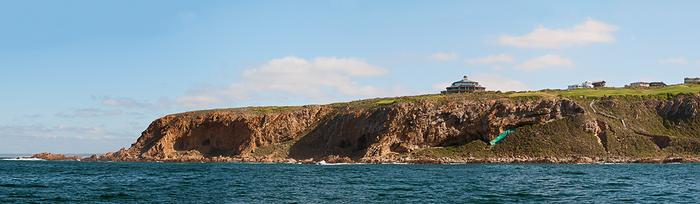
At the edge of the south coast of South Africa, Arizona State University professor Curtis Marean and his research teams have been teasing out the secrets of our earliest modern human ancestors in caves at Pinnacle Point for over 25 years.

Credit: Erich Fisher
At the edge of the south coast of South Africa, Arizona State University professor Curtis Marean and his research teams have been teasing out the secrets of our earliest modern human ancestors in caves at Pinnacle Point for over 25 years.
In late July, the site was declared a UNESCO World Heritage Site, the Olympic gold medal of heritage, which is only given to sites of “outstanding universal value” to all of humanity.
In 1999, while conducting reconnaissance on the south coast of South Africa, looking for a new field site to investigate ideas Marean had about the origins of modern humans, he explored a series of caves and rockshelters at the base of a 50-meter tall coastal cliff at Pinnacle Point. He saw high scientific potential in those sites, though they had never been excavated. In 2000, when he moved to ASU to join the Institute of Human Origins, he and his team did their first test excavations and commenced a research project that continues to reveal new and surprising clues about people living at the edge of the ocean from ~160,000 to 50,000 years ago.
In 2009, after successive breakthrough discoveries published in Nature and Science, Marean wondered how his team could use their scientific discoveries to give back to the local community that had so warmly welcomed and supported the researchers over the years. Marean decided to see if there was any opportunity for World Heritage Site recognition, since World Heritage sites can be potent drivers of tourism and job creation. He met with the mayor of the local town, Mossel Bay, and various stakeholders and members of the communities and began the process of surveys and information gathering. The group engaged the government of the Western Cape Province, which eventually took over the process and, crucially, appointed a full-time “champion” to run it, Dr. Mariagrazia Galimberti, who had done her PhD on Pinnacle Point materials. The application was submitted to UNESCO in March 2023, which was accepted on first submission! The formal announcement was made by UNESCO on July 26, 2024 from their meeting at New Delhi, India.
“Why does Pinnacle Point deserve World Heritage recognition? The research project itself is iconic in Quaternary — a period beginning 2.6 million years ago extending into the present — studies of climate and environment,” noted Marean. “Our research team has created a sophisticated narrative of human evolution embedded in a transdisciplinary study of changing climate and environment.”
“The history and adaptability of our species to change is essential to our understanding of all things,” said ASU President Michael Crow. “Pinnacle Point, with continuous human settlement for tens of thousands of years gives us that window into who we are and how we have adapted. It is a unique and unbelievable place that ASU will continue to use all we have to understand, and now as a world heritage site, its importance cannot be over stated.”
Their research has shown how a shift of looking at how humans survived from a focus solely on the land, to one embedded in the sea, had transformative impacts on the process of becoming human.
Outstanding research discoveries from the Pinnacle Point research team includes:
- Pinnacle Point documents the earliest evidence for humans eating sea foods and developing an adaptation to the sea, dated to ~160,000 years ago, published in Nature 2007.
- Early evidence for people modifying and working pigments, in this case red ochre, dated to ~160,000 years ago, published in Nature 2007.
- The earliest evidence for pyrotechnology, using fire to modify raw materials, is from Pinnacle Point, dated to ~160,000 years ago, published in Science 2009.
- The earliest evidence for a new advanced technology called microlithic technology is from Pinnacle Point, dated to ~71,000 years ago — good proxy evidence for the use of advanced projectile weapons — published in Nature 2012.
- Pinnacle Point was the first site to show that humans thrived through the Mt. Toba super-volcanic eruption at ~74,000 years ago, published in Nature 2018.
“Professor Marean’s decades-long research at Pinnacle Point is what brought the site into the limelight to be inscribed as World Heritage Site,” said Yohannes Haile-Selassie, director of the Institute of Human Origins.
“This project, and World Heritage recognition, would not have been possible without the ongoing support from Arizona State University, Institute of Human Origins, and the School of Human Evolution and Social Change, and the National Science Foundation and the Hyde Family Foundation,” added Marean. “In addition, this research was supported by an evolving team of some 60 scientists from eight countries, with hundreds of students—including South African students—gaining excavation and research experience, with many PhD research dissertations completed.”
“Pinnacle Point has proven to be an incredible insight into the origin of our species – particularly our relationship with the sea,” said Ryan Williams, director of the School of Human Evolution and Social Change. “It has also been a remarkable place for hands-on learning for numerous ASU anthropology students, from undergraduates to doctoral students. I am so proud of Curtis Marean for his tireless efforts to advance the understanding of this unique exemplar of the human experience and of our students who have been instrumental in advancing this work.”
During the past 10 years, Marean has also worked to build a modest outreach center in Mossel Bay called the Point Discovery Centre. His goal is a world-class information, outreach, and research center that will inform the local and international community of the science and stories told in the region but will require additional funding and long-term support to reach its full potential.
Marean and his team have many more research questions to tackle on the south coast, and he is excited to engage new emerging technologies that will help them do that. There is still much to learn about how our earliest modern human ancestors survived and thrived by the ocean as many other branches of our genus Homo went extinct.
Cite Scienmag News
Courtney Benton. (August 6, 2024). Arizona State University research site designated UNESCO World Heritage Site. Scienmag. https://scienmag.com/arizona-state-university-research-site-designated-unesco-world-heritage-site/
Courtney Benton. "Arizona State University research site designated UNESCO World Heritage Site." Scienmag, 6 August 2024, https://scienmag.com/arizona-state-university-research-site-designated-unesco-world-heritage-site/. Accessed 3 September 2026.
Courtney Benton. "Arizona State University research site designated UNESCO World Heritage Site." Scienmag. August 6, 2024. https://scienmag.com/arizona-state-university-research-site-designated-unesco-world-heritage-site/

