


When exactly does the aging process start? With the aging mechanisms unclear, no consensus has been reached about aging “cliffs”, where our body functions and biological processes just change dramatically, as if overnight.

Credit: Insilico Medicine
When exactly does the aging process start? With the aging mechanisms unclear, no consensus has been reached about aging “cliffs”, where our body functions and biological processes just change dramatically, as if overnight.
In 2019, a study published in the authoritative peer-reviewed journal Nature Medicine, based on plasma proteomics data, identified 34, 60, and 78 years old as key time points of aging. In August 2024, Nature Aging, a Nature portfolio journal focusing on aging mechanisms, published the latest findings incorporating comprehensive data including transcriptomics and metabolomics, pinpointing the aging cliffs to the 40s and 60s.
In the biomedical field, multi-omics data tracking RNA transcription, DNA methylation, protein composition, and change patterns of biological indicators are key to decoding disease mechanisms and developing targeted drugs. These technologies have also been applied to aging research, leading to breakthroughs including the multi-omics Chinese female aging clock by Chinese Academy of Science, and Precious2GPT, the combination of transformer and conditional diffusion for generation of multi-omics multi-species multi-tissue synthetic biological data, presented by Insilico Medicine. With the global population aged 65 and above exceeding 820 million, the demand for aging intervention research has become particularly urgent.
Started in 2014 by Alex Zhavoronkov, Ph.D., founder and CEO of Insilico Medicine, the Aging Research and Drug Discovery meeting (ARDD) has witnessed its ten-year anniversary and is currently the largest annual academic conference in the field of aging research. ARDD 2024 is co-chaired by Dr. Alex Zhavoronkov, Professor Morten Scheibye-Knudsen from the University of Copenhagen, and Dr. Daniela Bakula from the University of Copenhagen. In collaboration with the XPRIZE Foundation, the conference combines a five-day main presentation session with special events focusing on longevity drugs, aging biological mechanisms, and emerging technologies, encouraging the communication of cutting-edge anti-aging discoveries and promoting interdisciplinary thinking among academia and industry.
Over 170 experts attending ARDD come from important academic journals including Nature Biotechnology, Aging Cell, and npj Aging; leading companies and their affiliated funds including Novo Nordisk Foundation, Novartis, and L’Oréal; top research institutions such as Buck Institute for Research on Aging, McKinsey Health Institute, US National Institute on Aging, and Mayo Clinic; as well as world-renowned universities including Harvard University, Stanford University, University of Copenhagen, and National University of Singapore.
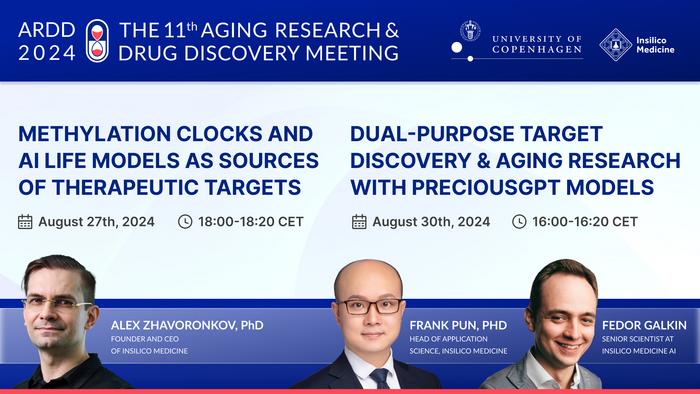
As a pioneer in applying generative AI to drug development, Insilico Medicine presents its leadership team and AI platform business development team at ARDD 2024, and industry partners are welcomed for communication and connection. On August 27th, Alex Zhavoronkov, Ph.D., founder and CEO of Insilico Medicine, will deliver a keynote speech on “Methylation Clocks and AI Life Models as Sources of Therapeutic Targets” from 18:00-18:20 local time; Frank Pun, Ph.D., head of application science of Insilico Medicine, and Fedor Galkin, senior scientist at Insilico Medicine, will share the latest progress in their presentation “Dual-Purpose Target Discovery & Aging Research with PreciousGPT Models”.
Aging is a common challenge faced by the humankind, and an inevitable, enduring decline after the body’s functions reach their peak, but fighting aging is not impossible. From Gilgamesh’s travels for immortality to AI-powered aging research, efforts to push technological boundaries might have lived through the years, pointing to a way to healthier longevity – a future we are never closer to achieve.
About Insilico Medicine
Insilico Medicine, a global clinical stage biotechnology company powered by generative AI, is connecting biology, chemistry and clinical trials analysis using next-generation AI systems. The company has developed AI platforms that utilize deep generative models, reinforcement learning, transformers and other modern machine learning techniques for novel target discovery and the generation of novel molecular structures with desired properties. Insilico Medicine is developing breakthrough solutions to discover and develop innovative drugs for cancer, fibrosis, immunity, central nervous system diseases, infectious diseases, autoimmune diseases, and aging-related diseases.
www.insilico.com
Cite Scienmag News
Beatrice Stafford. (August 22, 2024). ARDD 2024 | What can we do before the “cliff” of aging arrives? Scienmag. https://scienmag.com/ardd-2024-what-can-we-do-before-the-cliff-of-aging-arrives/
Beatrice Stafford. "ARDD 2024 | What can we do before the “cliff” of aging arrives?" Scienmag, 22 August 2024, https://scienmag.com/ardd-2024-what-can-we-do-before-the-cliff-of-aging-arrives/. Accessed 3 September 2026.
Beatrice Stafford. "ARDD 2024 | What can we do before the “cliff” of aging arrives?" Scienmag. August 22, 2024. https://scienmag.com/ardd-2024-what-can-we-do-before-the-cliff-of-aging-arrives/

