


Preventing the next pandemic begins before diseases emerge. This “pre-emergence” phase is the focus of a new center funded by the U.S. National Science Foundation and led by the University of California, Davis.

Credit: Nicole Gardner, UC Davis
Preventing the next pandemic begins before diseases emerge. This “pre-emergence” phase is the focus of a new center funded by the U.S. National Science Foundation and led by the University of California, Davis.
Supported with $18 million over seven years, the U.S. National Science Foundation Center for Pandemic Insights (NSF CPI) includes partnering institutions from across the United States. It aims to harness new technologies and develop sensing to detect, investigate, and ultimately prevent pandemics at their source.
Funded through NSF’s Predictive Intelligence for Pandemic Prevention (PIPP) program, the center includes 11 partnering institutions from across the United States. It also blends four UC Davis powerhouses: the School of Veterinary Medicine, College of Engineering, College of Agricultural and Environmental Sciences, and the School of Medicine.
“This center is a moonshot for being able to transform how we do investigations into the pre-emergence phase for pandemics,” said center lead Christine K. Johnson, a professor of epidemiology and ecosystem health in the UC Davis School of Veterinary Medicine and director of the EpiCenter for Disease Dynamics in its One Health Institute. “We’ll be able to optimize cutting-edge technology that’s already being applied in areas of human health, engineering and agriculture and bring them into this important space to help with wildlife and pandemic threats.”
Sensing a pandemic
Most pandemics are caused by emerging infectious diseases that originate in wildlife and are detected only after causing outbreaks in humans. The complex nature of infectious diseases limits the ability of scientists to conduct targeted surveillance and gather data at the speed or scale needed to detect pandemic threats.
Meanwhile, preventing pandemics requires a deep understanding of viruses where they naturally occur. This includes knowledge of disease cycles in wild animal hosts and how these disease cycles interact with people on the landscape. Those interactions occur at the pre-emergence phase of pandemics.
Johnson envisions sensor systems similar to those used for forecasting unusual weather events or earthquakes – one with access to high quality data “at key fault lines for virus emergence.”
Center scientists aim to:
- Study how epidemics cycle in nature, looking at animals that are the natural reservoirs for viruses. They will create models to understand how diseases may spill over before developing into pandemics.
- Create sensor networks that can detect disease cycles in nature.
- Fine-tune insights into pandemic risk using advanced computer programs that mix model predictions with sensor data.
Together, these efforts can enable large-scale, safe and efficient monitoring for emerging diseases.
Putting it together
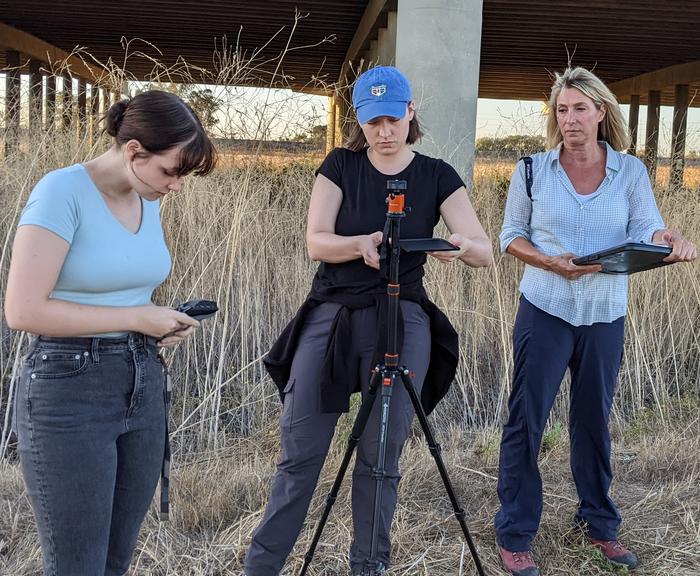
How might this look in the field? The team has been piloting strategies to sense animal movement and diseases across a range of species—from bats to birds to primates and more. Such noninvasive techniques allow scientists to collect data without handling wildlife, as well as access terrain that makes physically monitoring wildlife challenging.
Examples of UC Davis’ transdisciplinary work with the center include remote environmental sensing from Plant Sciences Associate Professor Troy Magney. Semiconductor technology from Professor Cristina Davis in the College of Engineering, which collects and analyzes volatile organic chemicals in the air. Expertise from co-lead Simon Anthony, associate professor in the UC Davis School of Veterinary Medicine, adds to the group’s deep inquiry into the ecological and evolutionary drivers of disease emergence. Combined, this kind of data can help alert scientists to real-time changes in the environment and among wildlife that warrant closer inspection.
“We are all too aware of the challenges we’ve been facing, and we’re well poised to inform on the solutions,” Johnson said. “We’ve strategically built our partnerships to bring together missing pieces to meet those challenges. With this center, I think we’ll have a much-improved shot of being able to bring new insights into the changing landscape of pandemics.”
Partnering institutions that will lead a range of center activities include the University of Southern California, Northeastern University, Labyrinth Global Health, Texas Tech University, San Diego Zoo Wildlife Alliance, UC Los Angeles, Albert Einstein College of Medicine, University of Michigan, UC San Diego, and Colorado State University.
“Research on emerging infectious diseases is a critical investment in our future, and it necessitates a collaborative approach that spans multiple disciplines and sectors and incorporates the newest tools and technology,” said NSF Director Sethuraman Panchanathan. “By bringing together experts in biology, computer science and artificial intelligence, engineering and more, these investments are well positioned to predict, prevent and respond to potential pandemics across all forms of life, thus safeguarding the health, economic stability and security of our nation.”
Cite Scienmag News
Kristina Jarvis. (August 22, 2024). New NSF Center for Pandemic Insights. Scienmag. https://scienmag.com/new-nsf-center-for-pandemic-insights/
Kristina Jarvis. "New NSF Center for Pandemic Insights." Scienmag, 22 August 2024, https://scienmag.com/new-nsf-center-for-pandemic-insights/. Accessed 5 September 2026.
Kristina Jarvis. "New NSF Center for Pandemic Insights." Scienmag. August 22, 2024. https://scienmag.com/new-nsf-center-for-pandemic-insights/

