


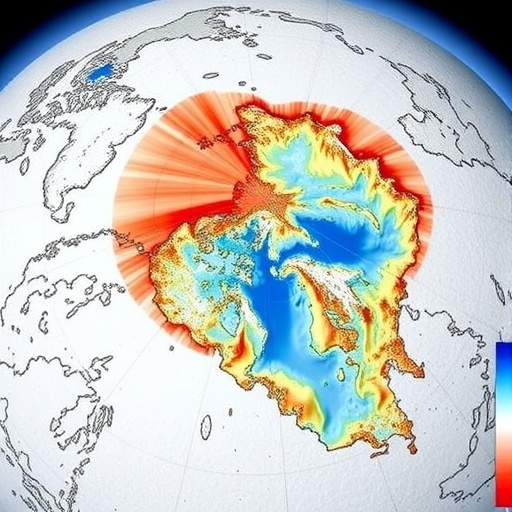
In a groundbreaking study that reshapes our understanding of Ice Age dynamics, researchers have unveiled compelling evidence of multiple glaciation events in East Siberia throughout the late Quaternary period. Utilizing cutting-edge uranium-lead (U-Pb) zircon dating techniques, this investigation uncovers a complex sequence of glacial advances and retreats previously obscured in the Arctic’s geological record. Their findings illuminate the intricate interplay between climate fluctuations and cryospheric changes in one of Earth’s least understood yet climatically pivotal regions. This research serves not only to refine paleoclimatic timelines but also to enhance predictive models for future glaciation patterns within the context of ongoing global climate change.
The Arctic, long recognized as a sentinel of climate variability, holds a geological archive critical for reconstructing the past rhythms of Earth’s cryosphere. East Siberia, in particular, presents a mosaic of glacial and periglacial features whose chronological framework has remained ambiguous due to limitations in dating methodologies. Traditional approaches, often reliant on stratigraphic correlations or radiocarbon dating, have struggled to resolve the timing of glacial episodes beyond the last glacial maximum. Here, the application of U-Pb zircon geochronology marks a methodological leap, enabling high-precision age determinations of mineral grains embedded within glacial deposits and their associated sediments.
Zircons, resilient crystals commonly found in igneous and metamorphic rocks, serve as robust timekeepers due to their uranium content that decays to lead at known rates. By targeting detrital zircons deposited within glacial sediments, the team reconstructed a chronology extending back several hundred thousand years, quantifying glacial pulses with unprecedented temporal resolution. The multi-phase glaciations revealed disrupt linear models of glacial history, suggesting a more episodic, dynamic climatic regime than hitherto documented for the Siberian Arctic zone.
Importantly, the study identifies at least three distinct glacial intervals within the late Quaternary period, each separated by phases of significant ice retreat and climatic amelioration. This pattern indicates the Siberian Arctic was not merely locked into prolonged cold phases but rather underwent rapid, repeated transitions between glacial and interglacial states. Such variability underscores the sensitivity of high-latitude environments to global atmospheric and oceanic forcings, which may have triggered feedback mechanisms accelerating climate shifts in the region.
The ramifications of these findings extend beyond academic geology and climatology. Understanding the timing and magnitude of past glaciations directly influences models predicting future ice sheet behavior amid anthropogenic warming. Present-day Arctic ice loss is unprecedented in modern history, but placing this trend within a deep-time context allows researchers to disentangle natural variability from human-induced changes. The evidence of prior glacial pulses suggests a baseline of climatic oscillations upon which recent alterations overlay — a crucial consideration for assessing the stability of permafrost, sea ice extent, and regional ecosystems.
Moreover, the multiphase glaciation framework offers insights into sedimentary basin evolution in East Siberia, impacting resource exploration and landscape stability assessments. Glacially derived sediments influence permafrost thermal regimes, soil development, and hydrology. By constraining the timing of sediment deposition, this research informs models of permafrost persistence and thaw, which have significant implications for carbon release dynamics and infrastructure planning in Arctic territories.
Technologically, this study exemplifies the power of integrating isotope geochemistry with sedimentary geology and remote sensing data. Advanced U-Pb dating demands meticulous sample preparation and mass spectrometric analysis, harnessing laser ablation techniques to precisely analyze zircon age populations within mixed sediment matrices. The researchers combined these data with stratigraphic sequences and geomorphological mapping to validate their chronological framework, demonstrating how cross-disciplinary methodologies propel paleoclimate research into a new era of accuracy and detail.
Climate history gleaned from this region may also influence our understanding of ancient migration routes and human adaptation in northern latitudes. Glacial expansion and contraction influence habitat availability, river courses, and resource distribution, shaping the dynamics of early human and megafaunal populations. The multiphase nature of glaciations suggests periods of environmental stress interspersed with windows of relative warmth, potentially modulating patterns of settlement and extinction.
The dataset now available opens avenues for refining climate models that incorporate phase-specific glacial dynamics rather than broad strokes of glacial-interglacial dichotomies. The nuanced glaciation chronology indicates that abrupt climate shifts and transient glacial phases played a pivotal role in sculpting the Arctic landscape and climate system. Such insights could refine predictions on sea-level changes, as repeated glaciations imply complex histories of ice volume fluctuations that ripple through global ocean systems.
From a global climate perspective, the revealed multiphase glaciations in East Siberia inform on teleconnections between polar and temperate latitude climate phenomena. Shifts in Siberian ice coverage exert influences on atmospheric circulation patterns, including the jet stream and monsoon systems, thereby linking regional glacial history to broader climate networks. The study highlights the necessity of incorporating high-latitude paleoenvironmental data in models aiming to forecast future climate variability and associated ecological impacts.
In summary, this landmark research, leveraging zircon U-Pb dating, charts a sophisticated timeline of glacial episodes hitherto unrecognized in East Siberia’s Arctic realms. It unveils a dynamic late Quaternary cryosphere shaped by multiple, discrete glaciations driven by complex climatic drivers. These revelations challenge previous binary climate narratives, extending the frontier of paleoclimatic understanding into a more intricate and responsive realm, vital for decoding the Arctic’s future in a rapidly warming world.
As scientists continue probing Earth’s frozen archives with ever-enhanced analytical tools, such studies underscore how Earth’s past ice ages contain critical lessons for navigating contemporary climatic challenges. This work stands as a testament to the power of geochronological innovation in unraveling the rich tapestry of ice age history, affirming that the Arctic continues to reveal profound insights into planetary climate dynamics and global environmental change.
Cite Scienmag News
Violet Maxwell. (August 13, 2025). Arctic Zircon Dates Uncover East Siberia’s Glaciation Phases. Scienmag. https://scienmag.com/arctic-zircon-dates-uncover-east-siberias-glaciation-phases/
Violet Maxwell. "Arctic Zircon Dates Uncover East Siberia’s Glaciation Phases." Scienmag, 13 August 2025, https://scienmag.com/arctic-zircon-dates-uncover-east-siberias-glaciation-phases/. Accessed 3 September 2026.
Violet Maxwell. "Arctic Zircon Dates Uncover East Siberia’s Glaciation Phases." Scienmag. August 13, 2025. https://scienmag.com/arctic-zircon-dates-uncover-east-siberias-glaciation-phases/


